Phonics Tutor Dubai 2026 — Online KS1 and KS2 Reading Support for British Curriculum Families
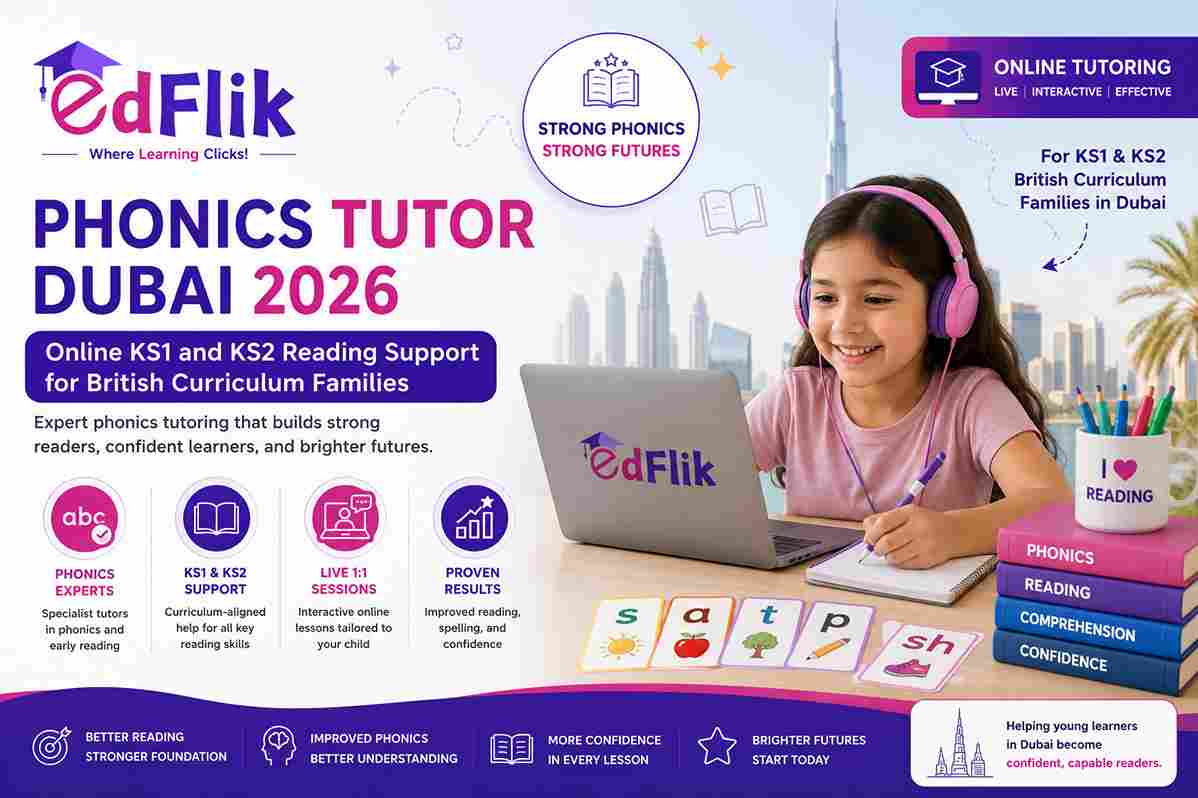
If your child is at a British curriculum school in Dubai and is struggling to read, decode unfamiliar words, or spell reliably, they most likely have a phonics gap. Online 1:1 phonics tutoring from AED 45 per session closes that gap faster than group classes — because phonics is a sequential skill and every child gets stuck at a different point.
How Phonics Works in Dubai British Curriculum Schools
Over 180 British curriculum schools operate across the UAE, most following the Letters and Sounds or Little Wandle structured synthetic phonics frameworks.
|
Phase |
Year Group |
What Children
Learn |
|
Phase 2 |
Reception |
Single letter
sounds (s, a, t, p, i, n, m, d, g, o, c, k) |
|
Phase 3 |
Reception–Year
1 |
Digraphs (ch,
sh, th) and vowel graphemes (ai, ee, igh, oa, oo) |
|
Phase 4 |
Year 1 |
Adjacent
consonants / blends (st, bl, cr, tr, nd, lt, mp) |
|
Phase 5 |
Year 1–2 |
Alternative
spellings (ay, oy, ie, ue, ew) — hardest phase for most children |
|
Phase 6 |
Year 2–3 |
Spelling
rules, prefixes, suffixes, common exception words |
|
Each phase
builds directly on the one before. A gap in Phase 3 creates a compounding
problem in Phase 5. This is why children who seem to "almost get"
reading can remain stuck for months without targeted intervention. |
5 Signs Your Child Has a Phonics Gap
• Guessing from context or pictures — looking at pictures rather than decoding letters on the page
• Confusion with similar-looking words — swapping was/saw, on/no, their/there, then/than
• Reading is slow and laborious — fluent decoding should be automatic by Year 2
• Phonetically readable words are spelled incorrectly — "light" as "liyt" or "rain" as "rane"
• Reluctance or distress when reading aloud — avoidance is often the first sign parents notice
How Online Phonics Tutoring Works for Ages 5–10
EdFlik's online phonics sessions for young children use:
• Interactive digital flashcards — letter tiles, digraph cards, and blending chains the child can manipulate on screen
• Shared whiteboard — the tutor and child write and draw together in real time
• Reading aloud together — the tutor follows the child's reading in a shared document, pausing to address errors immediately
• Phoneme isolation activities — sound-sorting games that build discrimination between similar phonemes
Sessions for Year 1–2 children run 30–40 minutes. Year 3–6 sessions run 45–60 minutes. Two sessions per week produces the fastest progress.
KS1 vs KS2: What Phonics Support Looks Like at Each Stage
KS1 (Year 1–2, Ages 5–7)
Primary focus: decoding accuracy — building grapheme-phoneme correspondences for all Phase 3–5 patterns and developing blending fluency. By end of Year 2, children should read most common single-syllable words without sounding out.
KS2 (Year 3–6, Ages 7–11)
At KS2, phonics work becomes multi-syllabic decoding, spelling pattern mastery, and reading fluency for longer texts. Common gaps: homophones (their/there/they're), silent letter patterns (knife, gnome, write), and prefix-suffix spelling rules.
Preparing for CAT4 and School Entrance Exams
A strong phonics and reading foundation by Year 4–5 directly benefits school entrance exam performance. The Verbal Reasoning (VR) battery in the CAT4 requires word analogies, vocabulary classification, and word codes — all depending on strong phonemic awareness built through systematic phonics.
EdFlik Phonics Tutoring
|
From AED 45
per session. Free 45-minute trial session. Ages 5–11. Book at www.edflik.com
or WhatsApp +91 88788 96600. |
Frequently Asked Questions
Q: Can phonics be taught online to young children?
Yes. Online 1:1 phonics tutoring is effective from age 5 using interactive digital tools, shared whiteboards, and letter manipulation activities. Short focused sessions of 30–45 minutes keep young learners engaged.
Q: What phonics phases do UAE British schools teach?
Most follow Letters and Sounds or Little Wandle. Phase 3–5 spans Reception to Year 2 covering digraphs, vowel graphemes, and alternative spellings. Phase 6 continues into Year 3 covering spelling rules.
Q: What are the signs my Year 1–3 child needs phonics support?
Guessing from pictures, swapping similar words (was/saw, their/there), slow laborious reading, phonetic spelling errors, and reluctance to read aloud are the most reliable signals.
Q: My child is in Year 4. Is it too late for phonics tutoring?
No. Many Year 4–6 children have Phase 5–6 gaps affecting fluency and spelling. EdFlik tutors target the specific gap rather than restarting from the beginning.
Q: How much does a phonics tutor cost in Dubai?
EdFlik: from AED 45 per session. In-person tutors: AED 120–250/hour. Mall reading clubs: AED 150–300 in group settings.