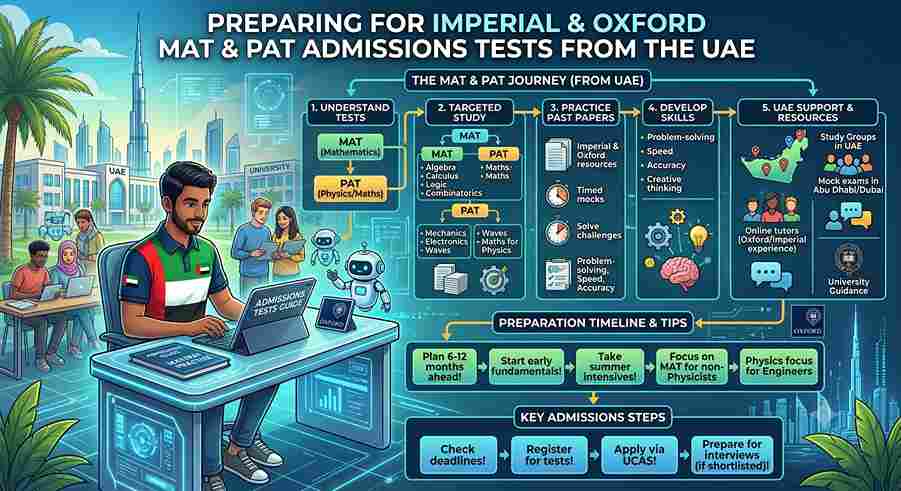
Preparing for the Imperial and Oxford MAT & PAT Admissions Tests from the UAE
Last Updated: October 2026 | By EdFlik Education Team
For high-achieving students across the United Arab Emirates (Dubai, Abu Dhabi, and Sharjah) enrolled in top-tier international schools following the British curriculum (Pearson Edexcel / Cambridge International A-Levels) or the International Baccalaureate (IB) Diploma Programme, securing an offer to study Mathematics, Computer Science, or Physics at the University of Oxford or Imperial College London is the pinnacle of secondary academic ambition.
However, stellar predicted grades (such as $4 \text{ A}^*$s at A-Level or a 42+42+42+ in the IBDP) are no longer enough to guarantee an interview or an admission offer. The decisive gatekeepers for these elite STEM programs are specialized university admissions tests: the MAT (Mathematics Admissions Test) for Oxford and Imperial Mathematics/Computer Science, and the PAT (Physics Aptitude Test) for Oxford Physics and Engineering science.
Every admissions cycle, exceptionally talented students across the UAE miss out on interviews because they prepare for these exams using standard school-level curriculum methods rather than the rigorous, creative problem-solving techniques demanded by university examiners.
In this comprehensive, exam-focused masterclass guide, our expert university admissions and STEM educators break down the formats of the MAT and PAT, explore the unique challenges faced by UAE-based applicants, provide a proven 5-step preparation roadmap, expose common traps, and supply a 100% copy-paste JSON-LD schema markup for your academic resources.
Part 1: Deconstructing the MAT and PAT
Both the MAT and PAT are designed to test mathematical intuition, deep conceptual understanding, and algebraic fluency rather than rote memorization of standard school formulas.
                   OXFORD & IMPERIAL ADMISSIONS TESTS
                                    |
      +-----------------------------+-----------------------------+
      |                                                           |
1. THE MAT (MATHEMATICS ADMISSIONS TEST)                    2. THE PAT (PHYSICS APTITUDE TEST)
• **Target Courses:** Mathematics, Computer Science,          • **Target Courses:** Physics, Engineering Science,
  and joint degrees at Oxford and Imperial.                   Materials Science at Oxford.
• **Format:** 2.5 hours, **non-calculator**.                • **Format:** 2 hours, **non-calculator**.
• **Content:** Pure mathematics and logical reasoning       • **Content:** A hybrid of rigorous A-Level/IB
  spanning algebra, functions, calculus, and sequences.       mathematics (approx. 50%) and advanced physics (50%).
Key Differences in Testing Style:
- The MAT: Tests whether a student can reason creatively with GCSE/AS-Level mathematical foundations. It features multiple-choice questions followed by long-form analytical questions where working out is rigorously inspected.
- The PAT: Combines advanced calculus and trigonometry with complex physical scenarios (mechanics, waves, circuits, and astrophysics). Students must apply mathematical modeling to real-world physical systems under intense time pressure.
Part 2: The UAE Context — Challenges and Advantages
Students studying in international schools across the UAE possess world-class academic infrastructure, but preparing for the MAT and PAT presents distinct regional hurdles:
                THE UAE APPLICANT'S PREPARATION LANDSCAPE
                                   |
      +----------------------------+----------------------------+
      |                                                         |
THE CHALLENGES                                              THE ADVANTAGES
• **Curriculum Gap:** Standard A-Level/IB syllabi             • **Global Perspective:** High exposure to
  do not cover the non-standard, multi-step problem           international academic competition frameworks.
  solving required by MAT/PAT.                              • **Access to Expert Support:** Specialized
• **Calculator Reliance:** Heavy reliance on graphics         1-to-1 tutoring bridges the gap between
  calculators in school blinds students to non-calc skills.     school exams and university aptitude tests.
Part 3: The 5-Step Preparation Roadmap for UAE Students
To bridge the gap between school-level exams and university admissions tests, students should follow a structured 5-phase timeline starting as early as Year 12 (Grade 11).
                  THE 5-STEP MAT / PAT PREPARATION PROTOCOL
                                   |
  Step 1: Early Syllabus Mastery ---> Complete core A-Level Pure Math / IB Math AA HL by end of Year 12.
  Step 2: Topic-Based Drilling   ---> Isolate weak areas (e.g., polynomial inequalities, calculus proofs, mechanics).
  Step 3: Non-Calculator Practice---> Ban calculators entirely during practice to build mental arithmetic fluency.
  Step 4: Past Paper Marathon    ---> Work backward through 15+ years of official MAT and PAT past papers.
  Step 5: Timed Mock Simulation  ---> Replicate exact test conditions under strict 2.5-hour/2-hour limits.
Part 4: Top 4 Traps That Cost UAE Students Interview Shortlists
- Relying on Calculators: Using graphics calculators during practice sessions. Because the MAT and PAT are strictly non-calculator exams, students who rely on technological shortcuts freeze when forced to simplify algebraic fractions or trigonometric identities by hand.
- Treating MAT/PAT Like Standard School Exams: Expecting direct, plug-and-chug formula questions. Admissions tests are deliberately designed with unexpected twists that require deep lateral thinking and multiple-step logical deductions.
- Leaving Multiple-Choice Questions Blank: Failing to realize that on many sections of these exams, guessing carries no negative marking penalty (though working out must be shown where required). Always make an educated elimination!
- Starting Too Late: Beginning preparation in September of Year 13 (Grade 12). With UCAS deadlines falling in mid-October, intensive preparation must begin during the summer break before Year 13.
Aiming for an Oxford or Imperial engineering, mathematics, or computer science offer from the UAE? EdFlik connects international school students globally with expert, 1-to-1 online admissions tutors specializing in MAT, PAT, A-Level Math, Further Math, and Physics HL, helping you secure your interview shortlist. Book a Free Demo Class Today!
Frequently Asked Questions (FAQs)
Q1: Is Further Mathematics necessary for the Oxford MAT?
Ans: While Oxford states that Further Mathematics is not strictly compulsory (as some schools do not offer it), having an A-Level or IB Higher Level background in Further Mathematics / additional calculus provides an enormous advantage in handling the rigorous algebraic speed required for the MAT.
Q2: Can I use a calculator during the PAT exam?
Ans: No. Calculators are strictly forbidden in both the MAT and PAT examinations. All arithmetic, algebraic expansions, and trigonometric simplifications must be performed entirely by hand.
Q3: When should UAE students begin studying for the MAT and PAT?
Ans: Ideally, preparation should begin during the summer term of Year 12 (Grade 11), allowing 4 to 5 months of dedicated problem-solving practice before the actual examination window in October of Year 13.
Q4: How does EdFlik support UAE students applying to Oxford and Imperial?
Ans: EdFlik connects students across Dubai, Abu Dhabi, and the UAE with vetted, expert 1-to-1 online tutors specializing in Oxbridge admissions test preparation (MAT, PAT, TMUA), advanced A-Level/IB STEM subjects, and interview coaching. Our personalized mentorship helps students master elite problem-solving techniques.
More on University Admissions
- University Admissions from the UAE: A Guide to UK, US and UAE Applications
- The Ultimate Guide to University Admissions in the UAE: What Scores Matter Most?
- University Admissions Beyond Grades | How Tutoring Becomes an Admissions Asset
- How to Prepare for the UCAT: Medical School Admissions Guide for UAE High Schoolers
- All University Admissions articles