
Ramadan Exam Prep Guide for UAE Students 2026 — How to Study Effectively During Fasting Month
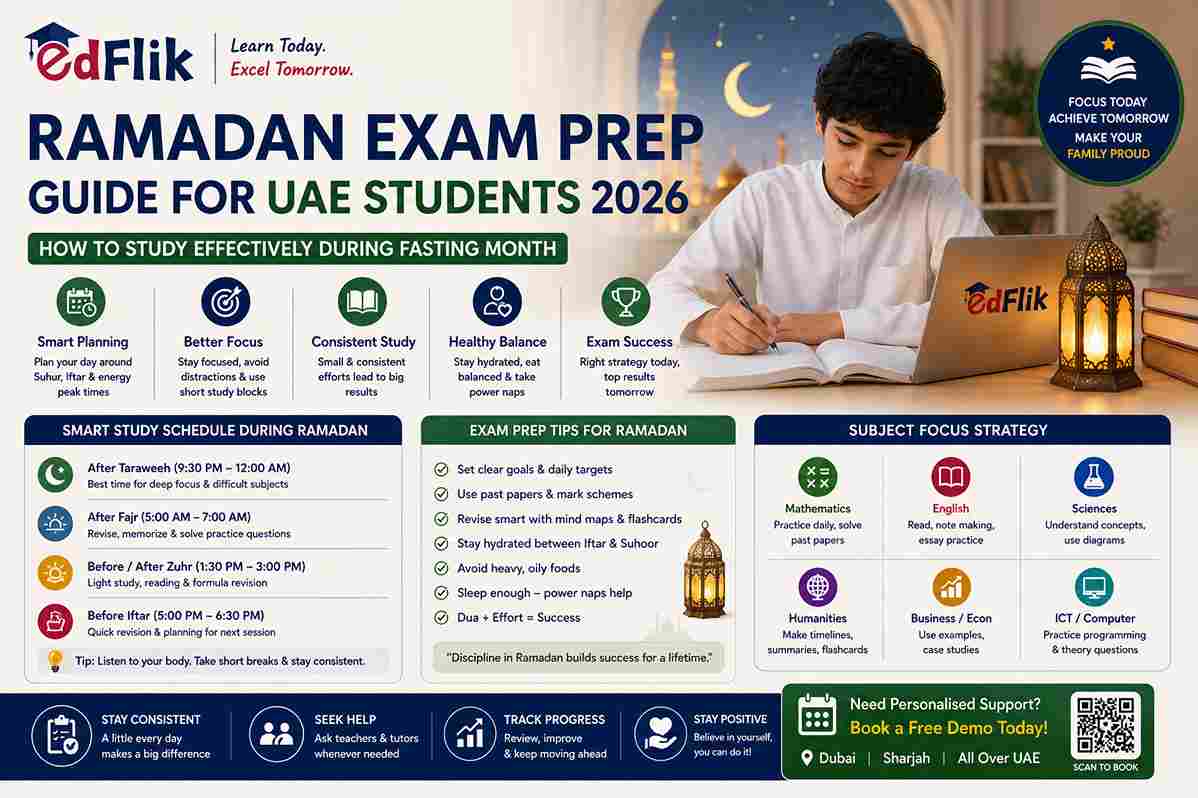
Ramadan falls in February or March during the UAE academic year — directly overlapping with mock exam periods, IGCSE coursework deadlines, and the critical final revision phase for May-June IGCSE, IB, and A-Level exams. For students who fast, this intersection requires a completely restructured study schedule. This guide is specifically written for UAE students balancing religious observance with academic demands — and for parents looking for practical guidance rather than generic study tips.
When Ramadan Overlaps With UAE Exam Preparation
|
Year |
Approximate
Ramadan Start |
UAE Academic
Context |
|
Ramadan 2027 |
Late January /
early February 2027 |
Overlaps with
January-February mock exams and final revision start for May-June
IGCSE/IB/A-Level — the most academically pressured period |
|
Ramadan 2028 |
Early January
2028 |
Overlaps with
start of new academic year for Year 12 and Year 10 students |
|
Ramadan 2026 |
Late February
/ early March 2026 |
Overlapped
with IGCSE/IB/A-Level exam preparation and post-mock analysis period |
|
Ramadan
shifts approximately 10–11 days earlier each year on the Gregorian calendar.
By 2027, it falls directly in the January-February exam preparation window —
the period when IGCSE, IB, and A-Level students are most academically
pressured. Preparing for this in advance, not adapting on the day, makes a
measurable difference. |
How UAE Schools Operate During Ramadan
Under UAE law, schools reduce operating hours during Ramadan. Most UAE private schools:
• Reduce the school day to 5–6 hours from the standard 6–8 hours
• Adjust class periods to shorter durations with the same subjects covered
• May reschedule or delay internal assessments and mock examinations
• Permit students to rest or pray during breaks rather than mandatory activities
The reduced school day means more time at home — but this advantage is only useful if that time is structured well. Many students waste the additional hours during the most depleted afternoon period rather than using it for recovery and then studying in the high-energy post-Iftar window.
The Ramadan Study Schedule That Actually Works
The Key Principle: Match Cognitive Demand to Energy Level
The most common mistake fasting students make is attempting intensive study during the lowest-energy period (typically 1–4 PM) and then resting during the highest-energy window (8:30–11:30 PM post-Iftar). Matching cognitive demand to energy level produces significantly better retention and output:
|
Time Window |
Energy State
During Fast |
Recommended
Activity |
|
Pre-dawn /
Suhoor (4:00–5:00 AM) |
Nourished,
relatively alert |
Focused 45–60
min session: difficult content review or past paper attempt if sleep is
adequate |
|
Morning school
hours (7:00–12:00) |
Fasting
begins; cognitive function still reasonable |
Engage fully
in school teaching — passive but effective consolidation time |
|
Early
afternoon (12:00–3:00 PM) |
Energy
declining, dehydration building |
Light note
review, flashcards, or rest — not new content or problem-solving |
|
Late afternoon
/ pre-Iftar (3:00–6:00 PM) |
Lowest energy
point of the fasting day |
Short active
review or complete rest — pushing through heavy study here produces poor
retention |
|
Iftar and
recovery (6:30–8:00 PM) |
Energy
progressively restoring |
Eat slowly; do
not attempt immediate intensive study; let energy restoration complete |
|
Post-Iftar
prime window (8:30–11:30 PM) |
Energy at or
near peak |
Most intensive
study of the day — past paper timed practice, new content, essay writing |
|
Late night /
Suhoor prep (11:30 PM+) |
Fatigue
building |
Sleep is the
priority; only extend if sleep quality is not affected |
Subject-Specific Ramadan Revision Strategies
IGCSE and A-Level Sciences
Science revision benefits most from the post-Iftar window: past paper questions, mark scheme review, and diagram practice require the active cognitive engagement that is hardest during afternoon depletion. Use morning school hours for listening and note consolidation; use evenings for active problem-solving.
IGCSE and IB Mathematics
Maths requires high cognitive load and is the subject most impaired by mild dehydration and fatigue. Reserve all Maths problem-solving for the post-Iftar evening window. Use Suhoor sessions only if sleep quality is genuinely maintained — a sleep-deprived Maths session produces more confusion than clarity.
Essay-Based Subjects
Essay planning and writing also benefit from the post-Iftar window. Reading-based revision — reviewing notes, reading case studies, consolidating arguments — is more manageable during the lighter afternoon period. Use afternoons to consolidate known content; use evenings to write and produce.
The 3 Non-Negotiables for Maintaining Academic Performance Through Ramadan
• Sleep — 7 to 8 hours minimum, consistently. Sleep deprivation compounds the cognitive effects of fasting dramatically. A well-rested fasting student outperforms a sleep-deprived non-fasting student. Sacrifice other activities before sleep.
• Full hydration between Iftar and Suhoor. Drink 2–3 litres of water in the evening and overnight window. Mild dehydration is the most directly manageable factor in Ramadan cognitive performance.
• Maintain tutoring and school sessions. Skipping sessions during Ramadan because of fatigue creates content gaps that must be recovered later under greater pressure. Reduced-intensity attendance is better than absence.
|
EdFlik
tutoring continues through Ramadan with UAE-sensitive scheduling — sessions
available in the post-Iftar window (8:00–11:00 PM) as well as standard
daytime slots. From AED 45 per session. Book at www.edflik.com or WhatsApp
+91 88788 96600. |
Frequently Asked Questions
Q: When is Ramadan in 2027 and does it overlap with IGCSE exams?
Ramadan 2027 is expected in late January or early February — overlapping directly with mock exam periods and the critical final revision phase for May-June IGCSE, IB, and A-Level exams.
Q: How should a fasting student structure their study day during Ramadan?
Light review pre-Iftar; most demanding study in the post-Iftar 8:30–11:30 PM window; optional focused Suhoor session if sleep quality is maintained. Avoid intensive study during the most depleted early afternoon period.
Q: Can students take IGCSE exams while fasting during Ramadan?
Yes — many UAE students do this successfully. Prioritise sleep, maintain overnight hydration, and avoid intense study during the most depleted afternoon hours.
Q: How do UAE schools accommodate students during Ramadan?
Schools reduce operating hours to 5–6 hours by law. Some assessments are rescheduled. Confirm your school's specific Ramadan timetable each year.
Q: Does fasting affect exam performance?
Research shows mixed results. Well-hydrated, well-rested fasting students typically maintain strong performance. Sleep deprivation and dehydration — not fasting itself — are the primary performance risks.