
Signs Your Child Needs a Tutor in UAE — Parent Checklist (2026)
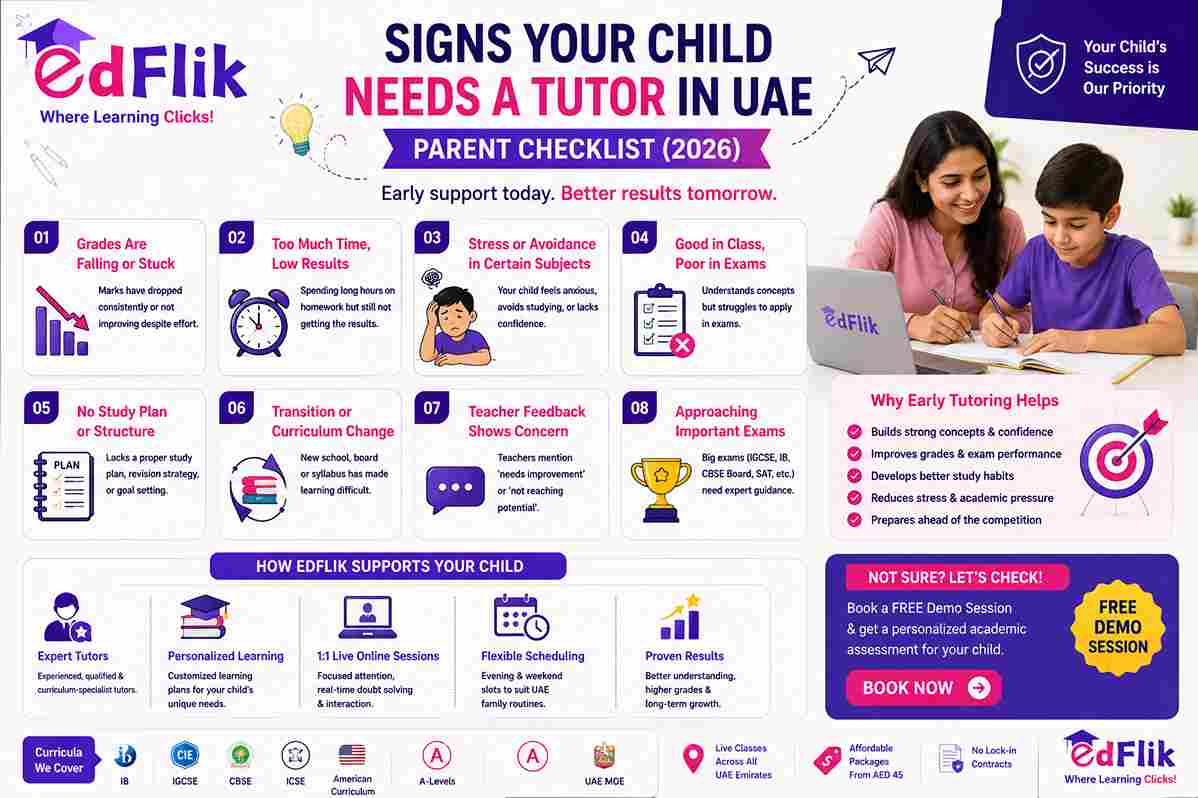
In the UAE's demanding academic environment — where students follow CBSE, IGCSE, IB, American, and multiple other curricula simultaneously depending on the school — knowing when your child genuinely needs structured tutoring support is one of the most important decisions a parent can make. The challenge is that the clearest signs are not always the most obvious ones. Declining grades are easy to spot. But the more meaningful early signals — growing anxiety, avoidance patterns, a specific disconnect between class understanding and exam performance — are easy to dismiss as phases.
This guide provides UAE parents with a clear, honest, curriculum-specific checklist of the ten most significant signs that a child would benefit from tutoring. It also explains what type of tutoring addresses each situation, and when starting tutoring is most effective.
Direct Answer — When Does a Child in UAE Need a Tutor?
A child needs a tutor when any one of the following is consistently true: grades are declining or stuck over two or more school assessment cycles; the child spends significantly more time on homework than peers without proportionally better results; school test performance consistently underperforms class exercise performance; the child is approaching a major exam year (IGCSE, CBSE board, IB Diploma, A-Level) without a structured revision plan; or the child says things like 'I'm just not good at Maths' — which is almost always a confidence response to accumulated failure experiences, not a fixed truth about ability.
The 10 Signs Your Child Needs a Tutor in UAE
Sign 1: Grades Are Declining or Stuck Over Multiple Assessment Cycles
A single low test result can have many explanations — a bad day, an unusual paper, a topic that was missed. But when grades in the same subject decline or plateau across two or more assessment cycles, this signals a structural gap that classroom teaching alone is not closing. This is the clearest and most unambiguous indicator for tutoring.
Curriculum-specific note: In CBSE schools, assessment cycles include Unit Tests, Half-Yearly Exams, and Annual/Board Exams. In IGCSE schools, internal assessments are often informal but should show progression. In IB schools, predicted grades issued by teachers are based on cumulative performance — a declining predicted grade is a significant warning sign.
Sign 2: Disproportionate Time Spent on Homework
If your child consistently takes three or four hours on homework that most classmates complete in one to one-and-a-half hours, this indicates either a knowledge gap (they are working without confidence in the method, so they restart problems repeatedly), a study skills gap (they do not know how to work efficiently through different question types), or both. Both are addressable through structured tutoring — but neither resolves itself without intervention.
This sign is particularly common in IGCSE Maths students who approach every unfamiliar question by trying multiple random approaches rather than recognising question types and selecting a method systematically. IB students who spend excessive time on homework without producing strong results often have ATL (Approaches to Learning) skill gaps that MYP tutoring would have addressed earlier.
Sign 3: Exam Performance Is Significantly Weaker Than Classroom Understanding
This pattern — understanding in class, underperforming in exams — is one of the most common and most misdiagnosed situations in UAE schools. Parents often hear 'my teacher says they understand everything in class' combined with exam grades that suggest otherwise. In virtually all cases, this is an exam technique gap, not a knowledge gap.
In IGCSE Maths, this manifests as correct thinking that is not written in the step-by-step format that earns method marks — a student who gets the right answer in their head but does not show the working loses all marks for that question. In IB subjects, this manifests as students who understand the content but do not respond to command terms correctly — 'Evaluate' requires two-sided analysis; 'State' requires a single specific answer; 'Explain' requires cause-and-effect reasoning. In CBSE, this manifests as understanding concepts but not writing them in the structured, keyword-inclusive format that CBSE marking schemes require.
A tutor who identifies this specific pattern and focuses on past paper technique and mark-scheme compliance — rather than reteaching content the student already knows — will produce faster improvement than one who revisits syllabus content.
Sign 4: The Child Expresses Anxiety or Avoidance Around Specific Subjects
When a child consistently says 'I hate Maths', 'Science doesn't make sense to me', or actively avoids doing homework in a specific subject, this is not a personality trait — it is a signal of accumulated failure experiences in that subject that have triggered an avoidance response. The longer avoidance continues, the further behind the student falls, which deepens the anxiety.
This spiral is particularly common in UAE IGCSE Science students who struggle with the volume of content and the specific answer language Cambridge requires, and in IB students who find HL Maths or HL Chemistry relentlessly demanding. Early tutoring intervention — with a tutor who structures sessions around small, achievable wins before introducing more challenging material — breaks the spiral effectively.
Sign 5: The Child Is Approaching a Major Exam Year Without a Revision Plan
IGCSE exams (May/June), CBSE board exams (February/March), IB Diploma exams (May), and A-Level exams (May/June) all require structured revision that begins months in advance. Students who arrive in January of an exam year without a clear subject-by-subject revision plan are at a significant disadvantage relative to their peers who have been revising systematically since September.
For UAE families, the recommendation is: begin tutoring for exam-year students in September at the latest. This gives 8–9 months before IGCSE and IB May exams, and 5–6 months before CBSE February/March exams. Last-minute intensive preparation in the final 4 weeks is far less effective than consistent weekly tutoring across a full school term.
Sign 6: The Child Changed Schools, Curricula, or Countries Recently
UAE families relocate frequently within the emirate and internationally. Curriculum transitions create specific academic risks that are often underestimated. A student moving from a CBSE school to a Cambridge IGCSE school faces not just new content but a completely different assessment philosophy, question format, and mark-scheme language. A student who transfers from a British curriculum school to an IB MYP school encounters criterion-referenced assessment for the first time. Without specific tutoring support during the transition year, students often fall behind in their new curriculum without clearly understanding why.
Sign 7: School Reports Consistently Mention 'Potential Not Reached'
If teacher comments in school reports regularly include phrases such as 'could achieve more', 'inconsistent performance', 'strong understanding but does not demonstrate this in formal assessments', or 'needs to consolidate understanding before the exam', these are signals that the child has genuine capability but something is blocking it. A diagnostic tutoring session can quickly identify whether the gap is knowledge-based, technique-based, or confidence-based.
Sign 8: The Child Has a Learning Difference
Students with dyslexia, ADHD, processing difficulties, or other learning differences often thrive with the right 1:1 tutoring that adapts pace, uses multi-sensory approaches, and removes the social pressure of classroom comparison. UAE schools vary significantly in their learning support provision, and many parents of children with learning differences find that consistent 1:1 tutoring significantly improves both academic performance and self-confidence, independent of any formal learning support plan the school may offer.
Sign 9: The Child Is a High Achiever Targeting Top Grades
Tutoring is genuinely not only for struggling students. In UAE's competitive academic environment — where the difference between an IGCSE B and an A* determines A-Level subject choices, where IB predicted grades affect university conditional offers, and where CBSE board aggregates determine Class 11 stream selection — high-achieving students benefit from tutoring that targets the specific techniques that separate top marks from good marks.
For IB students, the difference between a predicted 6 and a 7 in HL Chemistry often comes down to very specific IA criterion understanding and past paper precision — exactly the areas where a specialist tutor delivers targeted value that classroom teaching cannot provide at scale.
Sign 10: The Parent Is Now the Primary Source of Academic Support
When parents — regardless of their own educational background — find themselves spending significant personal time each week helping with homework, explaining concepts, or revising for tests with their child, this is a clear signal that the child needs more structured, expert support. This is not a failure of parenting — it is a recognition that specialist subject support at the level of IGCSE, IB, or CBSE board exam preparation is a different skill set from general parental support. Tutoring transfers that specialist responsibility to someone with both the subject expertise and the pedagogical approach to make it effective.
Frequently Asked Questions — Does My Child Need a Tutor UAE
Q: What are the signs that a child needs a tutor in UAE?
A: Key signs: grades declining or plateauing over two or more assessment cycles; spending disproportionately more time on homework than peers; anxiety or avoidance around specific subjects; consistently underperforming in exams relative to class exercise performance; approaching a major exam year without a structured plan; having recently changed schools or curricula; and school reports noting 'potential not reached' over multiple terms.
Q: At what age should a child in UAE start tutoring?
A: Tutoring benefits students at any age when a gap or challenge is identified. Many UAE families start light Maths and English foundation tutoring in Grade 3 or 4. The most common and impactful starting points are Grade 9 (transition to IGCSE), Grade 11 (IB Diploma start), and CBSE Class 9. Earlier intervention always produces better outcomes than last-minute exam preparation.
Q: Is it better to start tutoring before or after exams?
A: Always before exams — ideally 8–12 weeks before major assessments. Last-minute cramming in the final 2 weeks is the least effective form of tutoring. For IGCSE and IB May exams, starting in September; for CBSE February/March board exams, starting in October/November gives sufficient time for concept building, past paper practice, and technique refinement.
Q: Should a high-achieving child also get a tutor?
A: Yes. Tutoring is not only for students who are struggling. In UAE's competitive academic environment, many of the students who benefit most from tutoring are already performing well but targeting IB 7s, IGCSE A*s, CBSE 90%+ aggregates, or selective school entry (Dubai College Year 7, for example). Strategic tutoring focused on the techniques that separate top marks from good marks — past paper precision, IB IA quality, A-Level marking rubrics — is highly effective for ambitious students.
Q: My child understands the material but still scores poorly in exams — what does this mean?
A: This is one of the most common signs of an exam technique gap rather than a knowledge gap. It is particularly common in IGCSE Maths (method steps must be shown explicitly), IB subjects (command terms require specific response structures), and CBSE Sciences (diagram accuracy and answer format earn marks beyond correct content). A tutor who focuses on past paper technique and mark-scheme compliance will produce faster improvement than one who reteaches syllabus content the student already understands.
Q: How does EdFlik assess whether a child needs tutoring?
A: Every new EdFlik family receives a free demo session. The tutor conducts an informal diagnostic: a brief conversation and a few test questions to assess the child's current level, identify gaps, and understand their learning style. After the session, the parent receives feedback and a suggested tutoring plan. No commitment, no credit card required. Book at www.edflik.com.
What to Do Once You Identify the Signs
The most effective first step is not committing to a full tutoring programme — it is a single diagnostic session that identifies exactly what is causing the gap. A good tutor can, in one session, distinguish between a knowledge gap (the student has not understood key concepts), a skills gap (the student understands but cannot apply under exam conditions), and a confidence gap (the student has the knowledge and skills but anxiety undermines performance).
Each of these requires a different tutoring approach, and misidentifying the cause leads to ineffective tutoring — a student who needs exam technique coaching does not benefit from content reteaching.
At EdFlik, every new family receives a free demo session. The tutor diagnoses the issue, and you receive clear feedback on what is causing the gap and what a realistic improvement plan looks like. No commitment, no credit card required.
Book at www.edflik.com
You May Also Like To Read:-