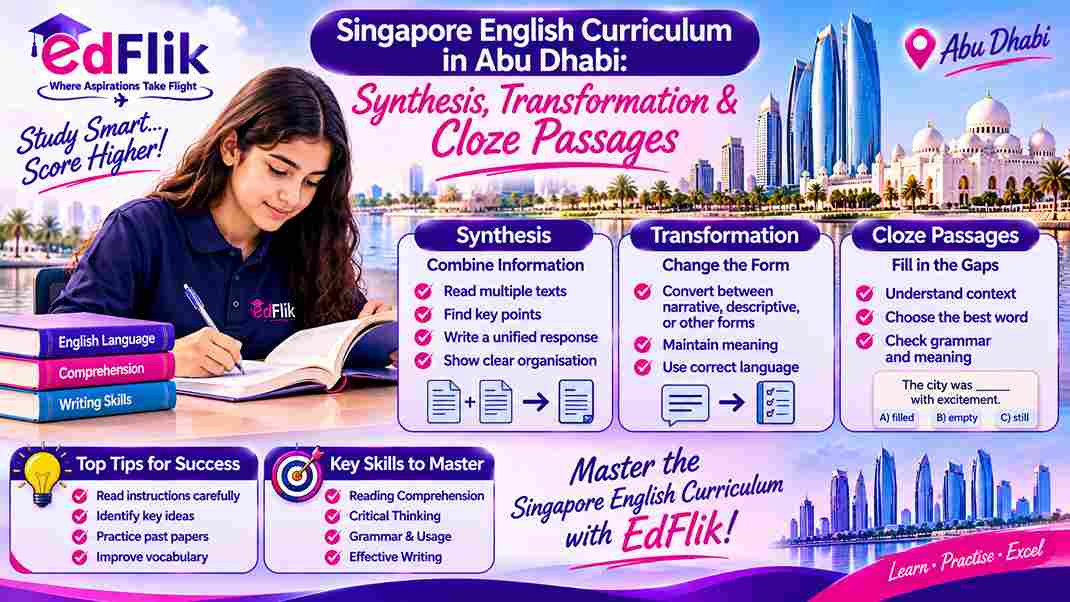
Singapore English Curriculum in Abu Dhabi: Synthesis, Transformation & Cloze Passages
By EdFlik Team | November 26, 2026
For upper-primary and lower-secondary students across Abu Dhabi—from Al Reem Island, Saadiyat Island, and Al Raha Beach to Khalifa City, Al Mushrif, and Mohammed Bin Zayed City—schools adopting the Singapore English Curriculum (modeled on Singapore's rigorous MOE EL Syllabus and PSLE Paper 2 Language Use and Comprehension standards) set an exceptionally high bar for grammatical precision, syntactic flexibility, and vocabulary depth. Unlike curricula that grade creative writing purely on general fluency, Singapore English Paper 2 tests whether a student can manipulate sentence architecture without altering a single shade of meaning—and deduce exact missing words from subtle contextual clues.
In Singapore-curriculum English assessments, two components consistently separate top-band scorers (AL1 / AL2 or 90%+ distinction) from mid-tier students: Synthesis and Transformation (S&T) and Cloze Passages (Grammar Cloze and Comprehension Cloze).
Many articulate, widely read students in Abu Dhabi's international schools lose unexpected marks in Synthesis & Transformation because a single missing comma, an unshifted verb tense in direct-to-indirect speech, a mismatched subject-verb agreement after "Neither... nor...", or changing a verb into an abstract noun incorrectly costs all 2 marks on a question (since S&T is graded all-or-nothing or 1+1 with zero tolerance for meaning distortion). Similarly, in Comprehension Cloze (15 open blanks with no word bank), students often plug in a word that sounds plausible in isolation rather than tracing the exact forward and backward contextual clues across surrounding sentences.
Mastering Synthesis, Transformation, and Cloze Passages not only elevates term grades across Abu Dhabi's Singapore-framework schools, but also builds rock-solid linguistic precision for Cambridge IGCSE First Language English (0500), IB MYP Language & Literature, and Digital SAT Reading & Writing.
This comprehensive masterclass guide breaks down the Core Rules of Synthesis & Transformation, the 4-Step Context-Clue Detective Method for Comprehension & Grammar Cloze, worked exam-style drills with full grammatical explanations, common mark-scheme traps, and 100% copy-paste JSON-LD schema markup.
Key Takeaways
- Preserve Exact Meaning, Tense, and Punctuation in Synthesis & Transformation: Every S&T rewrite must retain 100% of the original sentence's meaning without adding or dropping facts; watch punctuation closely—especially placing a comma after a subordinate clause at the start of a sentence (e.g., "Despite feeling exhausted, Maya finished her essay.") and no comma when the connector sits in the middle.
- Memorize the High-Frequency S&T Structural Shifts: Master Direct $\to$ Indirect Speech (pronoun, tense backshift, and time/place word shifts like tomorrow $\to$ the following day), Active $\to$ Passive Voice (keeping the exact tense via be + past participle), Conditional Inversion (Had I known...), Concessive Connectors (Despite / In spite of + noun/gerund vs. Although + clause), and Word-Class Conversions (adjective $\to$ noun).
- Use the "Read Twice + Forward/Backward Clue" Method for Comprehension Cloze: Never fill in Blank #1 on your first pass—read the entire passage first to grasp tone, tense, and theme, then identify parts of speech, collocations, connectors, and anaphoric/cataphoric references around each blank.
- Check Grammar Cloze Answers Against Subject-Verb Agreement, Prepositions & Tense Consistency: In Grammar Cloze (with a 15-word helping box), narrow each blank by word class first (preposition, pronoun, conjunction, auxiliary verb, or determiner) before checking singular/plural agreement and fixed prepositional pairings.
Part 1: Mastering Synthesis & Transformation (S&T)
In Synthesis and Transformation, students combine two separate sentences into one cohesive sentence (Synthesis) or rewrite a single sentence using a specified starter word or connector (Transformation). Examiners look for exact semantic equivalence, flawless grammar, and accurate spelling and punctuation.
As illustrated in the sentence-inversion diagram above, transforming sentence structure requires tracking every grammatical shift—such as moving an adverbial or negative phrase to the front, extracting tense onto an auxiliary verb (did), and inverting the subject and main verb—without losing original meaning.
High-Yield Synthesis & Transformation Rules Table
| S&T Pattern & Connector | Original Sentence(s) | Transformed / Synthesized Sentence | Critical Grammar & Punctuation Check |
| 1. Direct $\to$ Indirect Speech | "I will submit my science project tomorrow," Amina told her teacher. | Amina told her teacher that she would submit her science project the following day. | • Backshift tense (will $\to$ would, past $\to$ past perfect). • Shift pronouns (I $\to$ she, my $\to$ her) and time markers (tomorrow $\to$ the following day / the next day). • Remove quotation marks. |
2. Reported Questions (Yes/No & Wh-) | "Did you lock the laboratory door?" Mr. Tan asked Ravi. | Mr. Tan asked Ravi whether/if he had locked the laboratory door. | • Change question word order into statement order (he had locked, NOT had he locked). • End with a full stop, never a question mark! |
| 3. Active $\to$ Passive Voice | The committee has postponed the inter-school debate due to heavy rain. | The inter-school debate has been postponed by the committee due to heavy rain. | • Preserve the exact tense (has postponed [present perfect] $\to$ has been postponed). • Match singular/plural verb to the new subject. |
4. Despite / In spite of (Followed by Noun / Gerund) | Although the desert trail was steep, the hikers reached the summit before noon. | Despite the steepness of the desert trail, the hikers reached the summit before noon. (or: Despite the desert trail being steep,...) | • Despite and In spite of cannot be followed directly by a finite clause (Despite the trail was steep is a classic 0-mark error!). • Place a comma after the introductory phrase. |
5. Neither... nor / Either... or (Proximity Rule) | Sarah does not enjoy spicy food. Her brothers do not enjoy spicy food either. | Neither Sarah nor her brothers enjoy spicy food. | • The verb agrees with the noun closer to the verb (brothers = plural $\to$ enjoy; if reversed: Neither her brothers nor Sarah enjoys...). |
| 6. No sooner... than / Hardly... when | As soon as the bell rang, the students rushed out of the hall. | No sooner had the bell rung than the students rushed out of the hall. | • Invert auxiliary + subject (had the bell rung). • Pair No sooner with than (never when), and Hardly / Scarcely with when. |
| 7. Prefer... to / Would rather... than | Liam likes reading mystery novels more than watching television. | Liam prefers reading mystery novels to watching television. | • Pair prefer [gerund/noun] to [gerund/noun] (never prefer... than!). • Pair would rather [base verb] than [base verb]. |
8. Word-Class Transformation (Adjective $\to$ Noun) | The crowd was amazed by how courageous the firefighter was. | The crowd was amazed by the firefighter's courage. | • Convert adjectives accurately (courageous $\to$ courage, generous $\to$ generosity, punctual $\to$ punctuality, reluctant $\to$ reluctance). |
Part 2: Mastering Comprehension Cloze & Grammar Cloze Passages
In Singapore English Paper 2, Cloze Passages test two complementary skills:
- Grammar Cloze (10 marks — 15-word helping box): Focuses on function words—prepositions (at, by, for, with, against), relative pronouns (who, whom, whose, which), conjunctions (unless, whereas, provided), determiners, and auxiliary verbs.
- Comprehension Cloze (15 marks — no helping box): Requires supplying one exact word per blank based on overall passage comprehension, semantic clues, fixed phrases/collocations, and grammatical fit.
As outlined in the context-clues reference chart above, skilled readers scan surrounding sentences for definition clues, synonym/parallel clues, antonym/contrast clues (signaled by unlike, however, whereas), example clues (such as, including), and inference clues before locking in a word.
          4-STEP COMPREHENSION CLOZE DETECTIVE WORKFLOW
                                 |
  Step 1: Global First Read  ---> Read the ENTIRE passage from title to final sentence
                                  without writing anything; identify main topic,
                                  author's tone, and dominant tense (past vs. present).
  Step 2: Grammar Slot Check ---> Identify what PART OF SPEECH the blank requires:
                                  • Noun (singular/plural? countable/uncountable?)
                                  • Verb (tense? active/passive? subject agreement?)
                                  • Adjective / Adverb / Preposition / Connector?
  Step 3: Clue Hunting       ---> Underline forward & backward clues in the same and
                                  adjacent sentences (antonyms, synonyms, collocations,
                                  fixed phrasal verbs like "result ___" -> "in/from").
  Step 4: Final Read-Through ---> Re-read the completed passage aloud in your head to
                                  verify flow, logic, spelling, and tense consistency.
High-Frequency Comprehension Cloze Clue Categories to Watch For:
- Fixed Prepositional Collocations: capable of, succeed in, accused of, result in [effect] vs. result from [cause], prevent [someone] from [-ing], on the verge of, take pride in.
- Contrast & Concession Signals: When sentence A describes carelessness or danger and sentence B starts with "However,..." or "In contrast,...", look for an antonym of the earlier trait (e.g., reckless $\leftrightarrow$ cautious / prudent).
- Summary / Umbrella Nouns: A blank preceded by "These..." or "Such..." after listing specific instances (solar panels, wind turbines, and hydroelectric dams) often calls for a category noun like sources, alternatives, or innovations.
Part 3: Exam-Style Worked Drills (Synthesis, Transformation & Cloze)
Drill A: Synthesis & Transformation Practice (5 Questions)
- Original: We cannot start the science experiment unless the lab technician arrives.Rewrite using
Without:$\to$ Without the arrival of the lab technician, we cannot start the science experiment. (or: Without the lab technician arriving, we cannot start the science experiment.) - Original: Rania was very tired. However, she stayed up to revise her history notes.Rewrite using
Exhausted:$\to$ Exhausted though she was, Rania stayed up to revise her history notes. (Note: Keep the specific subject Rania in the main clause rather than leaving a pronoun-only main clause!) - Original: "Whose notebook is lying on the front desk?" asked Mrs. Lim.Rewrite in Indirect Speech:$\to$ Mrs. Lim asked whose notebook was lying on the front desk.
- Original: The museum curators restored the ancient manuscript with great care.Rewrite starting with
The ancient manuscript:$\to$ The ancient manuscript was restored with great care by the museum curators. - Original: If you do not water the desert seedlings regularly, they will wither.Rewrite using
Unless:$\to$ Unless you water the desert seedlings regularly, they will wither. (Avoid double negatives like "Unless you do not water"!)
Drill B: Mini Comprehension Cloze Walkthrough (5 Blanks)
Mangrove forests along Abu Dhabi's coastline play a vital (1)______in protecting shorelines from erosion and storm surges. Their dense, tangled root systems trap sediments and (2)______down incoming waves, creating calm waters where young fish and crabs can thrive. (3)______their ecological importance, coastal mangroves were once cleared rapidly to make (4)______for urban development. Today, however, extensive conservation programmes ensure that these valuable habitats are preserved for future (5)______.
Analytical Walkthrough:
- Blank (1):
role/part— Fixed collocation "play a vital role/part in". - Blank (2):
slow— Parallel verb with "trap" (plural subject "systems" + present simple tense) + context "creating calm waters" ("slow down"). - Blank (3):
Despite— Followed directly by a noun phrase ("their ecological importance") introducing a contrast with being cleared rapidly. - Blank (4):
way/room— Fixed idiom "make way/room for". - Blank (5):
generations— Standard collocation "for future generations" (plural noun required).
Part 4: Top 4 Exam Traps That Cost Singapore English Students Marks
- Using a Double Negative with
UnlessorHardly: Because unless already means "if... not", writing "Unless you don't hurry" reverses the sentence's meaning completely and loses all marks. - Leaving Pronoun-Only Main Clauses When Combining Two Sentences: When merging "Ali studied hard. He passed with distinction" using "Having...", write "Having studied hard, Ali passed with distinction"—putting the proper noun Ali in the main clause so the reader knows who "he" is.
- Writing Two Words in a Single Comprehension Cloze Blank: Unless explicitly permitted, every Comprehension Cloze blank accepts strictly one single word—writing "in order" or "a lot" in one blank earns zero credit.
- Forgetting Spelling & Capitalization Checks on S&T: Dropping a capital letter at the start of a transformed sentence, misspelling necessary / accommodation / occurred, or omitting the comma after an introductory subordinate clause invalidates an otherwise accurate S&T answer.
For expert 1-on-1 online tutoring support to help your child master Singapore English Synthesis & Transformation, Cloze Passages, Comprehension Open-Ended techniques, and Composition writing in Abu Dhabi, book a class on EdFlik.
Frequently Asked Questions (FAQs)
Q1: Why is Synthesis and Transformation considered one of the strictest sections in Singapore English?
Ans: In Singapore English Paper 2, each Synthesis and Transformation item tests exact preservation of meaning, grammatical accuracy, spelling, and punctuation simultaneously—even a minor tense slip, missing comma, or altered nuance can forfeit the marks for that item.
Q2: How can students improve their scores on Comprehension Cloze when there is no word bank?
Ans: Train students to read the entire passage first, identify the exact part of speech needed in each blank, underline forward and backward contextual clues (synonyms, antonyms, collocations, and connectors), and maintain a personal notebook of fixed prepositional phrases and idioms.
Q3: How does mastering Singapore English Paper 2 benefit students in Abu Dhabi's international schools?
Ans: The grammatical precision, syntactic agility, and contextual vocabulary inference built through Singapore English Synthesis, Transformation, and Cloze practice transfer directly to Cambridge IGCSE First Language English, IB MYP English, and Digital SAT Reading & Writing.