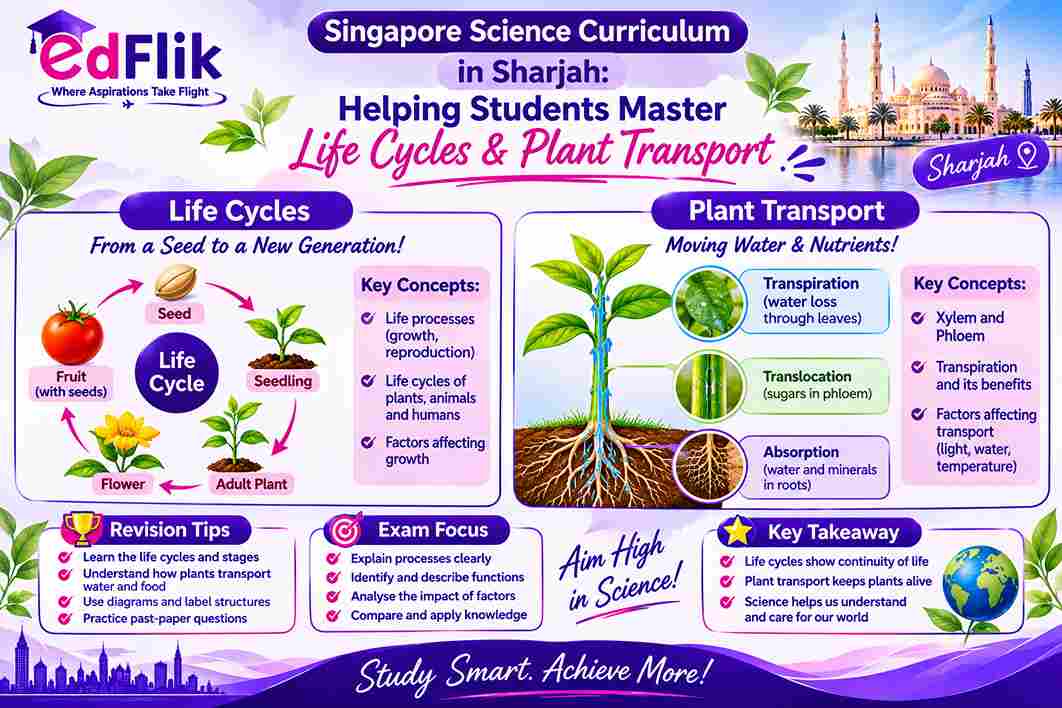
Singapore Science Curriculum in Sharjah: Helping Students Master Life Cycles & Plant Transport
By EdFlik Team | November 25, 2026
For students and parents across Sharjah—from Al Majaz, Al Khan, and Al Nahda to Muwaileh, University City, and Al Taawun—schools adopting the Singapore Science Curriculum (and Singapore-inspired inquiry frameworks at upper primary and lower secondary levels) set a remarkably high standard for conceptual reasoning and application. Rather than rewarding simple memorization of textbook definitions, Singapore Science assessments—especially Booklet B Open-Ended Questions (OEQs)—test whether students can observe an unfamiliar diagram, identify scientific variables, and construct complete cause-and-effect explanations.
Among the core biological themes in the Singapore Primary and Lower Secondary Science syllabus (Cycles and Systems), Life Cycles of Plants and Animals and the Plant Transport System are two of the highest-yielding topics—and also two of the most common places where capable students lose half-marks. A student might know that a seed needs warmth, water, and oxygen to germinate, yet lose marks for writing "sunlight" as a requirement for germination, or lose full credit on a girdling (ring-barking) stem experiment because they mention "food cannot travel down" without explaining why the stem swells above the cut ring while roots eventually die.
Building strong mastery in Life Cycles and Plant Transport not only boosts term grades in Sharjah's international schools, but also lays a rock-solid scientific foundation for Cambridge Lower Secondary Science, IGCSE Biology (0610), and IB MYP Sciences.
This comprehensive guide breaks down Life Cycles (Plants & Animals) and the Plant Transport System (Xylem & Phloem) under the Singapore Science framework, introduces the CER (Claim–Evidence–Reasoning) answering method for Open-Ended Questions, walks through classic exam experiments, highlights common mark-scheme traps, and includes 100% copy-paste JSON-LD schema markup.
Key Takeaways
- Separate Germination Conditions from Photosynthesis Conditions: A seed needs Water, Oxygen (air), and Warmth (suitable temperature) to germinate—sunlight is NOT required until the green leaves emerge and the seedling starts making its own food via photosynthesis (before that, it relies on stored food in the seed leaves / cotyledons).
- Distinguish 3-Stage vs. 4-Stage Animal Life Cycles & Control Strategies: Master 3-stage cycles (Egg $\to$ Nymph $\to$ Adult, e.g., grasshopper, cockroach, chicken) versus 4-stage cycles (Egg $\to$ Larva $\to$ Pupa $\to$ Adult, e.g., butterfly, mosquito, mealworm beetle), and explain why targeting the aquatic larva/pupa stage (removing stagnant water) is the most effective way to break a mosquito's life cycle.
- Know the Exact Directions & Roles of Water-Carrying (Xylem) vs. Food-Carrying (Phloem) Tubes: Water-carrying tubes (xylem) transport water and mineral salts upward only from roots to stems and leaves; food-carrying tubes (phloem) transport sugar (food made in leaves during photosynthesis) both upward and downward to all parts of the plant, including roots, flowers, fruits, and growing tips.
- Use the "CER" (Claim–Evidence–Reasoning) Template for Booklet B Open-Ended Questions: Never stop at a one-word answer—state your Claim, cite the Evidence from the diagram/experiment, and connect them with exact Scientific Reasoning.
Part 1: Mastering Life Cycles of Plants and Animals (Theme: Cycles)
In the Singapore Science Cycles theme, students learn that living things go through predictable stages of growth and reproduction to ensure the continuity of their own kind.
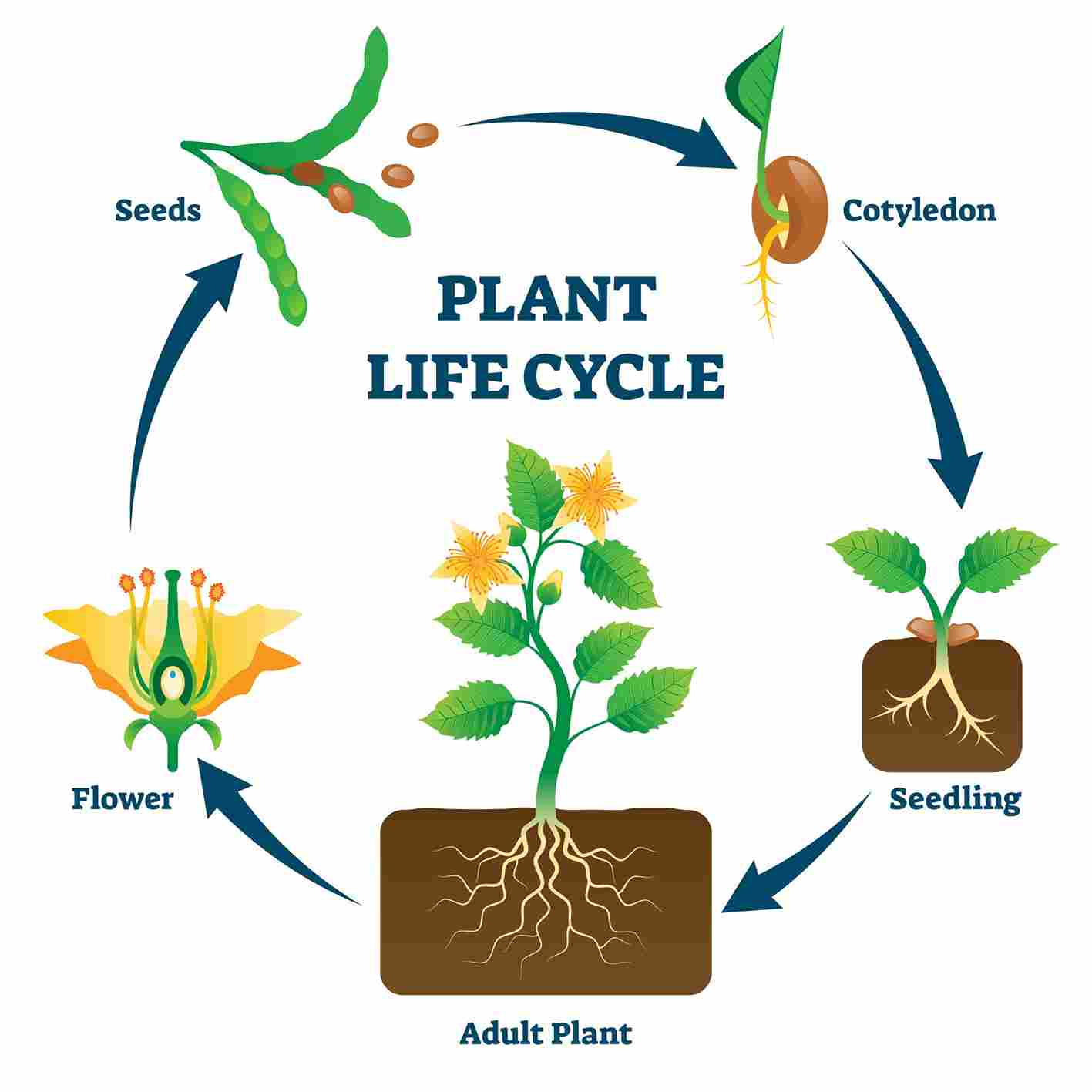
As illustrated in the flowering plant life cycle diagram above, a flowering plant progresses from Seed $\to$ Germinating Seedling (relying on cotyledons) $\to$ Adult Plant $\to$ Flower (pollination & fertilization) $\to$ Fruit with Seeds, restarting the cycle
Comparing Plant Germination vs. Adult Plant Growth
| Stage of Plant Life Cycle | Essential Requirements | Source of Food / Energy | Key Singapore Science Exam Concepts |
1. Seed Germination (Root emerges first, followed by shoot) | W-O-W: • Water • Oxygen (air) • Warmth (suitable temperature) | Seed leaves (cotyledons) store food until true green leaves develop. | • Light and soil/fertilizer are NOT needed for germination. • As the seedling grows, the mass of seed leaves decreases while the mass of root/shoot increases. |
| 2. Young & Adult Plant Growth | • Sunlight (light energy) • Water (from roots) • Carbon dioxide (from air through stomata) | Photosynthesis in chlorophyll-containing green leaves produces sugar (food). | • Once true green leaves open, the shriveled seed leaves drop off because the plant makes its own food. |
| 3. Flowering, Pollination & Seed Dispersal | • Pollinators (insects/birds) or wind. • Dispersal agents (wind, water, animals, explosive action). | Parent plant supplies nutrients to developing fruit and seeds. | • Seed dispersal prevents overcrowding and reduces competition for sunlight, water, mineral salts, and space. |
3-Stage vs. 4-Stage Animal Life Cycles
| Feature | 3-Stage Life Cycle | 4-Stage Life Cycle |
| Sequence of Stages | Egg $\to$ Nymph $\to$ Adult | Egg $\to$ Larva $\to$ Pupa $\to$ Adult |
| Common Exam Examples | Chicken, frog, cockroach, grasshopper, dragonfly. | Butterfly, mosquito, housefly, mealworm beetle, ladybird. |
| Appearance of Young | The nymph generally resembles the adult (though smaller and without wings in insects) and molts (sheds its outer covering) as it grows. | The larva (e.g., caterpillar, mosquito wriggler) looks completely different from the adult, eats continuously, and transforms inside a non-feeding pupa stage. |
| Pest Control Application | Target adult breeding sites and eggs. | For mosquitoes (vectors of dengue/malaria), removing stagnant water destroys eggs, larvae, and pupae before they develop wings and fly away. |
Part 2: Mastering the Plant Transport System (Theme: Systems)
In the Singapore Science Systems theme (and lower secondary biology extensions), students investigate how substances move throughout a flowering plant via two specialized vascular pathways.
As shown in the vascular transport diagram above, xylem vessels carry water and dissolved mineral salts upward in one direction only from the roots to the leaves, whereas phloem vessels carry sugar (food) both upward and downward to every living part of the plant
Side-by-Side Comparison: Water-Carrying vs. Food-Carrying Tubes
| Feature | Water-Carrying Tubes (Xylem) | Food-Carrying Tubes (Phloem) |
| Substances Transported | Water and dissolved mineral salts. | Food (sugar / sucrose) made in the leaves during photosynthesis. |
| Direction of Flow | One direction only (upward): Roots $\to$ Stem $\to$ Leaves & Flowers. | Two directions (upward and downward): Leaves $\to$ Roots, fruits, flowers, and growing shoots. |
| Location in Stem Cross-Section | Typically positioned on the inner side of the vascular bundle ring (in dicot stems). | Typically positioned on the outer side of the vascular bundle ring (closer to the bark). |
| Classic Exam Experiment | Colored Dye / Celery or Balsam Stem Test: Red/blue dye stains only the water-carrying tubes inside the stem and leaf veins. | Ring-Barking / Girdling Experiment: Removing an outer ring of bark cuts the food-carrying tubes (while leaving inner water-carrying tubes intact). |
Part 3: The CER Method for Singapore Science Open-Ended Questions (OEQs)
In Sharjah schools following the Singapore Science curriculum, students frequently know the science concept in their head yet score 1 out of 2 or 1.5 out of 3 on Booklet B because they leave out a logical link. Train your child to apply the CER (Claim – Evidence – Reasoning) template on every open-ended question:
             SINGAPORE SCIENCE "CER" ANSWERING TEMPLATE
                                 |
  1. CLAIM (Direct Answer)   ---> Answer the question directly (e.g., "The part of the
                                  stem above the cut ring swelled up.").
  2. EVIDENCE (Observation)  ---> Cite specific details from the diagram, table, or
                                  experimental setup (e.g., "Outer food-carrying tubes
                                  were removed at X, while inner water tubes remained.").
  3. REASONING (Science Rule)---> Explain the mechanism step by step ("Food made by
                                  the leaves during photosynthesis travelled down the
                                  food-carrying tubes and accumulated above X because
                                  it could not pass downward to the roots.").
Full Worked OEQ Walkthrough: The Ring-Barking (Girdling) Experiment (3 Marks)
Question: A gardener removed a complete outer ring of bark (containing the food-carrying tubes, while leaving the water-carrying tubes intact) at position X on the stem of a healthy potted plant kept in a sunny garden in Sharjah and watered daily. After two weeks, the stem just above X became swollen, and the leaves remained green. Explain both observations. [3 marks]
Full-Mark Model Answer:
- Why the stem swelled above X (2 marks): The green leaves continued to carry out photosynthesis in sunlight to make food (sugar). As the food travelled downward through the food-carrying tubes (phloem), it was blocked at X because those outer tubes had been removed, causing food (and water drawn in) to accumulate just above X, making the stem swell.
- Why the leaves remained green (1 mark): The water-carrying tubes (xylem) on the inside of the stem were still intact, so water and mineral salts absorbed by the roots continued to travel upward to the leaves for photosynthesis.
(Bonus follow-up question often asked in exams: What happens to the plant after several weeks? Eventually, the roots die because they do not receive food from the leaves for respiration; once the roots die, they can no longer absorb water and mineral salts, causing the whole plant to wilt and die!)
Part 4: Top 4 Exam Traps That Cost Singapore Science Students Marks
- Listing "Sunlight" or "Soil" as a Condition for Seed Germination: Seeds kept in a dark cupboard with damp cotton wool and warmth will still germinate! Sunlight is only needed after green leaves appear so the young plant can photosynthesize.
- Writing "Water and Food" Instead of "Water and Mineral Salts" for Xylem: In Singapore Science mark schemes, xylem transports water and mineral salts (never "plant food"), while phloem transports food (sugar) made in the leaves.
- Saying Food Travels "Only Downward" in Food-Carrying Tubes: Food made in mature leaves travels both upward (to growing shoot tips, flowers, and upper fruits) and downward (to the lower stem and roots).
- Explaining Seed Dispersal Only as "To Grow Elsewhere": Always write the full mark-scheme phrase: "To prevent overcrowding and reduce competition with the parent plant and other seedlings for sunlight, water, mineral salts, and space."
For expert 1-on-1 online tutoring support to help your child master Singapore Science concepts, Booklet B Open-Ended Question techniques, and practical experiments in Sharjah, book a class on EdFlik.
Frequently Asked Questions (FAQs)
Q1: Why do seeds not need sunlight to germinate in Singapore Science?
Ans: Before green leaves emerge, a germinating seed cannot carry out photosynthesis; instead, it uses stored food in its seed leaves (cotyledons) along with water, oxygen, and warmth to grow its first root and shoot.
Q2: How can students quickly remember the difference between xylem and phloem?
Ans: Remember "Xylem = Water & Mineral Salts (One-Way Up)" and "Phloem = Food (Two-Way Up & Down)"—the "Ph" sound in Phloem matches the "F" sound in Food!
Q3: How can Sharjah parents help children improve their scores on Singapore Science Open-Ended Questions?
Ans: Encourage your child to highlight key experimental variables (what was changed vs. kept constant) in every diagram and structure every written answer using Claim $\to$ Evidence from the diagram $\to$ Complete Scientific Reasoning with exact keywords.