Solving Velocity-Time and Distance-Time Graphs: IGCSE Physics Motion Equations Guide
Last Updated: October 2026 | By EdFlik Education Team
For students studying Cambridge IGCSE Physics (0625 / 0972) or Edexcel International GCSE Physics (4PH1), kinematics and motion represent some of the most fundamental yet heavily tested topics on Paper 1 and Paper 3/4. Whether a question asks you to calculate instantaneous acceleration from a curve, find total displacement under a jagged velocity-time graph, or apply SUVAT equations of motion to a falling object, graphical interpretation and algebraic manipulation are essential skills.
Many students lose marks not because they do not understand physics concepts, but because they confuse distance-time gradients with velocity-time areas, misinterpret negative velocities, or fail to include proper SI units in their final answers.
In this comprehensive, exam-focused masterclass guide, our expert physics educators break down the geometry of motion graphs, demystify speed versus velocity, and provide structured problem-solving frameworks to help you secure a top grade $A$ or $A^*$.
Part 1: The Language of Motion — Distance-Time Graphs
A distance-time graph (sometimes referred to as a displacement-time graph) plots distance traveled on the vertical y-axis against time on the horizontal x-axis.
Key Interpretations and Rules:
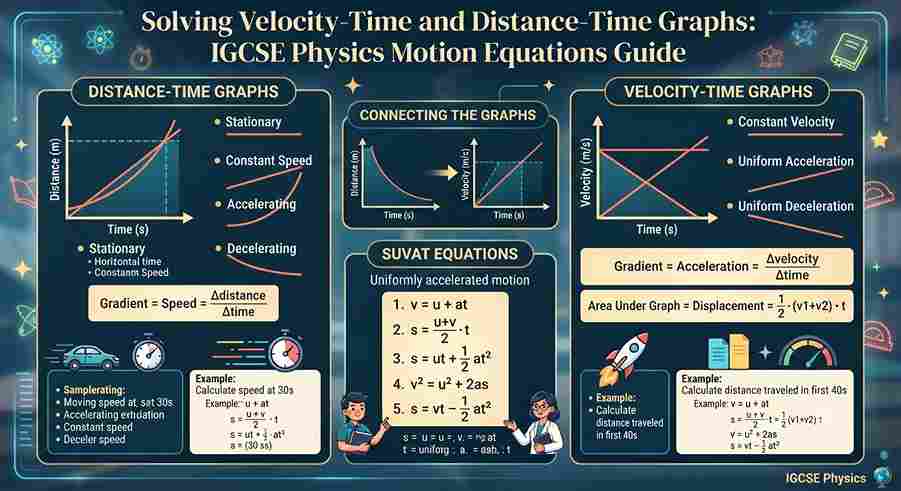
- The Gradient (Slope) Represents Speed:$$\text{Gradient} = \frac{\Delta \text{Distance}}{\Delta \text{Time}} = \text{Speed}$$
- A straight, diagonal line indicates constant speed.
- A steep line indicates high speed (fast movement).
- A shallow line indicates low speed (slow movement).
- A horizontal line (zero gradient) indicates the object is stationary (at rest).
- Curved Lines Mean Acceleration:
- If the curve becomes steeper (increasing gradient), the object is accelerating (speeding up).
- If the curve becomes flatter (decreasing gradient), the object is decelerating (slowing down).
- To find the instantaneous speed at a specific curved point, you must draw a tangent to the curve at that exact time and calculate the gradient of the tangent line.
Part 2: The Powerhouse of Mechanics — Velocity-Time Graphs
A velocity-time graph plots velocity (speed in a given direction) on the y-axis against time on the x-axis. Examiners love velocity-time graphs because they test two distinct mathematical operations: gradients and areas.
1. Finding Acceleration from the Gradient
$$\text{Acceleration } (a) = \frac{\text{Change in Velocity } (\Delta v)}{\text{Time Taken } (\Delta t)} = \text{Gradient of } v\text{-}t \text{ graph}$$
- Constant Acceleration: Represented by a straight upward-sloping line.
- Constant Deceleration: Represented by a straight downward-sloping line.
- Zero Acceleration (Constant Velocity): Represented by a horizontal line.
2. Finding Distance Traveled from the Area Under the Graph
The area enclosed between the velocity-time graph line and the time axis equals the total displacement (distance traveled).
- For rectangular or triangular sections under the graph, use standard geometry formulas:
- $\text{Area of Rectangle} = \text{base} \times \text{height}$
- $\text{Area of Triangle} = \frac{1}{2} \times \text{base} \times \text{height}$
- $\text{Area of Trapezium} = \frac{1}{2}(a + b) \times h$
Part 3: Connecting Graphs to Equations of Motion (SUVAT)
When acceleration is constant, IGCSE Physics problems can be solved using standard motion equations, which are derived directly from velocity-time graph principles.
The Core SUVAT Variables:
- $u = \text{initial velocity } (\text{m/s})$
- $v = \text{final velocity } (\text{m/s})$
- $a = \text{acceleration } (\text{m/s}^2)$
- $t = \text{time taken } (\text{s})$
- $s = \text{displacement / distance } (\text{m})$
The Three Essential IGCSE Equations:
- $v = u + at$ (Derived from the definition of acceleration: gradient of a $v\text{-}t$ graph starting at initial velocity $u$).
- $s = ut + \frac{1}{2}at^2$ (Derived from calculating total area under a $v\text{-}t$ graph split into a rectangle and a triangle).
- $v^2 = u^2 + 2as$ (Useful when time $t$ is neither given nor required in the problem).
Part 4: Top 4 Exam Traps That Cost IGCSE Physics Marks
- Confusing Distance-Time and Velocity-Time Gradients: Treating a distance-time graph gradient as acceleration, or attempting to find distance on a distance-time graph by calculating the area under the curve. Remember: Area under a v-t graph = distance; Gradient of a v-t graph = acceleration.
- Forgetting Units or Using Inconsistent SI Units: Leaving velocities in $\text{km/h}$ instead of converting them to meters per second ($\text{m/s}$) by dividing by $3.6$. Always check your units!
- Misinterpreting Negative Velocity: Assuming negative velocity means the object is moving backward in time or slowing down. In physics, a negative sign simply indicates movement in the opposite direction (e.g., falling downward or moving west).
- Incomplete Area Calculations on Complex Graphs: When calculating total distance on a multi-stage velocity-time graph (e.g., acceleration, constant speed, deceleration), students often forget to sum all individual geometric shapes (triangles and rectangles) correctly.
Struggling with IGCSE Physics motion graphs, SUVAT calculations, or past-paper kinematics problems? EdFlik connects international school students globally with expert, 1-to-1 online physics tutors, helping you master analytical problem-solving and secure top grade $A^$ results.*Book a Free Demo Class Today!
Frequently Asked Questions (FAQs)
Q1: What is the difference between speed and velocity on an IGCSE graph?
Ans: Speed is a scalar quantity (magnitude only), whereas velocity is a vector quantity (magnitude and direction). On IGCSE graphs, velocity-time graphs can dip below the time axis into negative values to show a reversal of direction, whereas distance-time graphs normally only go upward.
Q2: How do I find acceleration from a curved velocity-time graph?
Ans: When acceleration is changing (non-uniform), you cannot use a simple straight-line gradient formula. You must draw a tangent line touching the curve at the exact instant requested, construct a large right-angled triangle using the tangent line, and calculate $\Delta v / \Delta t$.
Q3: Are SUVAT equations applicable if acceleration is not constant?
Ans: No! The standard SUVAT equations only apply when acceleration is uniform (constant). If an object experiences changing acceleration or air resistance that varies with speed, you must rely on graphical analysis or calculus (at A-Level).
Q4: How does EdFlik support IGCSE Physics students?
Ans: EdFlik connects international school students worldwide with vetted, expert 1-to-1 online physics tutors specializing in Cambridge IGCSE, Edexcel, and IB MYP curricula. Our personalized sessions focus on clarifying complex mechanics principles, mastering graph interpretations, and tackling exam-style questions.