IGCSE Physics 0625 UAE — How to Answer 'Explain' Questions Using Cause and Effect
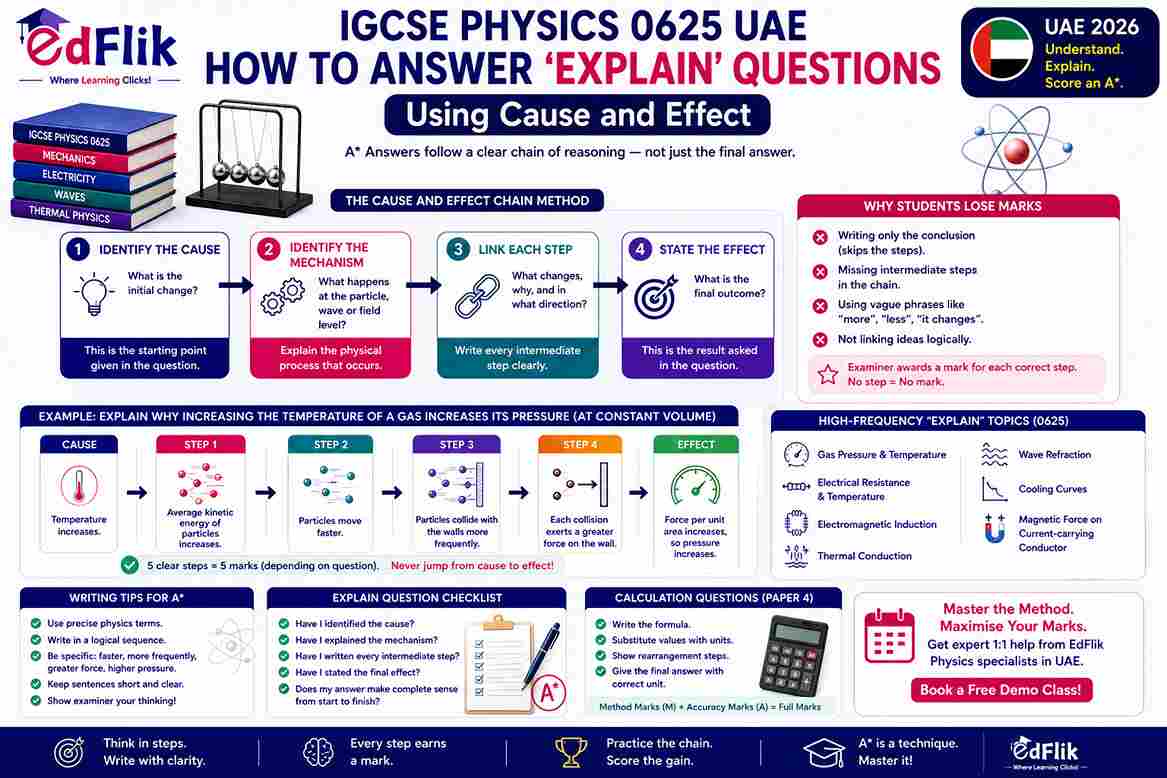
There is a specific pattern that appears repeatedly in IGCSE Physics 0625 Extended papers — and in the mark losses of UAE students who understand physics but score below their potential. A student who knows that increasing temperature increases gas pressure writes: 'the particles move faster and push on the walls more, so the pressure goes up.' The physics is correct. The conclusion is accurate. The mark scheme awards 1 or 2 marks out of 4 to 5. The chain of steps that connects cause to conclusion — each of which carries its own separate mark — has been collapsed into a single sentence. This is the explain-question gap, and closing it is the fastest route to significant Physics mark improvement for UAE students.
Why Cambridge Awards Marks for Each Chain Step — Not for the Conclusion
Cambridge IGCSE Physics 0625 Paper 4 mark schemes for explain and describe questions are structured as point-by-point mark lists — not as holistic assessments. Each step in the physical chain is listed separately, with its own mark. The examiner awards a mark for each step that appears in the student's answer — independently of whether the steps are in perfect order or grammatically smooth. The conclusion (the final effect the question asks about) is typically the last mark point — worth 1 mark. The intermediate steps are worth 2 to 4 marks. A student who writes only the conclusion earns the last mark and loses all the intermediate ones.
The practical implication: for every explain question on Cambridge 0625 Paper 4, the goal is to make the chain as explicit and as long as possible — never compress multiple steps into one sentence when the mark scheme allocates separate marks to those steps.
The Cause-and-Effect Chain Method — Step by Step
For every 'explain' or 'describe' question on Cambridge 0625 Paper 4:
1. Identify the cause: what is the initial change given in the question? (e.g. temperature increases, current increases, voltage changes, medium changes)
2. Ask: what happens at the particle/wave/field level as a direct result of this cause? Write it as a statement.
3. Ask: what does that change cause? Write the next step.
4. Continue the chain until you reach the final effect the question is asking about.
5. State the final effect explicitly — even if it was given in the question, state it as the conclusion of the chain.
6. Count your chain steps — if the question is worth 4 marks, you need at least 4 distinct steps. If you only have 2 or 3, go back and look for the missing steps.
Complete Cause-and-Effect Chains for the Most Common 0625 Explain Topics
|
Question |
Complete
Mark-Scheme Chain (each step = one mark) |
|
Explain why increasing temperature increases gas pressure at
constant volume |
(1) Increasing temperature increases average kinetic energy of
particles → (2) particles move faster (higher average speed) → (3) particles
collide with container walls more frequently → (4) each collision exerts
greater force (greater change in momentum per collision) → (5) pressure
(force per unit area) increases |
|
Explain why resistance of a metal wire increases with temperature |
(1) Increasing temperature causes lattice ions to vibrate with
greater amplitude → (2) more frequent collisions between free electrons and
vibrating ions → (3) electrons are impeded more in their flow through the
metal → (4) resistance increases |
|
Explain how an electromagnetic induction current is produced |
(1) A conductor moves relative to a magnetic field (or a changing
magnetic field passes through a conductor) → (2) the magnetic flux linkage
through the conductor changes → (3) a changing flux linkage induces an EMF
(Faraday's law) → (4) if the circuit is complete, a current flows in the
direction given by Lenz's law (opposing the change that caused it) |
|
Explain why a ray of light bends when it passes from air into
glass |
(1) Light travels at a lower speed in glass than in air → (2) as
the wavefront crosses the boundary, the part of the wavefront in glass slows
down while the part still in air continues at the original speed → (3) this
speed difference causes the wavefront to change direction → (4) the ray bends
toward the normal (since it is entering a denser medium) |
|
Explain how thermal energy is transferred by conduction in a
metal |
(1) Free electrons in the hotter region of the metal have greater
kinetic energy → (2) these electrons move through the metal and collide with
other free electrons and lattice ions in cooler regions → (3) they transfer
kinetic energy to particles in the cooler region → (4) the cooler region
warms up; this continues until thermal equilibrium |
|
Explain why the temperature stays constant during a change of
state (e.g. melting) |
(1) During a change of state, the thermal energy supplied does
not increase the kinetic energy of the particles → (2) instead, the thermal
energy is used to break the bonds between particles (potential energy
increases, not kinetic energy) → (3) since temperature depends on average
kinetic energy of particles, temperature does not rise during the phase
change → (4) this energy is the latent heat of fusion or vaporisation |
Calculation Questions — Method Mark Rules for 0625 UAE Students
Paper 4 also includes calculation questions — with the same method mark structure as Cambridge Maths 0580. The rules:
• Write the formula before substituting. Even for simple formulas: 'P = IV' before '= 5.0 × 2.4'.
• Substitute values with units into the formula.
• Show any rearrangement steps explicitly: 'R = V/I, therefore I = V/R'.
• State the final answer with the correct unit. If the question asks for speed in m/s and your calculation is in cm/s, convert before writing the final answer.
• For significant figures: follow the question's instructions ('give your answer to 2 significant figures'). If no instruction, 2 to 3 significant figures is generally safe.
The most common 0625 calculation errors among UAE students: using the wrong formula (memorise P = IV, V = IR, F = ma, p = mv, E = Pt, v = fλ, s = vt, and the specific heat/latent heat equations); rounding intermediate values before the final calculation (keep 4+ significant figures throughout); and forgetting to include the unit in the final answer (losing the accuracy mark even when the number is correct).
How to Practise Explain Questions — A Weekly Method
The most effective way to improve explain-question performance for UAE 0625 students: collect all explain/describe questions from the last 5 years of Paper 4. Answer each one without looking at the mark scheme. Then compare your chain to the mark scheme — count how many steps you wrote and how many steps earned marks. For every step you missed, add it to a 'missing steps' notebook. Review the notebook before every subsequent practice session. Within 4 to 6 sessions, the chains that were incomplete will become complete and automatic.
Frequently Asked Questions — IGCSE Physics 0625 Explain Questions UAE
Q: Why do UAE students lose marks on IGCSE Physics explain questions even when their physics is correct?
A: Because Cambridge mark schemes award separate marks for each step in the causal chain — not for the conclusion alone. Writing 'particles hit harder so pressure increases' earns 1 or 2 marks out of 4 to 5. The intermediate steps (kinetic energy increases, speed increases, collision frequency increases, greater force per collision) each carry their own mark and must be written explicitly.
Q: What is the cause-and-effect chain method?
A: For every explain question: (1) identify the cause; (2) write what happens at the particle/wave/field level; (3) write each intermediate step explicitly; (4) state the final effect. Never compress multiple steps into one sentence. Count the steps in your chain — if the question is worth 4 marks, you need at least 4 distinct steps.
Q: What are the most common 0625 explain question topics?
A: Gas pressure and temperature (kinetic theory), resistance and temperature in metals, electromagnetic induction, wave refraction, thermal conduction in metals, latent heat during phase change, and magnetic force on current-carrying conductors. Each has a specific 3 to 5 step chain. Memorise and practise all six.
Q: What is the correct chain for explaining increased gas pressure with temperature?
A: 5 steps: (1) kinetic energy of particles increases → (2) particles move faster → (3) collision frequency with walls increases → (4) greater force per collision (greater momentum change) → (5) pressure (force per unit area) increases. Each step earns one mark. Writing only steps 2 and 5 earns 2 out of 5.
Q: How should UAE students approach Physics calculation questions?
A: Write the formula; substitute values with units; show any rearrangement; state the answer with the correct unit. Same method-mark logic as Cambridge Maths 0580. Writing only the final answer earns only the accuracy mark — losing all method marks regardless of whether the answer is correct.
How EdFlik Supports IGCSE Physics 0625 Students Across UAE
EdFlik IGCSE Physics tutors build the cause-and-effect chain into the first session for every 0625 student. Every session uses official past papers with mark-scheme correction. From AED 60 per class. Free demo. www.edflik.com.