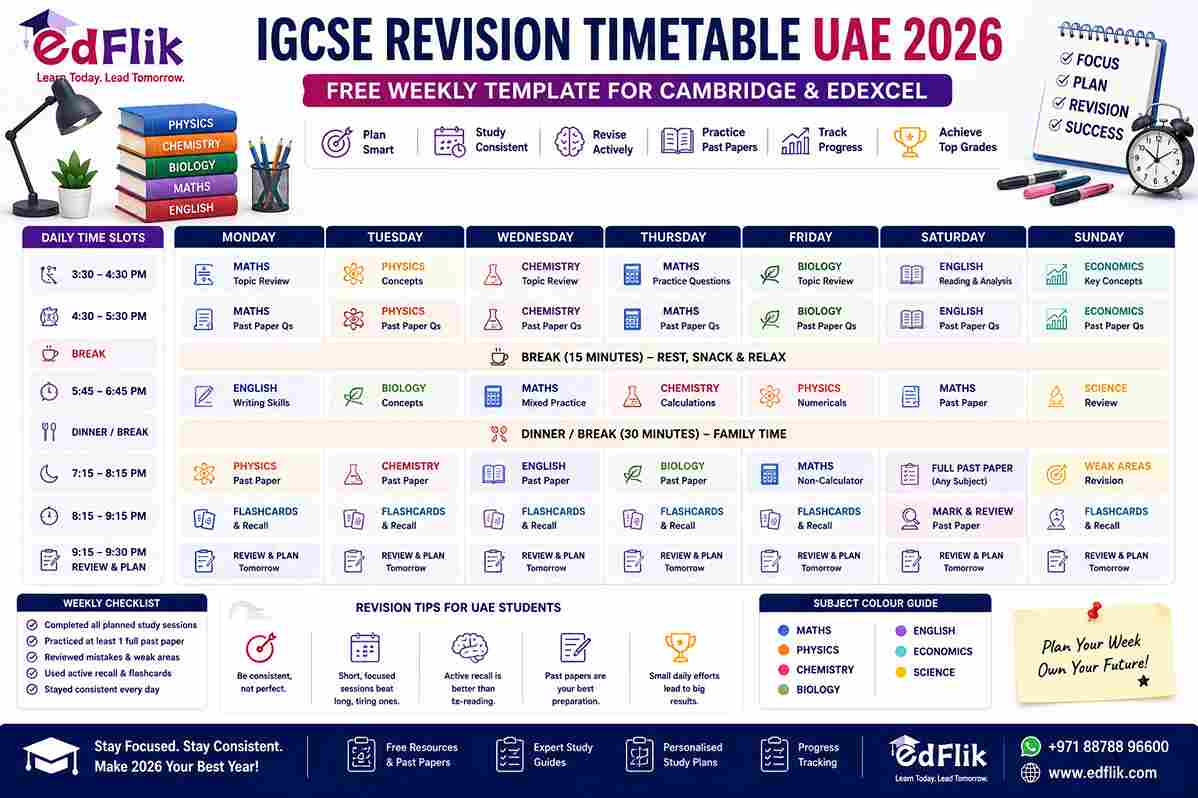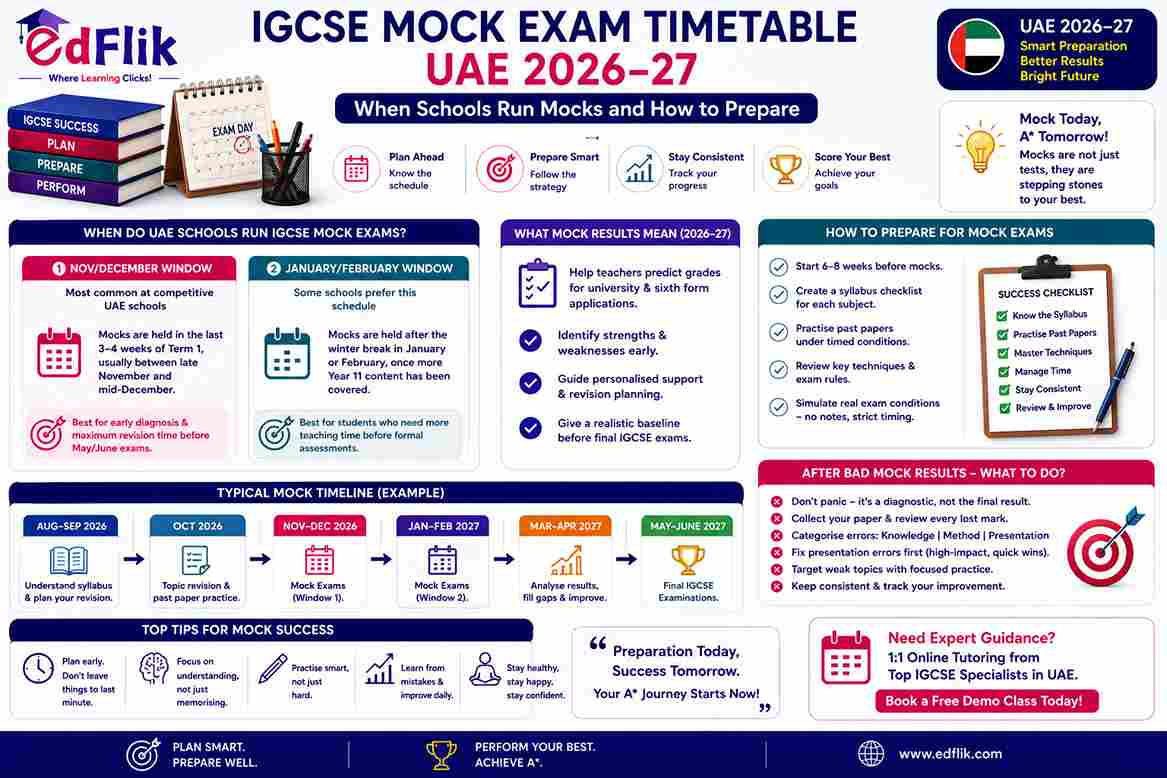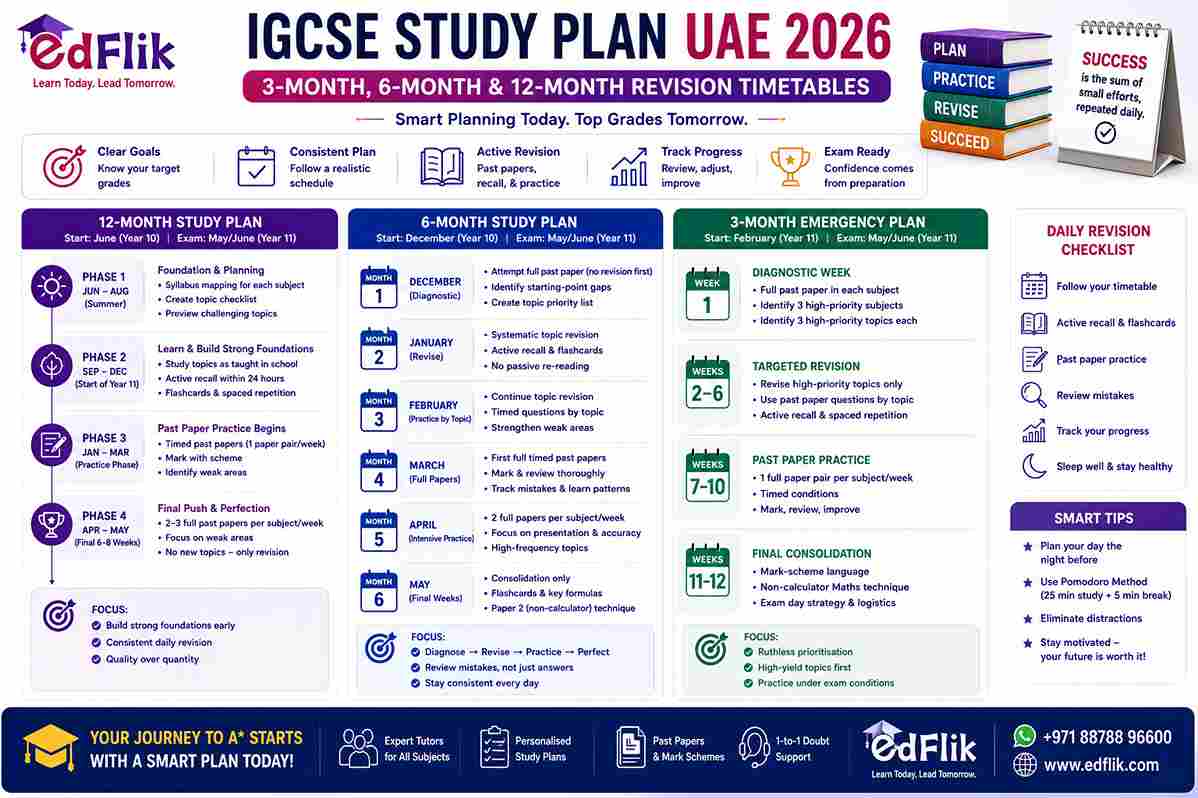
Study Timetable UAE 2026 — How to Create an Effective Study Schedule for School Students

A well-designed study timetable is one of the most practical academic tools a UAE school student can have — and one of the least effectively used. Most UAE students either have no timetable at all (studying reactively, the night before each assignment) or have a beautifully colour-coded timetable that is abandoned after three days because it was too ambitious. This guide covers how to build a study timetable that is achievable, evidence-based, and UAE school-specific — taking into account school timings, tutoring sessions, UAE public holidays, Ramadan, and the examination preparation timeline.
Building a UAE School Study Timetable — The 5-Step Framework
Step 1: Map Fixed Time
Before allocating any study time, map what is already fixed. For most UAE secondary school students:
• School: 7:30am-3:00pm (or 3:30pm) Monday to Friday (most UAE schools have Friday as a school day)
• Transport: 45-90 minutes total (school runs in Dubai can be significant)
• Extracurricular activities: sports, music, art — typically 2-4 sessions per week, 60-90 minutes each
• Tutoring sessions: typically 1-3 sessions per week
• Sleep: 8-9 hours for secondary students (non-negotiable for cognitive function)
• Prayer times, Friday prayers, family meals: fixed commitments that vary by family
Mapping these fixed commitments reveals the genuine available study time — which for most UAE secondary students is 1.5 to 3 hours on school days and 3 to 5 hours on Fridays and Saturdays.
Step 2: Prioritise by Gap, Not by Subject
The most common timetable mistake: allocating equal time to all subjects. Evidence-based allocation: give the most study time to the subjects where the gap between current performance and target is largest. If IGCSE Chemistry is at Grade C and the target is Grade A, Chemistry deserves more time than IGCSE English Language which is at Grade B and needs only Grade B.
Step 3: Design 45-60 Minute Blocks
Research consistently shows attention and retention decline after approximately 60 minutes of continuous study. UAE students who plan 3-4 hour continuous sessions are planning for progressive inefficiency. The evidence-based structure: 45-50 minutes of focused study, 10-15 minute genuine break (not phone scrolling — physical movement, snack, walk), then next 45-50 minute block.
Step 4: Sequence Hardest Subject First
Plan the subject requiring the most cognitive effort in the first block of each session. Working memory and analytical capacity are highest at the start of a study period. Doing the easiest subject first uses the best cognitive time on the lowest-priority task.
Step 5: Include Regular Retrieval Practice
The timetable should not only plan what to learn (new content) but also when to revisit previously covered material. Spacing retrieval practice — testing recall of material covered 3-7 days ago — is the single most evidence-supported technique for long-term retention. A simple rule: every Sunday, spend 30 minutes reviewing material covered in the previous week's study sessions.
UAE-Specific Study Calendar Considerations
|
Period /
Event |
Study
Planning Consideration |
Recommended
Adjustment |
|
Ramadan (dates
vary — approximately 10 days earlier each year) |
Fasting
reduces daytime energy; evening study after Iftar most productive; school
schedules shorten in Ramadan |
Shift primary
study sessions to post-Iftar (8pm-11pm); plan for lower daily volume;
compensate on non-fasting days on either side |
|
UAE National
Day (December 2-3) and adjacent days |
Mini-break
period; often 3-4 days of school closure or reduced schedule |
Use for Year
11 and IB/A-Level Year 2 students as a focused revision sprint — 2-3 past
papers per subject over the holiday |
|
School
half-term breaks (October and February) |
1-week school
breaks; valuable examination preparation time for Year 11 and Sixth Form
students |
Plan 3-4
focused study hours per day; use for catching up on content areas identified
as weak in the Term 1 mock examinations |
|
Summer holiday
(June-August) |
Long break; no
school; important for Year 10→11 preparation and Year 12→13 Year 13 start |
Year 10
students: 45 minutes of foundation subject work 4 days per week; Year 12
students: identify the October-November school mock timeline and begin
studying from late August |
|
EdFlik
tutoring sessions are the scheduled anchor points around which a study
timetable is built. The tutor identifies specific content priorities at each
session and assigns between-session practice tasks — turning abstract
"study Maths" into specific "complete these 5 quadratic
questions and check against the mark scheme." From AED 45 per session.
Free diagnostic. Book at www.edflik.com or WhatsApp +91 88788 96600. |
Frequently Asked Questions
Q: How should a UAE student create a study timetable?
(1) Map all fixed commitments first (school, transport, activities, sleep). (2) Allocate most study time to subjects with largest performance gaps — not equal time for all. (3) Plan 45-60 minute blocks with 15-minute breaks. (4) Schedule hardest subject first in each session. (5) Include weekly retrieval practice of previously covered material.
Q: How many hours should a UAE IGCSE student study per day?
Year 7-9: 45-90 minutes beyond homework. Year 10: 1.5-2.5 hours. Year 11: 2-3 hours on school days; 4-5 hours on weekends during Jan-May examination preparation. Hours matter less than study quality — active recall outperforms passive reading in any amount of time.
Q: How should UAE students manage study time during Ramadan?
Study immediately after Iftar — highest energy window. Avoid the hour before Maghrib. If Ramadan falls in exam months, plan for reduced daily intensity with longer post-Iftar sessions. Night study (8-11pm) is often the most productive window for fasting students.
Q: Should UAE students study on weekends?
In examination years, yes — but differently from school days. Morning session (9am-12pm): 2-3 hours of timed past paper practice. Afternoon: rest, family time, exercise. Evening (4-7pm): 2-3 hours of content work or mark scheme review. Don't plan the same schedule both Saturday and Sunday — one recovery day is cognitively important.
Q: How far in advance should UAE students start their study timetable?
Year 11 IGCSE: September of Year 11 (9 months before May exams). IB Year 2 / A-Level Year 13: September of the final year (IA completion in Term 1 alongside revision). CBSE Class 12: September of Class 12 for February/March board exams.