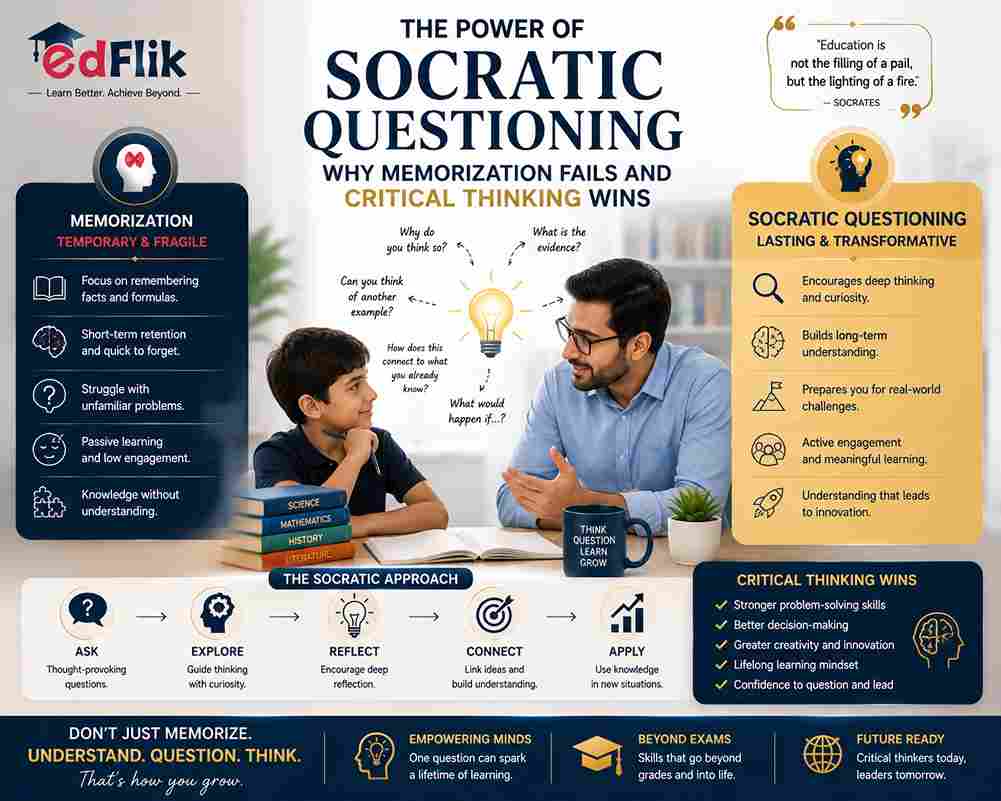
The Power of Socratic Questioning: Why Memorization Fails and Critical Thinking Wins
Last Updated: August 2026 | By: EdFlik Education Team
Quick Contact: Looking for an online tutor in Dubai & UAE 2026 who fosters real critical thinking? WhatsApp us at +91 88788 96600 | Sessions starting from AED 55–75/hour | Book a Free Trial Class today viawww.edflik.com.
Introduction: The Trap of Memorizing for Exams
Picture a familiar scene across study desks in Dubai, Abu Dhabi, and Sharjah: a high school student sitting late into the night surrounded by highlighter pens, flashcards, and open textbooks. They are desperately cramming definitions, formulas, and historical dates into their short-term memory, hoping they can hold onto them long enough to empty them onto an exam paper the next morning.
For decades, traditional educational systems have rewarded this exact cycle. Rote memorization can often secure passing grades on basic recall tests. However, the moment a student faces a modern Cambridge IGCSE, A-Level, or IB examination featuring unfamiliar application questions, case studies, or multi-step problem-solving, memorization completely collapses.
Why? Because memorizing facts is not the same as understanding them. To thrive in an automated, rapidly evolving world, students need something far more powerful than a good memory: they need critical thinking. And the most effective catalyst for critical thinking is an ancient yet revolutionary teaching technique known as Socratic Questioning.
Section 1: Why Rote Memorization Fails in Modern Classrooms
Rote learning treats the human brain like a hard drive—something to be loaded with files that can be retrieved verbatim upon command. While useful for basic multiplication tables or spelling, relying on memorization for advanced academic success creates severe vulnerabilities:
- The Fragility of Short-Term Retention: Information crammed into memory via repetition without deep context evaporates rapidly once the exam ends, leaving no foundational framework for subsequent grade levels.
- Inability to Adapt to Unfamiliar Contexts: International exams are deliberately designed to test application rather than recall. If a physics or economics question twists a standard scenario into a new shape, a rote learner freezes because they cannot find an exact match in their memory bank.
- The "Illusion of Competence": Reading and rereading a textbook chapter tricks students into feeling familiar with the material, mistaking recognition for actual comprehension.
Section 2: What is Socratic Questioning?
Named after the classical Greek philosopher Socrates, the Socratic method replaces traditional lecturing and direct answers with disciplined, open-ended inquiry.
Instead of telling a student what a concept means or how to solve an equation, a Socratic mentor acts as a cognitive facilitator. They ask targeted, probing questions that guide the student to uncover the underlying logic, test their own assumptions, and arrive at the solution independently.
- Traditional Approach: "The formula for photosynthesis is $6CO_2 + 6H_2O \rightarrow C_6H_{12}O_6 + 6O_2$. Memorize it."
- Socratic Approach: "What do plants take in from their environment? What energy source acts on those elements, and what must be produced for the plant to grow?"
By prompting the student to construct the answer themselves, the knowledge moves from fragile short-term memory into permanent, active cognitive architecture.
Section 3: Core Benefits of the Socratic Method for Students
Integrating Socratic dialogue into tutoring sessions transforms how students interact with complex subjects like mathematics, sciences, and humanities:
1. Deepens Comprehension Over Surface Learning
Socratic questioning forces students to explain the why and how behind every concept, eliminating gaps in their understanding. They stop accepting facts blindly and start understanding structural relationships.
2. Cultivates Intellectual Humility and Resilience
When students realize they do not have an immediate answer, they no longer panic. Socratic guidance teaches them that getting stuck is not a failure, but a normal, productive part of intellectual discovery.
3. Builds Unshakable Exam Confidence
Students trained through inquiry-based dialogue develop independent problem-solving instincts. When they encounter a terrifying, brand-new question on an exam paper, they do not search their memory for a script; they break the problem down logically using the analytical tools they’ve practiced.
Section 4: Common Pitfalls Parents and Tutors Make
Well-meaning educators and parents often accidentally stifle critical thinking through everyday habits:
- Rescuing Too Quickly: Stepping in with the correct answer the moment a student hesitates or looks confused, depriving them of the struggle required to build neural pathways.
- Asking Closed "Yes/No" Questions: Asking "Do you understand this?" which usually invites a polite, uninformative nod rather than a genuine demonstration of reasoning.
- Treating Mistakes as Punishable: Creating an environment where wrong answers carry emotional weight, forcing children to guess what the teacher wants to hear rather than exploring authentic logic.
Section 5: The EdFlik Advantage: Mentorship Through Inquiry
At EdFlik Education, our 1-on-1 online tutors reject passive lecturing. We use structured Socratic dialogue to ignite curiosity and build autonomous, confident thinkers across the UAE:
- Interactive Guidance: Our tutors use digital whiteboards and targeted questioning to help students discover answers themselves, cementing long-term mastery.
- Customized Pacing: Tailoring inquiry depth to match each student's specific curriculum (British, American, or IB) and individual learning speed.
- Exceptional Affordability: Elite critical-thinking mentorship starting at just AED 55–75/hour, providing transformative education without inflated agency markups.
Success Stories & Testimonials
"My son used to memorize math formulas like poetry without having any idea what they actually meant. His EdFlik tutor used questioning techniques that forced him to think critically about how equations worked. His analytical skills and exam scores have skyrocketed."
— Parent in Dubai Marina
"Instead of just giving me corrections on my essays, my EdFlik tutor asked questions that made me find the logical flaws in my own arguments. It completely changed how I write and think."
— A-Level Student, Abu Dhabi
Frequently Asked Questions (FAQ)
What is Socratic questioning in education?
Socratic questioning is an inquiry-based teaching method where educators use open-ended, probing questions to guide students to discover answers, analyze assumptions, and build critical thinking skills independently.
Why is rote memorization inefficient for modern exams?
Rote memorization relies on short-term recall, which fails when students encounter unfamiliar, application-based questions that require deep analytical problem-solving.
How much do expert 1-on-1 tutoring sessions cost with EdFlik?
EdFlik offers expert 1-on-1 online tutoring focused on critical thinking and deep comprehension starting at an accessible AED 55–75/hour.
Ready to Transform How Your Child Learns?
Move beyond rote memorization and equip your child with lifelong critical thinking skills. Experience the EdFlik difference today.
- WhatsApp Us:+91 88788 96600
- Visit Us:www.edflik.com
- Special Offer: Book your Free Trial Class now!