Twice-Exceptional (2e) Students in the UAE — When Giftedness Masks a Learning Difference
A child who reads two years above grade level but cannot finish a timed maths paper. A child who solves complex problems mentally but produces almost nothing on paper. A child who was called "gifted" by one teacher and "lazy" or "careless" by another, in the same school year.
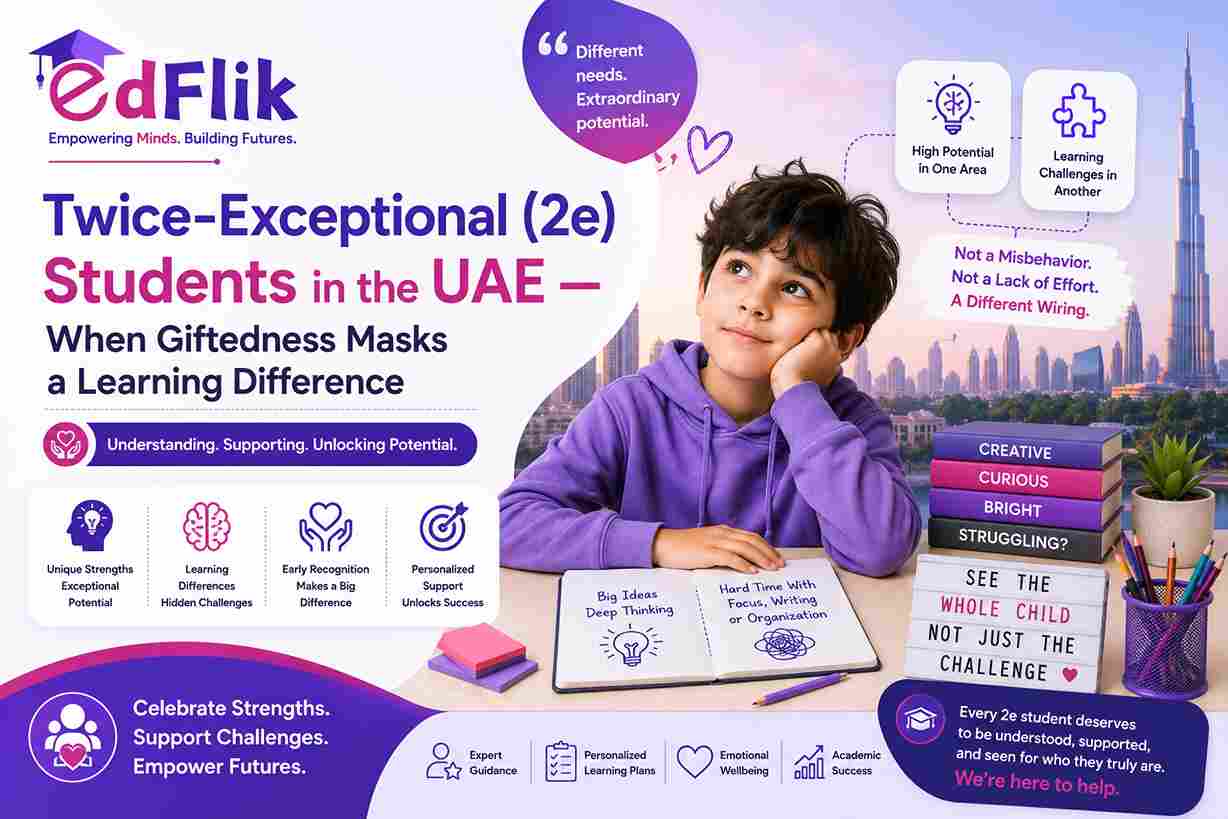
These are twice-exceptional students — commonly shortened to **2e** — and the UAE's international school system, for all its curriculum diversity, has very little written specifically about them. Most support content addresses either giftedness *or* learning differences. Almost none addresses what happens when both are present in the same child at the same time.
## What Does Twice-Exceptional Actually Mean?
A twice-exceptional student is a child who is both:
1. **Gifted or highly able** in one or more areas — verbal reasoning, mathematical thinking, general cognitive ability, or a specific subject, and
2. **Living with a diagnosed or undiagnosed learning difference** — most commonly dyslexia, dyscalculia, ADHD, dysgraphia, or a processing difficulty.
The two profiles do not cancel each other out. Instead, they mask each other. Giftedness allows the child to compensate just enough to hide the learning difference for years. The learning difference, in turn, drags down performance just enough that the giftedness is never formally recognised. The result is a student who is quietly capable of far more than their grades suggest — and who is rarely correctly identified by either school or family.
## Why UAE Schools Often Miss 2e Students
UAE private schools operate a wide range of identification systems — CAT4 cognitive testing, internal school assessments, and curriculum-specific screening (IGCSE, IB, American, MOE). These systems are generally good at flagging students who are clearly behind or clearly advanced. They are far less reliable at flagging students who sit in the middle on paper while masking a significant internal gap between potential and output.
A few patterns repeat across Dubai, Abu Dhabi, and Sharjah schools:
- **The "careless" label.** A child who understands a concept instantly but makes repeated small errors under time pressure is frequently labelled careless or inattentive, when the underlying issue may be a processing speed or working memory difference.
- **The high-average trap.** A 2e student's compensations often produce grades that are good but not exceptional — B/B+ rather than A* — which rarely triggers either a gifted referral or a learning support referral.
- **Behavioural misreading.** Boredom from insufficient challenge and frustration from an undiagnosed difficulty can look identical from the outside: disengagement, off-task behaviour, or resistance to written work.
- **Subject-specific unevenness dismissed as inconsistency.** A student who is exceptional in verbal subjects and unexpectedly weak in numerical ones (or vice versa) is often assumed to simply "prefer" one subject, when a specific difficulty may explain the gap.
## Signs Your Child May Be Twice-Exceptional
No single sign confirms a 2e profile, but a cluster of the following is worth raising with your school's learning support coordinator or an educational psychologist:
- Strong verbal or general knowledge that is well ahead of peers, alongside consistent difficulty with written output, spelling, or numerical fluency
- Rapid, insightful understanding in discussion, followed by work on paper that does not reflect that understanding
- A pattern of "underachieving relative to ability" noted by more than one teacher over more than one year
- Strong performance in low-stakes, untimed settings and a sharp drop under timed exam conditions
- Intense interest and depth in one or two specific topics, alongside broad avoidance of tasks involving writing, organisation, or sequencing
- A self-reported sense of "knowing the answer but not being able to show it"
## Why Correct Identification Matters
Misidentifying a 2e student in either direction has real academic consequences. Treating the child purely as gifted, without addressing the underlying difficulty, leaves the learning difference to compound as academic demands increase — the gap becomes harder to close each year, particularly at the IGCSE-to-A-Level or MYP-to-Diploma transition, where independent written output increases sharply. Treating the child purely as a struggling learner, without recognising the giftedness, risks disengagement, underachievement, and a self-image built around "not being good at school" despite genuine intellectual strength.
Getting the identification right — usually through a combination of school observation, cognitive assessment (such as CAT4 or an educational psychologist's evaluation), and subject-specific diagnostic work — allows both sides of the profile to be supported at the same time, rather than one being addressed at the expense of the other.
## How Tutoring Supports a 2e Profile Differently to Standard Tutoring
Generic tutoring — whether aimed at "catching up" or "getting ahead" — is usually the wrong tool for a 2e student, because it addresses only one half of the profile. What tends to work better is a dual approach within the same sessions:
- **Working at the child's actual conceptual level**, not their grade-level expectation, so the sessions engage rather than bore the gifted side of the profile
- **Building explicit scaffolds for the specific difficulty** — structured writing frames for a student with dysgraphia, worked-example sequencing for a student with dyscalculia, or segmented session structure for a student with ADHD-linked attention difficulty
- **Separating "does the child understand this" from "can the child currently produce this on paper,"** and addressing each with different techniques
- **Building metacognitive awareness with the student** — many 2e students respond well to understanding their own profile explicitly, rather than being told simply to "try harder" or "slow down"
EdFlik's 1:1 live tutoring model, with sessions matched to individual students rather than group pacing, gives tutors the flexibility to run exactly this kind of dual-track session — working at conceptual depth while building the specific scaffolds a child's profile requires, and reporting patterns back to parents so school conversations are backed by evidence rather than impressions.
## Frequently Asked Questions
**Q: Is twice-exceptional the same as being "gifted with a disability"?**
A: Broadly yes — 2e specifically refers to the overlap between high ability and a diagnosed or suspected learning difference, such as dyslexia, dyscalculia, dysgraphia, or ADHD, occurring in the same student.
**Q: Can a UAE school formally test for a 2e profile?**
A: Most UAE private schools use CAT4 or similar cognitive testing plus internal academic screening, which can surface the pattern, but a fuller diagnostic assessment usually requires a referral to an educational psychologist for formal identification.
**Q: What is the biggest risk of missing a 2e identification?**
A: Underachievement that compounds over time — the gap between a child's potential and their actual output tends to widen at key transition points, such as Grade 9–10 or the MYP-to-Diploma shift, if it is not addressed early.
**Q: Does EdFlik provide tutors experienced with twice-exceptional students?**
A: EdFlik matches families with tutors experienced in both enrichment and learning-difference-adapted teaching, and sessions can be explicitly briefed to address both sides of a child's profile. Free trial sessions are available to assess fit before committing.
*EdFlik provides live, 1:1 online tutoring for students aged 3–18 across all seven emirates, covering IB, IGCSE, A-Level, American, ICSE, SAT, AP, and MOE curricula. Sessions start from AED 45. Free trial class available at [www.edflik.com](https://www.edflik.com).*