Understanding Primary Productivity and Energy Transfer: Edexcel IAL Biology Unit 4 Notes
Last Updated: October 2026 | By EdFlik Education Team
For students studying Pearson Edexcel International Advanced Level (IAL) Biology Unit 4 (WBI14: Energy Flow, Ecosystems and the Environment), mastering the flow of energy through living systems is a core requirement. Examiners consistently test your ability to define thermodynamic terms, calculate energy budgets, and explain why ecological efficiency limits food chain lengths.
In this comprehensive, exam-focused masterclass guide, our expert biology educators break down primary productivity, energy transfers across trophic levels, and the mathematical formulas you must memorize for your Unit 4 exam.
Part 1: Photosynthesis as the Foundation of Energy Flow
Before energy can flow through an ecosystem, it must first be captured. Life on Earth is solar-powered, and autotrophic producers (such as plants and algae) convert light energy into chemical energy via photosynthesis.
- The Light-Dependent Stage: Occurs across the thylakoid membranes of chloroplasts. Light energy photoionizes chlorophyll, driving photolysis (splitting water into protons, electrons, and oxygen) and generating ATP and reduced NADP through photophosphorylation.
- The Light-Independent Stage (Calvin Cycle): Takes place in the stroma. It uses the ATP and reduced NADP from the first stage to fix carbon dioxide into glycerate 3-phosphate (GP) and reduce it to glycerate 3-phosphate derivative (GALP), which is subsequently synthesized into glucose and other essential organic molecules.
Part 2: Defining Primary Productivity
Not all sunlight striking a leaf is converted into plant biomass. Much of it is reflected, passes straight through, or is the wrong wavelength. We measure the rate of energy capture using specific productivity metrics:
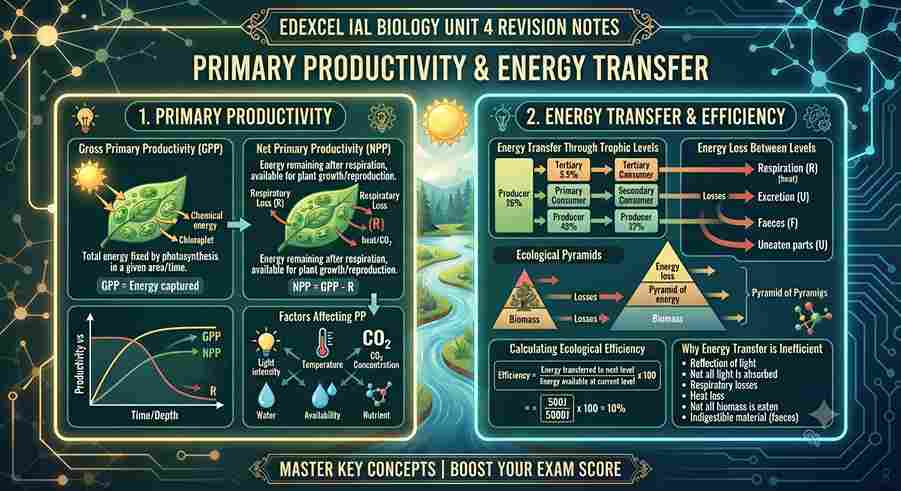
1. Gross Primary Productivity (GPP)
Gross Primary Productivity is the rate at which energy is incorporated into organic molecules by plants through photosynthesis in a given area or volume over a given time.
- Units: Typically expressed as $\text{kJ m}^{-2}\text{ year}^{-1}$ or $\text{g m}^{-2}\text{ year}^{-1}$.
2. Respiration Losses ($R$)
Plants do not store all the energy they capture. A significant fraction (often 20% to 50% or more) is broken down via aerobic respiration to fuel cellular maintenance, active transport, and growth. This is represented as $R$ (respiratory loss).
3. Net Primary Productivity (NPP)
Net Primary Productivity is the rate at which energy is transferred into the organic molecules that make up new plant biomass, taking respiratory losses into account.
This is the actual chemical energy store available to herbivores (primary consumers). The relationship is defined by the fundamental Edexcel equation:
$$\text{NPP} = \text{GPP} - R$$
Part 3: Energy Transfer Across Trophic Levels
When primary consumers eat plants, or secondary consumers eat other animals, chemical energy is transferred along the food chain. However, this transfer is notoriously inefficient—usually only yielding an efficiency of roughly $5\%$ to $10\%$ between trophic levels.
Why is Energy Transfer Inefficient?
Energy is lost at each step due to several inescapable biological factors:
- Incomplete Ingestion: Consumers do not eat the entire organism (e.g., roots, woody stems, bones, or fur are left behind).
- Incomplete Digestion and Egestion: Not all ingested material can be digested; much of it is egested as feces ($F$).
- Metabolic Heat Losses (Respiration): A massive portion of digested energy is released to the environment as heat ($R$) through respiration to power movement, body temperature regulation, and metabolic reactions.
Part 4: Consumer Productivity Formulas
For animal consumers, we calculate Net Productivity ($N$) using the standard Edexcel formula:
$$N = I - (F + R)$$
- $I$ = Chemical energy store in ingested food
- $F$ = Chemical energy lost to the environment in feces and urine
- $R$ = Respiratory losses to the environment
Calculating Ecological Efficiency
To determine how successfully energy moves from one trophic level to the next, use the percentage efficiency formula:
$$\text{Efficiency} = \left( \frac{\text{Net Productivity}}{\text{Energy Received (or Ingested)}} \right) \times 100$$
Part 5: Top 4 Exam Traps That Cost Students Unit 4 Marks
- Confusing GPP and NPP: Forgetting to subtract respiratory losses ($R$) when a question asks for the energy actually available to primary consumers.
- Unit Confusion: Mixing up energy units ($\text{kJ m}^{-2}\text{ yr}^{-1}$) with biomass units ($\text{g m}^{-2}$) in calculations. Always match what the data table provides.
- Forgetting Feces vs. Excretion: Misidentifying what $F$ stands for in consumer energy budgets ($F$ encompasses both undigested food in feces and metabolic waste products like urea in urine).
- Vague Explanations of Inefficiency: Saying "energy is lost" without specifying how (e.g., lost as heat via respiration, lost in unconsumed plant parts, or lost in feces). Examiners penalize lack of precision.
Preparing for Pearson Edexcel IAL Biology Unit 4 exams? EdFlik connects international school students globally with expert, 1-to-1 online biology tutors, helping you master ecological calculations, essay structures, and past-paper mark schemes to secure top grade As and A*s.Book a Free Demo Class Today!
Frequently Asked Questions (FAQs)
Q1: Why are food chains rarely longer than 4 or 5 trophic levels?
Ans: Because energy transfer efficiency between trophic levels is so low (around 10%), there is simply not enough remaining chemical energy stored in biomass at the top of a food chain to sustain a viable population of tertiary or quaternary consumers.
Q2: What factors affect the Gross Primary Productivity (GPP) of an ecosystem?
Ans: GPP is heavily influenced by abiotic factors such as light intensity, carbon dioxide concentration, temperature, water availability, and the concentration of mineral ions (like magnesium for chlorophyll synthesis).
Q3: How do farming practices increase net productivity in livestock?
Ans: Farmers restrict energy losses by keeping animals indoors (reducing heat loss and movement, which minimizes $R$) and feeding them highly digestible, high-protein diets (which minimizes unabsorbed waste in feces, optimizing $I$ and $N$).
Q4: How does EdFlik support EdFlik IAL Biology students?
Ans: EdFlik connects international school students worldwide with vetted, expert 1-to-1 online biology tutors specializing in Edexcel International A-Level specifications. Our personalized coaching focuses on clearing difficult biological concepts, practicing data analysis questions, and mastering exam techniques.