Understanding Stationary Waves and Diffraction Gratings: Edexcel IAL Physics Unit 2 Revision Masterclass
Last Updated: October 2026 | By EdFlik Education Team
For students studying Pearson Edexcel International Advanced Level (IAL) Physics Unit 2 (Waves and Electricity), the waves section often makes or breaks an exam paper. While basic wave properties like frequency, wavelength, and the wave equation ($v = f\lambda$) are familiar from IGCSE or GCSE, Unit 2 introduces advanced wave phenomena that demand rigorous mathematical precision and conceptual clarity.
Among all wave topics tested in Section A, stationary waves (standing waves) and diffraction gratings consistently pose the greatest challenge. Examiners do not just test rote memorization; they test whether you understand how superposition creates nodes and antinodes, how harmonics are formed in strings and pipes, and how to calculate precise angle deviations using diffraction grating equations.
In this comprehensive, exam-focused masterclass guide, our expert IGCSE and IAL physics educators break down the core mechanics of stationary waves, unpack diffraction grating formulas, and share high-impact strategies to secure top $A^*$ grades.
Part 1: Stationary Waves — Formation and Harmonics
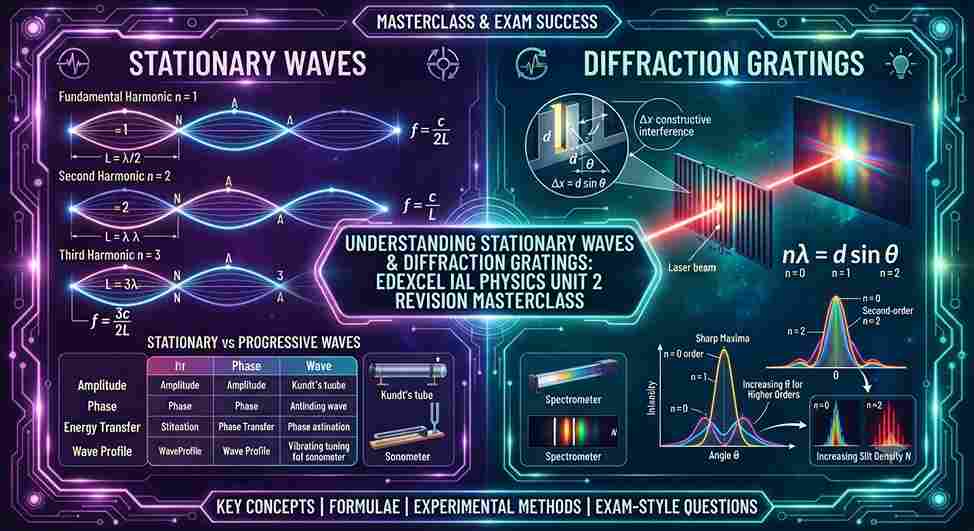
Unlike progressive waves—which transfer energy continuously from one point to another—stationary (standing) waves store energy within fixed regions. They are formed by the superposition of two progressive waves of identical frequency, wavelength, and amplitude traveling in opposite directions (typically an incident wave and a reflected wave).
1. Nodes vs. Antinodes
- Nodes ($N$): Points of zero amplitude where destructive interference occurs continuously because the two interfering waves are completely out of phase ($180^\circ$ or $\pi$ radians apart).
- Antinodes ($A$): Points of maximum amplitude where constructive interference occurs because the two waves arrive completely in phase.
2. Harmonics on Stretched Strings
When a string of length $L$ is fixed at both ends, it can only vibrate at specific resonant frequencies, producing standing waves with nodes at both ends.
- First Harmonic (Fundamental Frequency, $f_1$):
- Contains 1 antinode and 2 nodes.
- Wavelength: $\lambda_1 = 2L$
- Frequency: $f_1 = \frac{v}{2L}$ (where $v = \sqrt{\frac{T}{\mu}}$ is wave speed).
- Second Harmonic ($2f_1$):
- Contains 2 antinodes and 3 nodes.
- Wavelength: $\lambda_2 = L$
- Frequency: $f_2 = \frac{v}{L} = 2f_1$
- General Formula for Strings:$$f_n = \frac{n v}{2L} \quad \text{for } n = 1, 2, 3, \dots$$
3. Stationary Waves in Air Columns (Pipes)
Edexcel IAL examiners frequently test air columns, which behave differently depending on whether the pipe is open or closed:
- Closed Pipe (Closed at one end, open at the other): Has a node at the closed end and an antinode at the open end. Produces only odd harmonics ($f_1, 3f_1, 5f_1$).
- Open Pipe (Open at both ends): Has antinodes at both ends. Produces all harmonics ($f_1, 2f_1, 3f_1, 4f_1$).
Part 2: Diffraction Gratings — The Physics of High-Resolution Spectra
When monochromatic light passes through a single slit or a double slit, diffraction and interference produce broad, fuzzy fringes. However, when light passes through a diffraction grating—an optical component containing thousands of closely spaced parallel slits per millimeter—the interference pattern becomes extremely sharp and bright.
1. The Diffraction Grating Equation
When coherent light of wavelength $\lambda$ is directed normally at a diffraction grating with slit separation $d$, bright maxima (principal maxima) are observed at specific angles $\theta$ according to the master formula:
$$n\lambda = d \sin\theta$$
Where:
- $n$ = order of maximum ($0, 1, 2, 3, \dots$)
- $\lambda$ = wavelength of the incident light (in meters)
- $d$ = distance between adjacent slit centers (grating spacing)
- $\theta$ = angle of diffraction from the zero-order maximum
2. Calculating Grating Spacing ($d$)
Exam questions rarely give you $d$ directly. Instead, they provide the number of slits per millimeter ($N$). You must convert this carefully:
- If a grating has $N$ lines per millimeter, the slit separation $d$ in meters is:$$d = \frac{1}{N \times 10^3} \text{ meters} \quad \text{or} \quad d = \frac{10^{-3}}{N}$$
3. Finding the Maximum Order ($n_{\max}$) Possible
A very common 3-mark exam question asks: "What is the highest order of maximum visible on the screen?"
- The Strategy: Since the maximum possible angle of diffraction is $\theta = 90^\circ$, we know that $\sin(90^\circ) = 1$.
- Substitute $\sin\theta = 1$ into the grating equation:$$n_{\max} = \frac{d}{\lambda}$$
- Crucial Rule: Always round down to the nearest whole integer. (For example, if calculation yields $n = 4.3$, the highest visible order is 4; rounding up to 5 would require an angle greater than $90^\circ$, which is physically impossible).
Part 3: Top 4 Exam Traps to Avoid in Unit 2 Waves
- Unit Conversion Slips: Wavelengths are almost always given in nanometers ($\text{nm} = 10^{-9}\text{ m}$) or micrometers ($\mu\text{m} = 10^{-6}\text{ m}$). Forgetting to convert these before plugging them into $n\lambda = d\sin\theta$ results in catastrophic calculation errors.
- Confusing Grating Lines ($N$) with Slit Separation ($d$): Remember that $N$ is lines per unit length, whereas $d$ is the distance between individual slits ($d = 1/N$).
- Misinterpreting Node-Antinode Distance: The distance between a node and an adjacent antinode is always $\frac{\lambda}{4}$, while the distance between two adjacent nodes (or two adjacent antinodes) is $\frac{\lambda}{2}$.
- Calculator Angle Mode: Ensure your calculator is set to Degrees (not Radians) when calculating $\sin\theta$ for diffraction grating problems.
Struggling with Edexcel IAL Physics Unit 2 wave equations, stationary wave harmonics, or electricity circuits? EdFlik connects international school students globally with expert, 1-to-1 online physics tutors, helping you master difficult concepts and secure top grades.Book a Free Demo Class Today!
Frequently Asked Questions (FAQs)
Q1: What is the main difference between progressive and stationary waves?
Ans: Progressive waves transfer energy from one place to another through particle oscillations, whereas stationary waves store energy within fixed bounds, containing alternating nodes (zero amplitude) and antinodes (maximum amplitude).
Q2: How do I calculate slit separation $d$ if a grating has 500 lines per mm?
Ans: First, convert lines per mm to lines per meter by multiplying by $10^3$ (giving $5 \times 10^5\text{ lines/m}$). Then, take the reciprocal: $d = \frac{1}{5 \times 10^5} = 2 \times 10^{-6}\text{ m}$ (or $2\mu\text{m}$).
Q3: Can white light produce a spectrum through a diffraction grating?
Ans: Yes! Unlike monochromatic laser light which produces sharp single-color lines, white light diffracts different wavelengths at different angles ($n\lambda = d\sin\theta$), spreading each order into a continuous rainbow spectrum with red light deflected the most because of its longer wavelength.
Q4: How does EdFlik support Edexcel IAL Physics students?
Ans: EdFlik connects international school students worldwide with vetted, expert 1-to-1 online physics tutors specializing in Pearson Edexcel IAL Unit 1 through Unit 6. Our personalized coaching focuses on clarifying complex principles, mastering calculation frameworks, and tackling past-paper mark schemes.