What Should You Look for in an IB Biology Tutor?

IB Biology is a subject full of fascinating ideas, from cells and genetics to ecology and human physiology. It is also a course that asks students to think like scientists. They need to know facts, apply them to unfamiliar situations, analyse data, and plan their own investigations. For many students, the challenge is not learning biology itself but learning how to show what they know in the way the IB expects.
For parents, choosing the right support can feel like a big decision. A good IB Biology tutor will help your child understand the content, build the skills the exams reward, and stay organised through the two years of the course. This guide explains what to look for when you choose an IB Biology tutor online, with a focus on course level, practical skills and one-to-one support that suits families in the UAE.
Confirm the Course Level: SL or HL
IB Biology is offered at both Standard Level (SL) and Higher Level (HL). HL covers more content and expects greater depth, so the study approach can differ. Students on either level still need strong foundations, but the amount of content and the depth of questions will vary. Course details can be updated, so please check the current IB Biology subject guide for the requirements that apply to your child.
When you speak to a tutor, ask whether they teach SL, HL or both, and how they adapt their lessons for each level. A tutor who can explain the difference between the two levels, and who knows which topics are shared and which are extra for HL, is well placed to plan your child's support. If your child is studying one level but their tutor focuses mainly on the other, it is worth raising this early.
Build Practical and Data Skills Online
IB Biology places real weight on practical work. Students are expected to design experiments, record and process data, draw graphs with suitable axes, evaluate their methods and explain their conclusions. Some of this is easiest to practise in a laboratory, but a skilled online tutor can build these abilities in other ways.
Ask how the tutor approaches practical and data skills. Strong online lessons often include reading and interpreting data tables, drawing and critiquing graphs, identifying independent, dependent and controlled variables, calculating uncertainties where relevant, and discussing sources of error. Ask whether your child can take part in simulations or home-based activities arranged with their school. The aim is to help your child think like a scientist, whatever the setting.
Practise with Exam-Style Questions
IB Biology exams use a range of question types, from short factual answers to extended responses that ask students to link ideas together. Students who practise only from memory often find that the exam questions feel unfamiliar. Regular practice with exam-style questions helps them recognise what is being asked and organise their answers clearly.
Ask the tutor how they select practice questions and how they review answers. Look for a tutor who asks your child to explain their reasoning, who points out where command terms such as "describe", "explain" or "evaluate" change what a good answer looks like, and who tracks topics that need more work.
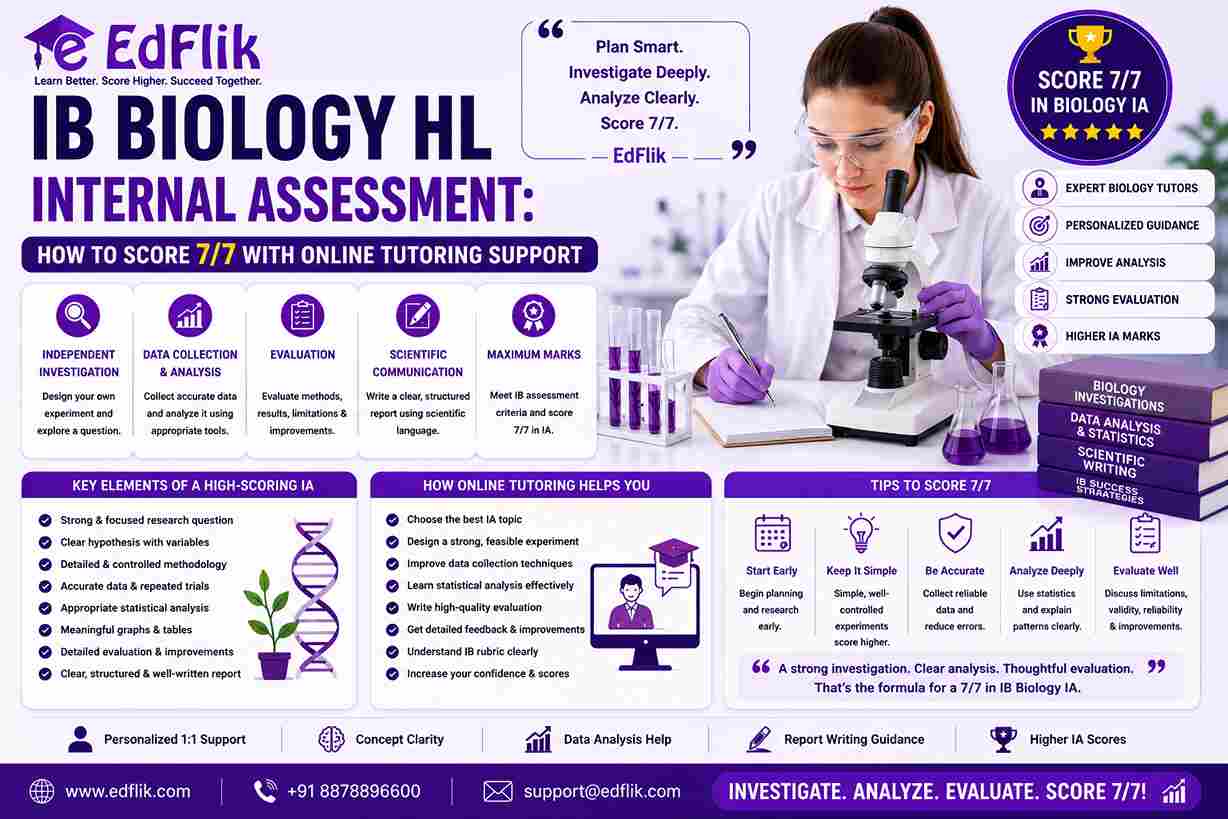
Can a Tutor Help with the Internal Assessment?
The Internal Assessment (IA) is an individual investigation that your child completes during the course, and it is assessed by their teacher. A tutor can help with the general skills that support it, such as planning an investigation, understanding how data is analysed, or structuring a clear write-up. What matters most is that the work remains your child's own, in line with IB academic integrity rules.
Ask a prospective tutor how they would support the IA. A good answer will focus on guiding your child's thinking through questions, explaining the assessment criteria, and reviewing drafts in a way that encourages independent work. Be cautious of any approach that offers to write the investigation for your child. Check the current IB guidance and speak to your child's teacher about what support is appropriate.
Why One-to-One Lessons Suit Biology
Biology has a lot of content, and students often find it easier to learn when topics connect. A one-to-one lesson lets the tutor check how well your child understands the links between cells, genetics, and body systems, and go back to a topic when a link is missing. It also gives your child time to ask the questions they might not feel comfortable asking in a larger class.
One-to-one lessons are also flexible. If your child is preparing for an assessment, the tutor can spend more time on that topic. If they are confident in one area, the tutor can move on to the next. This makes learning feel more personal and often more efficient.
Plan Ahead for Assessments
IB assessments are scheduled across the course, and it helps to know which topics and skills are coming up. Many students benefit from a simple plan: a short review of recent content each week, regular practice questions, and a deeper revision period before each assessment. Ask your tutor how they would organise this across the year, and how they will adjust the plan if your child's school timetable changes.
Check the current assessment dates and requirements with your child's school, as these can vary.
A Practical Checklist
Use this list when you compare IB Biology tutors:
- Confirm whether the tutor teaches SL, HL or both, and how lessons are adapted for each level.
- Ask how practical and data skills are taught in an online setting.
- Check how exam-style questions are practised, including command terms and extended answers.
- Ask how the tutor would support the Internal Assessment while keeping the work the student's own.
- Confirm that lessons are one-to-one, so pacing suits your child.
- Ask how the tutor plans around assessment dates and tracks progress.
- Check the cost per class and ask how a free trial works before you commit.
How EdFlik Can Help
EdFlik offers live, one-to-one online tutoring for students aged 3 to 18, including IB courses. Each lesson is about one hour and is built around your child's level, topics and goals. Classes are priced from AED 45 per class, and families can start with free trial classes to see how a tutor works before making any commitment.
To explore IB Biology support for your child, book a free trial at www.edflik.com or email support@edflik.com. We are happy to talk through your child's level, assessment timetable and goals, and help you find the right next step.
Conclusion
The right IB Biology tutor helps your child master the content, develop practical and data skills, and write answers that match what examiners look for. Look for clarity on SL or HL, practice with exam-style questions, thoughtful support for the Internal Assessment, and a plan that fits the course timeline. A free trial is a gentle way to see whether the match feels right for your child.
Frequently Asked Questions
Does the tutor cover both SL and HL?
Ask each tutor which levels they teach and how they adapt lessons for SL and HL. A good tutor can explain the differences and will check the current IB Biology subject guide for the requirements your child needs.
How are practical and data skills taught online?
Online lessons can build these skills through data tables, graph drawing, variable identification and discussion of experimental design. Ask the tutor to show an example of how they would work through a data question with your child.
Can a tutor help with the Internal Assessment?
A tutor can support planning, understanding of assessment criteria and clear structure, while the investigation remains your child's own work. Check current IB guidance and speak with your child's teacher about appropriate support.
How much does a class cost in AED?
Classes on EdFlik are priced from AED 45 per class. Your exact cost depends on the package you choose, so please check current pricing at www.edflik.com or email support@edflik.com for the latest details.
Can I try a class first?
Yes. Families can book free trial classes to see how a tutor teaches before committing. It is a relaxed way to check fit, ask questions and decide what works best for your child.