What Should You Look for in an ICSE Maths Tutor?
Maths is one of those subjects where a small wobble early on can become a big worry later. A child who is unsure about algebra may find graphs confusing, and a student who avoids word problems may start to dread the subject altogether. If you are searching for ICSE maths help, an ICSE maths tutor in the UAE, or ICSE mathematics online classes, you are looking for a partner who can steady that journey.
As a parent, you do not need to be a maths expert to make a good choice. You need a clear checklist, a few honest questions to ask, and a way to see whether the lessons are working. This guide walks you through the most important things to look for, from syllabus knowledge and teaching style to progress reporting and free trial classes.
Start with the Syllabus
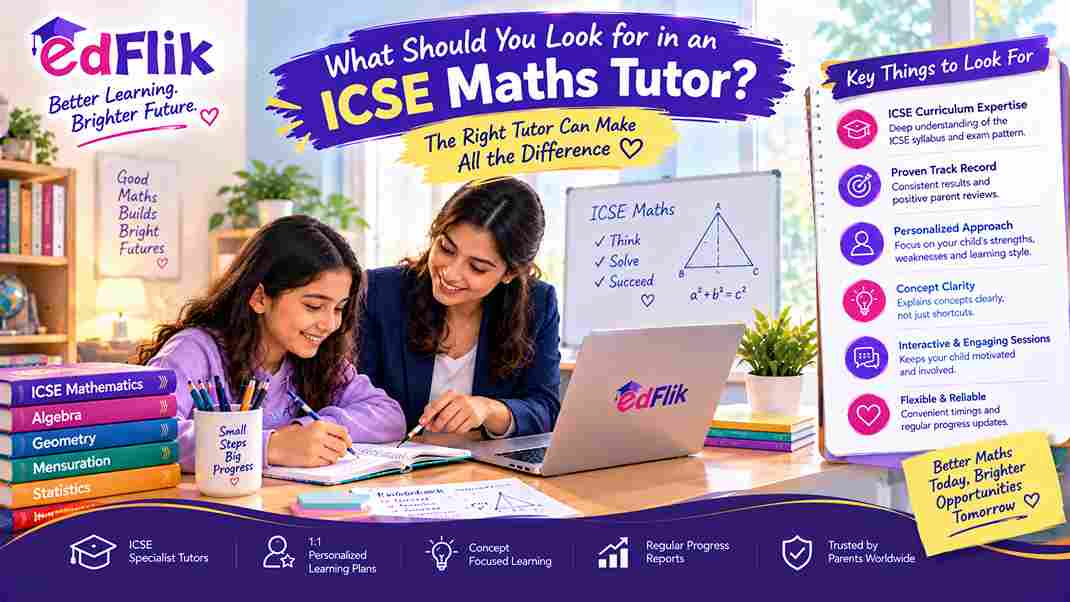
The ICSE curriculum has its own structure, terminology and assessment style, so the first thing to check is whether the tutor understands it. A tutor who is comfortable with ICSE will be able to explain how topics connect, which areas carry the most weight in exams and how questions are typically worded.
You do not need to take anyone's word for it. Ask the tutor to show how they follow the ICSE syllabus, perhaps by walking through a recent topic and explaining how they would prepare your child for it. Please also check the current official syllabus or specification from the board, because details can change over time.
Look for Teaching That Fits Your Child
Every child learns maths differently. Some students need to see a diagram before the numbers make sense. Others need to talk through their reasoning out loud, or work through a worked example step by step. A good tutor notices these differences and adapts.
Pay attention to how the tutor explains a concept. Do they check for understanding by asking your child to explain the method back to them? Do they use simple language, avoid rushing, and encourage questions? Maths confidence grows when a child feels safe to say, "I do not get this yet." That feeling is just as important as the content itself.
Why One-to-One Lessons Matter
Maths is cumulative. Each step builds on the one before it, which means a student's specific gaps matter more than a general group lesson can address. One-to-one teaching allows the tutor to see exactly where your child is getting stuck, whether that is fractions, indices, quadratic equations, geometry or trigonometry.
One-to-one lessons also give your child time to think. In a busy classroom, a student may be hesitant to ask the same question twice. In a private lesson, they can repeat, rephrase and practise until the idea clicks. Over several weeks, this steady attention often builds both skill and self-belief.
Check How Progress Is Reported
A tutor should be able to tell you, in plain language, what your child has covered and what is improving. Ask how progress will be shared and how often. Helpful reports usually include the topics covered, the areas of strength, the areas that still need practice and suggestions for home work.
At EdFlik, we share monthly progress reports, which helps parents follow the bigger picture without needing to chase updates every week. You can also ask your tutor for a quick topic checklist, short practice results or notes on how your child is responding in lessons.
Think About Consistency and Scheduling
Maths rewards regular practice more than occasional marathon sessions. Before you choose a tutor, think about the weekly rhythm that works for your family. Some students benefit from two sessions a week, especially when they are catching up on a topic, while others do well with one focused lesson and regular practice at home.
Ask how rescheduling works. Life in the UAE is busy, and sometimes a class needs to move. A clear, flexible process means your child does not lose momentum when plans change. At EdFlik, we aim to make rescheduling straightforward, so the focus stays on learning.
A Simple Checklist for Choosing an ICSE Maths Tutor
Use these steps to compare your options:
- Confirm syllabus knowledge. Ask the tutor to explain how they follow the ICSE syllabus for your child's year.
- Ask about teaching style. Look for a tutor who checks understanding and explains ideas in more than one way.
- Identify your child's main gaps. Note the two or three topics that cause the most frustration at home.
- Confirm the lesson format. Make sure the sessions are one-to-one and interactive.
- Agree on progress reporting. Decide how often you will receive updates and what they will include.
- Book a free trial. Use the first session to see how your child responds and whether the tutor communicates well.
- Review after a month. Look at your child's confidence, homework habits and any progress notes, then decide whether to continue.
What a Free Trial Should Show You
A free trial is your chance to see the tutor in action. Notice whether your child feels comfortable, whether the tutor listens carefully and whether the lesson covers a topic your child genuinely needs. You should also notice how the tutor handles mistakes. The best tutors treat errors as useful information rather than failures.
After the trial, talk with your child. Ask them what they found clear, what felt confusing and whether they would like another lesson. Their honest answer is one of the most useful signals you will get.
How EdFlik Can Help
At EdFlik, we offer live, one-to-one maths classes for children and teens aged 3 to 18, including ICSE maths support. Each class lasts about one hour, and prices start from AED 45 per class. We offer free trial classes so you can see the teaching style, lesson flow and communication before you commit.
To find out more or to book a free trial, visit www.edflik.com or email support@edflik.com. Our team will be glad to help you choose the right starting point for your child.
Conclusion
Choosing an ICSE maths tutor is about more than finding someone who knows the content. It is about finding a teacher who understands the syllabus, explains ideas clearly, tracks progress honestly and makes your child feel capable. Take your time, ask questions, and use a free trial to see how the lessons feel. With the right support, many students find that maths becomes less intimidating and far more rewarding.
Frequently Asked Questions
Does the tutor know the ICSE syllabus?
Ask the tutor to show how they follow the ICSE syllabus for your child's year. A good answer will explain how topics are sequenced and how exam questions are usually structured. You can also check the current official syllabus from the board to compare.
How many classes do families usually book each week?
This depends on your child's goals and schedule. Some families choose one weekly class for steady practice, while others book two sessions when catching up on a topic or preparing for exams. Your tutor can help you agree on a rhythm that feels manageable.
What does a free trial look like?
A free trial is a live, one-to-one lesson with a tutor. You can see how they explain topics, how your child responds and how the lesson is structured. It is a relaxed way to decide whether the tutor is a good fit before you commit.
How are reschedules handled?
Life can be busy, so rescheduling is part of most families' experience. Ask the tutor or our team how changes are arranged, and agree on a simple process at the start. A clear approach keeps your child's learning on track even when plans shift.
Which age groups are supported?
EdFlik supports children and teens aged 3 to 18 across many subjects. For ICSE maths, the right level and approach depend on your child's year and current needs, so it is worth discussing their goals before choosing a starting point.