Year 7 Tutor UAE 2026 — Secondary School Transition Guide for Dubai and Abu Dhabi Families
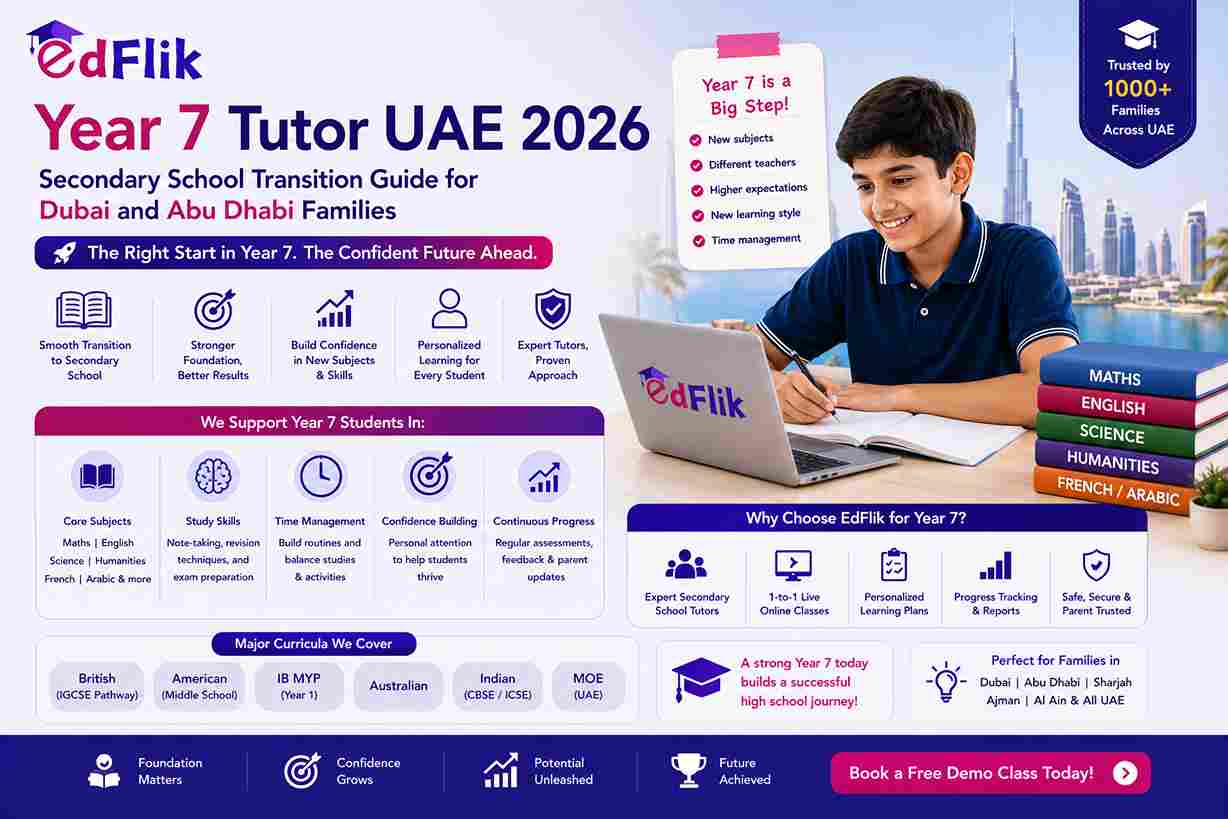
Year 7 is the academic transition point that catches more UAE families off guard than any other. Students who were high-achieving in Year 6 primary suddenly find themselves in a more demanding environment — specialist teachers, abstract Maths, analytical writing, and significantly more homework than KS2. This is not a sign of a struggling student; it is the normal difficulty spike of secondary school entry. Targeted tutoring in Year 7 prevents the confidence dip from becoming a grade pattern that is harder to reverse in Year 9-10.
What Changes Between Year 6 and Year 7 in UAE British Curriculum Schools
|
Area |
Year 6
(Primary — KS2) |
Year 7
(Secondary — KS3) |
Common
Tutoring Trigger |
|
Mathematics |
Arithmetic,
fractions, decimals, basic geometry — all with concrete examples |
Introduction
of algebraic variables, expressions, and equations; angles and geometric
proofs; data handling at a higher level |
Unable to work
with variables and unknowns; confused by expressions vs equations |
|
English |
Narrative and
descriptive writing; reading comprehension at KS2 level; structured sentences |
Analytical
essay writing; paragraph structure (Point-Evidence-Explanation); text
analysis of literature and non-fiction |
Writing still
narrative/descriptive when Year 7 expects analytical; paragraph structure not
established |
|
Science |
Integrated
science (plants, animals, materials, space) — broadly thematic |
Separate
Physics, Chemistry, Biology treated as distinct disciplines with their own
vocabulary and method |
No science
vocabulary for new disciplinary content; confusion about which subject
applies to which concept |
|
Learning
format |
One class
teacher for most subjects; homework familiar and structured |
One specialist
teacher per subject; homework varies by subject and teacher; more
self-directed research expected |
Time
management across multiple subjects; not knowing how to study independently |
|
Assessment |
KS2-style
assessment with teacher feedback; SAT-style testing |
Subject-specific
assessments, some with mark-scheme style scoring; mock exam format in some
subjects |
Unfamiliar
assessment format; not knowing what examiners are looking for in each subject |
Year 7 Maths — The Algebra Transition
The most consistent Year 7 tutoring trigger in UAE is the introduction of algebra. The shift from "25 + 12 = ?" (arithmetic with known values) to "3x + 7 = 22, find x" (abstract manipulation of unknown values) is a genuine cognitive shift that requires explicit bridging — not just more practice of Year 6 arithmetic.
EdFlik Year 7 Maths tutors specifically target this bridge: connecting the arithmetic operations students know to the algebraic representations they encounter for the first time. Effective Year 7 algebra tutoring:
• Uses visual models: Algebra tiles, balance diagrams, or number line representations make the concept of "variable" concrete before moving to purely symbolic manipulation
• Connects to arithmetic: "3x + 7 = 22" is "three groups of something, plus 7, equals 22 — what does each group contain?" connects to familiar thinking before introducing algebraic procedure
• Builds pattern from examples: Finding the value that makes an equation true by starting with specific numbers, then generalising
Year 7 English — The Analytical Writing Gap
Year 7 English in British curriculum UAE schools expects students to write analytical paragraphs — "Point, Evidence, Explanation" (PEE) or "Point, Evidence, Analysis, Link" (PEAL) structures — rather than the narrative and descriptive writing most primary students have practised extensively. UAE Year 7 students who write well creatively often struggle with the analytical format because:
• They try to tell a story rather than make an argument
• They describe what a text says rather than analyse what it means
• They write single long paragraphs rather than structured analytical paragraphs with a clear point
Tutoring Intensity at Year 7 — The Right Level
For most Year 7 UAE students, 1 session per week per struggling subject is the appropriate starting intensity. Overloading Year 7 with daily tutoring in multiple subjects creates anxiety and reduces the intrinsic motivation that secondary school needs to develop. The goal at Year 7 is: close the specific gaps, build the study skills, and develop the confidence that allows independent academic functioning. More is not always better at this age.
|
EdFlik
provides Year 7 tutoring for UAE students at British curriculum, IB, CBSE,
and American curriculum schools — matching tutors to the specific secondary
school and curriculum. Year 7 tutors are matched by school type and the
specific Year 7 content gap (algebra, analytical writing, science
vocabulary). From AED 55 per session. Free diagnostic. Book at www.edflik.com
or WhatsApp +91 88788 96600. |
Frequently Asked Questions
Q: Why do so many UAE students need tutoring support in Year 7?
The Year 6 to Year 7 transition involves simultaneous changes: specialist subject teachers, abstract algebra, analytical writing, more independent homework, and often a new school environment. Students who were strong in Year 6 frequently find Year 7 unexpectedly demanding.
Q: What subjects do Year 7 UAE students most often need tutoring for?
Mathematics (introduction of algebraic variables and expressions — the most common trigger), English (analytical essay writing vs narrative), Arabic (higher formal Arabic requirements), and Science (first encounter with Physics, Chemistry, Biology as separate disciplines).
Q: Is Year 7 tutoring different from primary school tutoring?
Fundamentally different — Year 7 requires subject-specific analytical demands, examination-style questions, and increasingly abstract content. Primary tutoring focuses on foundational skills. Tutors effective with KS1-2 are not automatically effective for Year 7.
Q: When should UAE parents start Year 7 tutoring?
At identified schools, start in September when first assessments appear. For students with known Year 6 foundation gaps, August/early September before Year 7 begins is significantly more effective — addressing gaps before they compound.
Q: Which UAE schools start IGCSE content in Year 9 or Year 7?
Most UAE British curriculum schools start IGCSE in Year 10. DC and some selective schools begin aspects of IGCSE content from Year 9. IB schools use MYP criteria from Grade 6. Confirm with your specific school when IGCSE-style assessment begins.