IGCSE Chemistry 0620: The Complete Tutoring Guide for Students in Dubai
The Challenge: Why IGCSE Chemistry Catches Students Off-Guard
Your child coasts through Year 8 and 9 science. Then IGCSE Chemistry starts and everything intensifies.
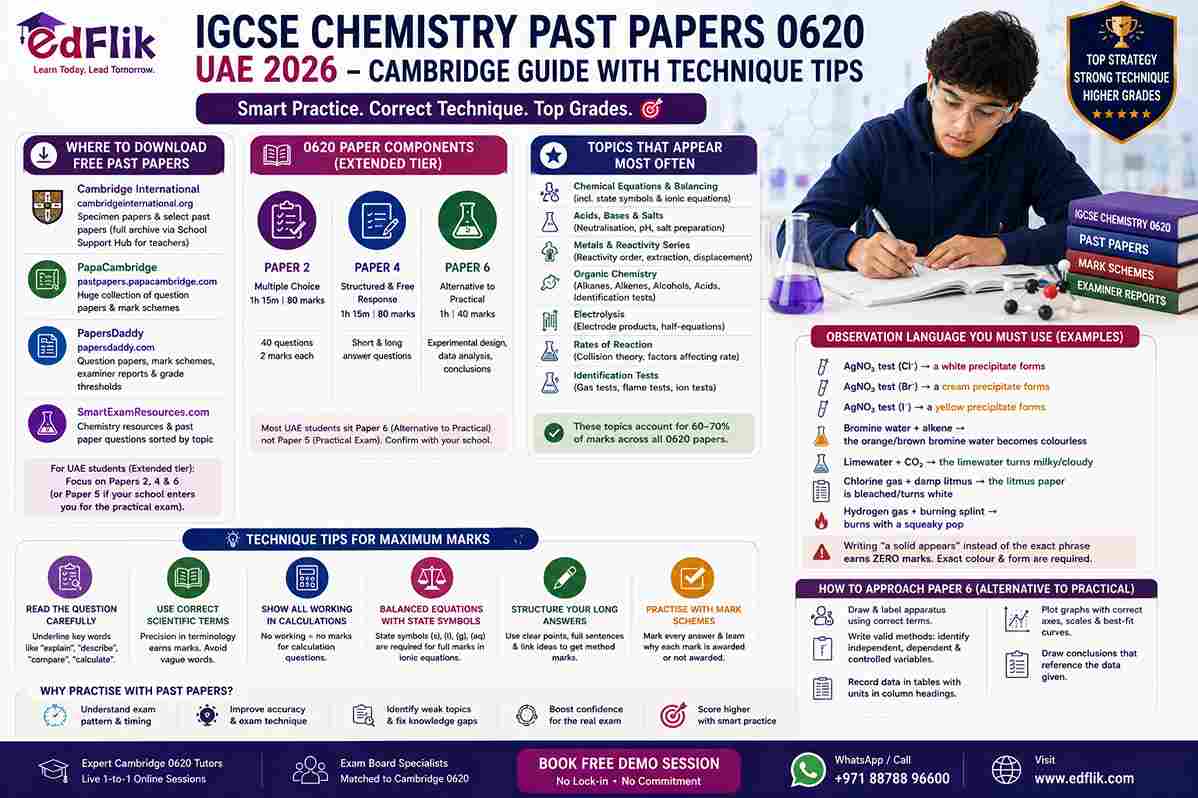
Suddenly there's Paper 1 (multiple choice), Paper 2 & 3 (theory), and most intimidating of all, **Paper 6 — the practical exam**. This isn't just solving problems on paper. Your child has to *perform an experiment under exam conditions*, collect data precisely, and interpret results correctly.
Add chemical calculations, understanding bonding at a molecular level, and memorising reaction types — and many parents watch their child's confidence crumble.
**The real issue?** Most tutors treat IGCSE Chemistry as a volume game — memorise more facts, solve more questions. They skip the *practical skills* that Paper 6 tests. They skip the conceptual depth that makes calculations intuitive.
EdFlik's approach is different.
What Makes an Effective IGCSE Chemistry Tutor
1. Paper 6 Practical Expertise
Paper 6 is worth 15% of the final grade — that's a full grade point. Yet many students get minimal practical training.
A good IGCSE Chemistry tutor doesn't just explain reactions — they guide your child through:
· **Experiment Design** — identifying variables, controls, fair testing
· **Data Collection** — measuring precisely, recording significant figures, repeated trials
· **Safety Protocols** — IGCSE is strict about lab safety procedures
· **Error Analysis** — calculating uncertainties and explaining anomalies
· **Result Interpretation** — drawing conclusions that match the data
EdFlik tutors have lab teaching experience. They've conducted experiments hundreds of times and know exactly where students slip up.
2. Chemical Calculations Mastery
This is where many students lose marks:
· Mole calculations (converting grams to moles)
· Stoichiometry (using balanced equations to predict quantities)
· Percentage yield (comparing actual vs. theoretical)
· Concentration calculations (mol/dm³ and g/dm³)
· Atom economy
Each of these topics requires a different calculation method. A student who doesn't understand the *method* just plugs numbers into formulas and prays.
EdFlik tutors build conceptual understanding first, then teach the calculation. This approach sticks.
3. Bonding Clarity
IGCSE bonding is conceptually dense:
· Ionic bonding (electron transfer)
· Covalent bonding (electron sharing)
· Metallic bonding
· Intermolecular forces (van der Waals, hydrogen bonding)
· How bonding type predicts physical properties (melting point, solubility, conductivity)
Many students memorise "ionic compounds have high melting points" without understanding *why*. When the exam asks them to predict a property of an unfamiliar compound, they're lost.
Good tutors use analogies, visuals, and examples to build deep understanding. By the end, your child can predict properties of any compound based on its bonding — not because they memorised a list, but because they understand the principle.
Book Your Free Trial Now
Stop dreading IGCSE Chemistry.
Book a free trial class with one of our IGCSE Chemistry 0620 specialists. WhatsApp **+91 88788 96600** or visit **www.edflik.com**
Most students see confidence return within 2–3 weeks of tutoring.
5 Tutoring Mistakes Dubai Parents Make (And How to Avoid Them)
Mistake 1: Skipping Practical Training
Parent books a tutor for "theory help." Mistake. Paper 6 is where students most need guidance, yet it gets ignored. Ensure your tutor includes practical lab training.
Mistake 2: Over-Relying on Memorisation
Handing your child a "Chemistry Facts" book and hoping they remember 100+ facts is a losing strategy. Tutors who build understanding beat tutors who push memorisation every time.
Mistake 3: Not Starting Early Enough
IGCSE Chemistry exams are in May/June. By March, it's too late to learn fundamentals. Smart families start tutoring in September or October so there's time to revisit and deepen.
Mistake 4: Ignoring Calculation Practice
Chemistry calculations scare many students because they seem arbitrary. Tutors who teach the *logic* behind calculations give students confidence. Tutors who just show worked examples leave students confused.
Mistake 5: Not Tracking Mock Exam Progress
You hire a tutor and assume they're helping. EdFlik tutors check in monthly with progress reports. Ask your tutor: "Can you show me how my child's mock scores are trending?" If they can't, they're not tracking properly.
Why EdFlik IGCSE Chemistry Tutors Get Results
Certified Teachers with 5+ Years IGCSE Experience
Every EdFlik chemistry tutor has taught IGCSE for 5+ years. They know the exact topics the Cambridge exam board favours. They know which calculations appear every year. They know which practicals are likeliest on Paper 6.
Complete Syllabus Coverage
We cover:
· Atomic structure & periodicity
· Chemical bonding & structure
· Stoichiometry & the mole
· Redox reactions
· Thermochemistry
· Rates of reaction & equilibrium
· Acids, bases & titrations
· Organic chemistry (limited scope, but thorough)
· Analytical chemistry (flame tests, gas tests, identifying compounds)
· Paper 6 practicals (designing, performing, analysing)
Calculation-Focused Tutoring
We break every calculation type into logical steps. Your child learns *why* the method works, not just how to apply it. By exam day, they've solved 50+ calculations and feel confident.
Monthly Progress Reports
Every month you'll receive:
· Topics covered and mastered
· Mock exam scores (if available)
· Weak areas needing focus
· Plan for next month
No guessing. You'll know exactly how your child is progressing.
Free Trial Guarantee
Not happy after a free trial? We'll match your child with a different tutor — no charge.
IGCSE Chemistry 0620 Curriculum
Core Content:
· Atomic structure (protons, neutrons, electrons, mass/atomic number)
· Bonding (ionic, covalent, metallic)
· Structure & Properties (how bonding predicts properties)
· Chemical Calculations (moles, stoichiometry, percentage yield)
· Rates of Reaction (concentration, temperature, catalysts)
· Equilibrium
· Acids & Bases
· Redox (oxidation states, balancing redox equations)
· Organic Chemistry (alkanes, alkenes, alcohols, carboxylic acids)
· Analytical Chemistry (identification tests)
· Thermochemistry (exothermic vs. endothermic)
Paper 6 Practicals (Approximately 6–8 Practicals Across These Topics):
· Titrations (volumetric analysis)
· Crystallisation
· Thermal decomposition
· Reactions with non-metals
· Preparation of salts
· Gas identification tests
· pH measurement
How It Works: 6 Steps to Chemistry Mastery
Step 1: Contact EdFlik
WhatsApp +91 88788 96600 or www.edflik.com. Tell us your child's current score (if available), weak areas, and exam date.
Step 2: Tutor Matching
Within 24 hours, we match a qualified IGCSE Chemistry specialist.
Step 3: Free Trial
Your child attends 1–2 free classes. Judge for yourself whether the tutor's teaching style clicks.
Step 4: Subscribe
Choose a package. Most families do 2–3 sessions per week (2–3 hours total).
Step 5: Regular Progress Tracking
Monthly reports show what's improving and where to focus next.
Step 6: Exam-Ready Preparation
By exam month, your child has solved dozens of past papers, understands the question format, and feels prepared.
What Students Say
*"Paper 6 scared me until my tutor walked me through a real experiment. By the exam, I'd done so many practicals that I felt confident. Scored 42/50 on Paper 6."*
— Aisha Al-Ketbi, Dubai
*"The mole concept finally clicked when my tutor explained it with analogies. Suddenly calculations made sense."*
— Omar Hassan, Sharjah
*"My tutor showed me that bonding explains *why* compounds behave the way they do. Changed how I think about chemistry."*
— Priya Nair, Ajman
FAQs:-
Q: When should tutoring start?
A: September/October for a May/June exam. This gives 6–8 months to cover the syllabus deeply and practise thoroughly.
Q: How much tutoring is needed?
A: 2–3 sessions per week (2–3 hours total) works for most students. Struggling students sometimes do 4 sessions; stronger students do 1–2.
Q: Is Paper 6 practicals really worth 15% of the grade?
A: Yes. 15% for Paper 6 (practical exam), 45% for Papers 2&3 (theory), 30% for Paper 1 (MCQ), 10% for coursework. Paper 6 is significant — don't ignore it.
Q: What if my child is weak at calculations?
A: Calculations are learnable. With focused tutoring, most students go from dreading calculations to solving them confidently. We recommend starting with calculation-focused sessions.
Q: Can we focus on just Paper 6?
A: Yes, though we recommend balanced tutoring (theory + practicals). But if your child's calculations are solid and they just need practical training, we can focus there.
Q: What's the cost?
A: Starting at 45 AED per hour. Most families invest 180–270 AED per week.
Q: How do I know if my child will pass?
A: With consistent tutoring starting 5+ months before the exam, passing is very likely. Most students improve by 1–2 grades.