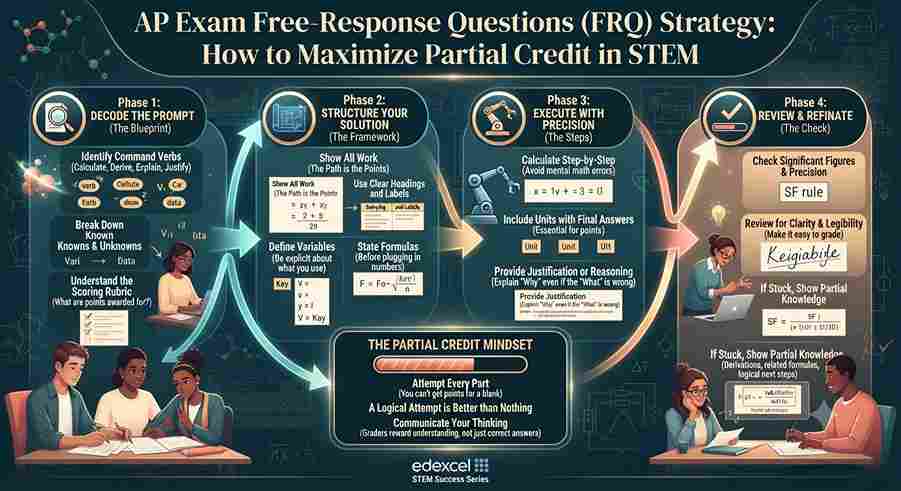
AP Exam Free-Response Questions (FRQ) Strategy: How to Maximize Partial Credit in STEM
Last Updated: October 2026 | By EdFlik Education Team
For high school students enrolled in rigorous Advanced Placement (AP) STEM courses—such as AP Calculus (AB/BC), AP Physics (1, 2, or C), AP Chemistry, and AP Statistics—the exam format is divided into two halves: multiple-choice questions (MCQs) and free-response questions (FRQs).
While MCQs test your speed and accuracy under tight time constraints, the FRQ section is where the score differentiation happens. Scoring a 4 or a 5 on an AP STEM exam requires more than just arriving at the correct final numerical answer. In fact, AP readers (graders) award points systematically across a rubric that prioritizes methodology, conceptual understanding, intermediate algebraic steps, and appropriate units.
Many capable students lose precious points simply because they treat an FRQ like a multiple-choice question, writing down only a naked number without showing their logical progression.
In this comprehensive, exam-focused masterclass guide, our expert AP educators break down the College Board grading mindset, reveal how partial credit works, and provide actionable frameworks to maximize every point on your next AP exam.
Part 1: Decoding the AP STEM Grader’s Mindset
When an AP reader opens your exam booklet or digital submission, they are not looking for reasons to dock points; they are actively hunting for reasons to award points.
AP grading rubrics (officially known as scoring guidelines) allocate points across distinct categories:
- Setting up the appropriate equation, principle, or physical law.
- Executing correct algebraic or mathematical substitutions.
- Carrying out intermediate calculations accurately.
- Stating the final numerical answer with correct significant figures and physical units.
If your final calculation is wrong because of a simple arithmetic error in line two, but your initial setup, physical principles, and substitution equations were pristine, you will still earn most of the available points! Conversely, writing a naked final answer with zero supporting work—even if it is numerically correct—will often earn a score of zero.
Part 2: Step-by-Step Framework for Tackling Any STEM FRQ
To consistently capture partial credit, adopt a rigorous, repeatable problem-solving routine for every FRQ part (a, b, c, etc.):
Step 1: Define Your Knowns and Unknowns
Before picking up your calculator, write down what the problem gives you using standard AP notation (e.g., $m = 2.5\text{ kg}$, $v_0 = 0\text{ m/s}$, $\theta = 30^\circ$). This signals to the reader that you understand the physical context and primes your brain for equation selection.
Step 2: State the General Formula First
Never start plugging numbers into a derived or rearranged formula immediately. Always state the fundamental, un-manipulated formula as it appears in the AP formula sheet or curriculum framework.
- Example in Physics: Write $F_{\text{net}} = ma$ or $\sum \tau = I\alpha$ before substituting values.
- Example in Calculus: State the integral or derivative formula before evaluating limits.
Step 3: Substitute Values with Units Included
Substitute your known values into the equation with their respective units. Keeping units intact through intermediate steps acts as an internal self-check—if your units do not cancel out correctly, you know an algebraic error has occurred.
Step 4: Box or Underline Your Final Answer
Make it effortless for the reader to locate your final answer. Include proper SI units (e.g., Joules, Newtons, meters per second, radians per second squared) and adhere to the AP standard of rounding final numerical answers to 3 significant figures.
Part 3: Subject-Specific Strategies for Maximizing Partial Credit
1. AP Calculus (AB and BC)
- Justify All Claims: When a question asks "Is the function increasing or decreasing at $x = 3$?", writing "Yes" or giving a number is worth zero points. You must state the mathematical justification: "Since $f'(3) = 2 > 0$, the function is increasing because its first derivative is positive."
- Show Indeterminate Forms for L'Hôpital's Rule: If you use L'Hôpital's Rule to evaluate a limit yielding $\frac{0}{0}$ or $\frac{\infty}{\infty}$, you must explicitly state that the limit results in an indeterminate form before taking the derivative of the numerator and denominator. Omitting this statement forfeits the point.
2. AP Physics (1, 2, C)
- Derivation Questions Are Algebraic: When an FRQ asks you to derive an expression for terminal velocity or angular frequency using only given variables ($m, g, R$), do not substitute any numbers. Using numbers on a derivation question results in an automatic score of zero for that part.
- Justify Physics Explanations Using First Principles: When answering qualitative paragraph-length response questions, reference fundamental laws (e.g., Conservation of Energy, Newton's Second Law) rather than vague conversational descriptions.
3. AP Chemistry
- Show Equilibrium ICE Tables: For equilibrium and thermodynamics calculations, always set up a clear Initial, Change, Equilibrium (ICE) table. Even if your final equilibrium concentrations contain an arithmetic slip, the reader awards credit for correct table setup and $K_c$ expression formulation.
- Explain Particle-Level Behavior: In particulate representations or justification questions, explicitly reference intermolecular forces, kinetic molecular theory, or collision frequency rather than macroscopic observations.
Part 4: Top 4 Traps That Cost AP Students Valuable Points
- Leaving Out Units: Forgetting to write units ($\text{m/s}^2$, $\text{mol/L}$, $\text{rad/s}$) on final answers. While AP occasionally forgives missing units on one or two parts, habitual omission loses easy points.
- Carrying Rounding Errors Forward: Rounding intermediate calculations to 2 decimal places too early in a multi-part FRQ (e.g., using part (a)'s rounded answer in part (b) and (c)). Always store full calculator precision or carry at least 4 decimal places until the final step.
- Answering "Explain" Prompts with Math Only: Writing down an equation or number when the prompt explicitly asks to "Describe" or "Explain". Math equations alone do not constitute a prose explanation unless requested.
- Leaving Blanks Out of Panic: Never leave an FRQ section entirely blank. Write down relevant formulas, definitions, or sketched diagrams related to the prompt. Often, a well-stated fundamental principle will earn 1 out of 2 possible points even if you cannot finish the algebra.
Preparing for AP exams and striving for top scores of 4 or 5? EdFlik connects international school students globally with expert, 1-to-1 online AP tutors across Calculus, Physics, Chemistry, and Statistics, helping you master FRQ rubrics, complex problem-solving, and exam technique.Book a Free Demo Class Today!
Frequently Asked Questions (FAQs)
Q1: How strict are AP graders on minor arithmetic errors?
Ans: AP graders are very forgiving of minor arithmetic mistakes (like adding $2 + 3 = 6$) provided your conceptual setup and algebraic methodology are completely correct. You will lose only the specific calculation point while retaining full credit for setup and substitution.
Q2: Can I use calculator shortcuts (like numerical solvers or graphing integrals) on AP Calculus FRQs?
Ans: Yes, approved graphing calculators (like TI-Nspire or TI-84) can be used to evaluate definite integrals, derivatives at a point, or find intersections. However, you must still write down the mathematical setup (e.g., $\int_{0}^{5} f(x) dx$) in your booklet before stating the calculator's decimal output.
Q3: What should I do if I get stuck on part (a) of an FRQ but know how to do part (b)?
Ans: Many AP FRQs are designed with independent or "carry-through" parts. If you cannot solve part (a), invent a reasonable placeholder value or state an assumption (e.g., "Assuming $v = 12\text{ m/s}$ for subsequent calculations...") and use it to successfully solve part (b) and (c). AP graders will award full follow-through credit!
Q4: How does EdFlik support AP STEM students?
Ans: EdFlik connects international school students worldwide with vetted, expert 1-to-1 online AP tutors specializing in College Board curricula. Our personalized sessions focus on dissecting past FRQ rubrics, mastering challenging conceptual topics, and building exam-day time management.