Mastering ICE Tables and Le Chatelier’s Principle in AP Chemistry Free-Response Sections
Last Updated: October 2026 | By EdFlik Education Team
For high school students enrolled in Advanced Placement (AP) Chemistry, conquering chemical equilibrium represents one of the ultimate academic milestones. Whether you are tackling gas-phase pressures ($K_p$), molar concentrations ($K_c$), weak acid-base buffer systems, or solubility product constants ($K_{sp}$), equilibrium concepts appear on virtually every AP Chemistry exam—with the heaviest concentration of points sitting squarely in the Free-Response Question (FRQ) section.
Every May, AP Chemistry readers (graders) award points systematically across rubrics that prioritize rigorous Initial, Change, Equilibrium (ICE) table setups, correct equilibrium expression formulations, stoichiometric mole-ratio applications, and qualitative Le Chatelier’s principle explanations.
Many capable students lose easy points not because they don't understand chemistry, but because they set up ICE tables using grams instead of molarities, miscalculate stoichiometric shifts, or write incomplete qualitative justifications for stress-induced equilibrium shifts.
In this comprehensive, exam-focused masterclass guide, our expert AP chemistry educators break down the mechanics of ICE tables, demystify Le Chatelier’s principle, and provide structured problem-solving frameworks to help you secure a top score of 5.
Part 1: The Foundation — Setting Up and Executing ICE Tables
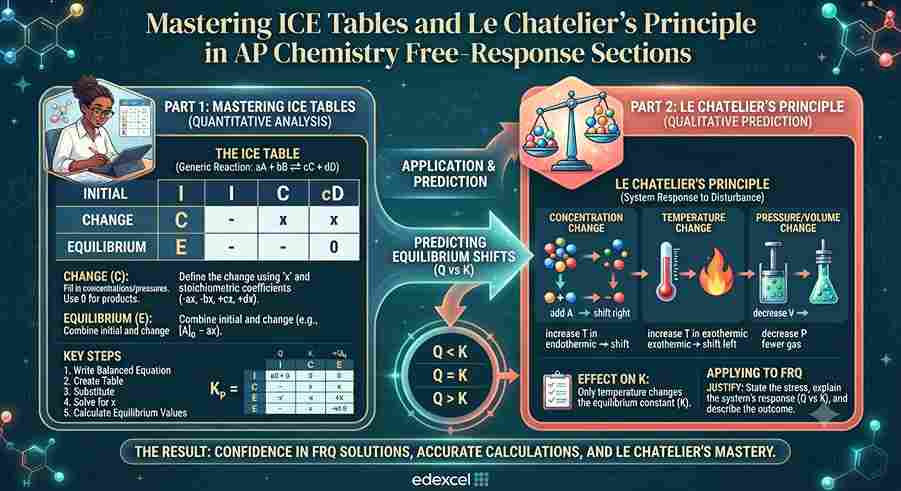
An ICE table (Initial, Change, Equilibrium) is your systematic organizational tool for tracking how a chemical reaction proceeds from its starting conditions to the final state of dynamic equilibrium.
The Golden Rules of ICE Table Construction:
- Always Use Molarity ($M$) or Pressure ($atm$): Never put grams, milliliters, or total moles directly into an equilibrium constant expression ($K_c$ or $K_p$). If given grams or moles in a volume $V$, immediately convert values to molar concentration ($M = \frac{\text{moles}}{\text{liters}}$) before entering them into the "Initial" row.
- Understand the "Change" Row Stoichiometry: The change row must strictly respect the stoichiometric coefficients of the balanced chemical equation. If a reactant decreases by $-x$, a reactant with coefficient $2$ decreases by $-2x$, and a product with coefficient $3$ increases by $+3x$.
- The Equilibrium Row Formulation: The equilibrium row is always the sum of Initial and Change ($E = I + C$, keeping negative signs in mind). These are the exact numerical values or expressions you plug into your $K_c$ expression.
Part 2: Step-by-Step Problem-Solving Framework for $K_c$ and $K_{sp}$ Calculations
When faced with a complex equilibrium calculation on an FRQ (such as calculating equilibrium concentrations or determining the value of $K_c$), follow this four-step workflow:
Step 1: Write the Balanced Chemical Equation and the $K_c$ Expression
Always start by writing the balanced equation, followed immediately by the equilibrium constant expression.
- Example: For $N_2(g) + 3H_2(g) \rightleftharpoons 2NH_3(g)$$$K_c = \frac{[NH_3]^2}{[N_2][H_2]^3}$$(Note: Pure solids ($s$) and pure liquids ($l$) are excluded from equilibrium expressions because their effective concentrations remain constant).
Step 2: Construct and Populate the ICE Table
Set up your table clearly with columns for every species in the balanced equation:
| Equation | N2(g) | + | 3H2(g) | ⇌ | 2NH3(g) |
| Initial (I) | $0.100 M$ | $0.200 M$ | $0.000 M$ | ||
| Change (C) | $-x$ | $-3x$ | $+2x$ | ||
| Equilibrium (E) | $0.100 - x$ | $0.200 - 3x$ | $2x$ |
Step 3: Solve for $x$ (Using Given Equilibrium Concentrations or the $5\%$ Approximation)
If you are given one equilibrium concentration (e.g., $[NH_3]_{eq} = 0.040 M$), you can solve for $x$ immediately ($2x = 0.040 \implies x = 0.020$). If you are solving for $x$ using $K_c$ and the quadratic formula, check whether $K$ is very small ($K < 10^{-4}$), allowing you to use the 5% approximation (neglecting $x$ when subtracted from an initial concentration, e.g., $0.100 - x \approx 0.100$) to simplify algebra.
Step 4: Calculate Final Values and Include Units
Substitute your solved value of $x$ back into the equilibrium row expressions, compute final concentrations, and remember that equilibrium constants are technically unitless on the AP exam, though verifying individual concentrations with correct units ($M$ or $atm$) is essential.
Part 3: Mastering Le Chatelier’s Principle Qualitative FRQs
Le Chatelier’s principle states that if a stress (such as a change in concentration, pressure, volume, or temperature) is applied to a system at equilibrium, the system shifts in a direction that relieves or counteracts that stress.
AP Chemistry FRQs frequently test your ability to explain why a system shifts using precise molecular reasoning:
1. Changes in Concentration
- Adding a reactant shifts the equilibrium to the right (toward products) to consume the excess reactant.
- Removing a product shifts the equilibrium to the right to replace what was lost.
2. Changes in Pressure and Volume (For Gas-Phase Systems)
- Decreasing container volume (increasing pressure) shifts the equilibrium toward the side of the reaction with the fewer moles of gas to reduce total pressure.
- Trap to Avoid: If a reaction has an equal number of moles of gas on both sides (e.g., $H_2(g) + Cl_2(g) \rightleftharpoons 2HCl(g)$), changing volume or pressure has zero effect on the equilibrium position.
3. Changes in Temperature (The Only Stress That Alters $K$)
Unlike concentration or pressure changes (which shift equilibrium position without changing the numerical value of $K$), temperature changes alter the equilibrium constant ($K$) itself.
- Treat heat as a reactant in endothermic reactions ($\Delta H > 0$) or as a product in exothermic reactions ($\Delta H < 0$).
- Example (Exothermic): $A + B \rightleftharpoons C + \text{Heat}$ ($\Delta H = -92\text{ kJ/mol}$). Increasing temperature adds heat (product), causing the equilibrium to shift to the left, which causes the equilibrium constant $K$ to decrease.
Part 4: Top 4 Traps That Cost AP Chemistry Points
- Forgetting to Include Stoichiometric Coefficients in the Change Row: Failing to multiply $x$ by the coefficient in the balanced equation (e.g., writing $-x$ instead of $-3x$ for $3H_2$), which ruins the mole ratio and guarantees an incorrect equilibrium expression.
- Confusing Reaction Quotient ($Q$) with Equilibrium Constant ($K$): Failing to calculate $Q$ using initial concentrations when a problem asks whether a system is at equilibrium or which direction it will shift. Remember: Compare $Q$ to $K$. If $Q < K$, shifts right; if $Q > K$, shifts left.
- Vague Le Chatelier Explanations: Writing conversational answers like "The reaction shifts right because it wants to balance out." AP readers require rigorous scientific justification citing rates, collisions, partial pressures, or stress alleviation.
- Using Grams Instead of Moles in ICE Tables: Entering mass values directly into an ICE table without dividing by molar mass and dividing by volume in liters to obtain molarity ($M$).
Preparing for AP Chemistry exams and aiming for a score of 5? EdFlik connects international school students globally with expert, 1-to-1 online AP chemistry tutors, helping you master ICE tables, Le Chatelier’s principle, buffer calculations, and rigorous past-paper FRQ problem-solving. Book a Free Demo Class Today!
Frequently Asked Questions (FAQs)
Q1: When is it mathematically valid to use the 5% approximation in an ICE table?
Ans: You can use the 5% approximation (ignoring $-x$ or $+x$ when added/subtracted from an initial concentration) when the equilibrium constant $K$ is very small (typically $K < 10^{-4}$). To earn full credit on the AP exam, always verify your assumption at the end by confirming that $x$ is less than 5% of the initial concentration.
Q2: Do catalysts affect the position of chemical equilibrium?
Ans: No! Catalysts (such as enzymes or transition metal surfaces) speed up both the forward and reverse reactions equally by lowering activation energy. They allow the system to reach equilibrium faster, but they have zero effect on the equilibrium position or the value of $K$.
Q3: Why are pure solids and liquids omitted from $K_c$ expressions?
Ans: Because their effective concentrations (moles per liter of pure substance) remain constant throughout the reaction. Their activity is defined as 1, so they do not appear in the mass action expression.
Q4: How does EdFlik support AP Chemistry students?
Ans: EdFlik connects international school students worldwide with vetted, expert 1-to-1 online AP tutors specializing in College Board curricula. Our personalized coaching focuses on dissecting past FRQ rubrics, mastering complex chemical calculations, and building exam-day confidence.