How to Maximize Partial Credit on AP Calculus Free-Response Questions (FRQs)
Last Updated: October 2026 | By EdFlik Education Team
For high school students enrolled in Advanced Placement (AP) Calculus AB or BC, the exam represents the culmination of a rigorous year of mathematical study. While multiple-choice questions test your speed and computational agility, the Free-Response Question (FRQ) section is where university-level credit is truly won or lost.
Every May, thousands of capable students walk out of the AP Calculus exam feeling confident because they "got an answer," only to receive a disappointing 3 or 4 in July. Why? Because AP Calculus FRQs are not graded on your final numerical answer alone; they are graded on your mathematical methodology, communication precision, justification logic, and intermediate steps.
In this comprehensive, exam-focused masterclass guide, our expert AP mathematics educators break down the AP Calculus reader grading guidelines, reveal how partial credit is distributed, and provide a tactical framework to maximize every point on your next exam.
Part 1: Decoding the AP Calculus Reader’s Scoring Mindset
When AP readers gather at the annual scoring reading to grade hundreds of thousands of student booklets, they follow strict, standardized scoring rubrics provided by the College Board.
The Core Grading Reality:
- Methodology Trumps Arithmetic: If you make a minor arithmetic slip in part (a) (e.g., writing $2 \times 3 = 5$), but your calculus setup, differentiation rules, and integration limits are entirely correct, you will lose at most one point for the arithmetic error. All subsequent steps that use that number will receive full follow-through credit.
- Naked Numbers Earn Zero: Writing down a final decimal answer (e.g.,
4.826) with zero supporting calculus work, integral setups, or derivative expressions earns 0 out of 9 points, even if the number is correct to three decimal places. - The Point Breakdown: Each FRQ is worth 9 points, typically broken down across parts (a), (b), (c), and (d) (e.g., 3 points, 3 points, 2 points, 1 point). Each part awards independent points for specific mathematical milestones: setting up an expression, taking a derivative/integral, evaluating limits, and stating a proper justification.
Part 2: Step-by-Step Framework for Tackling Any Calculus FRQ
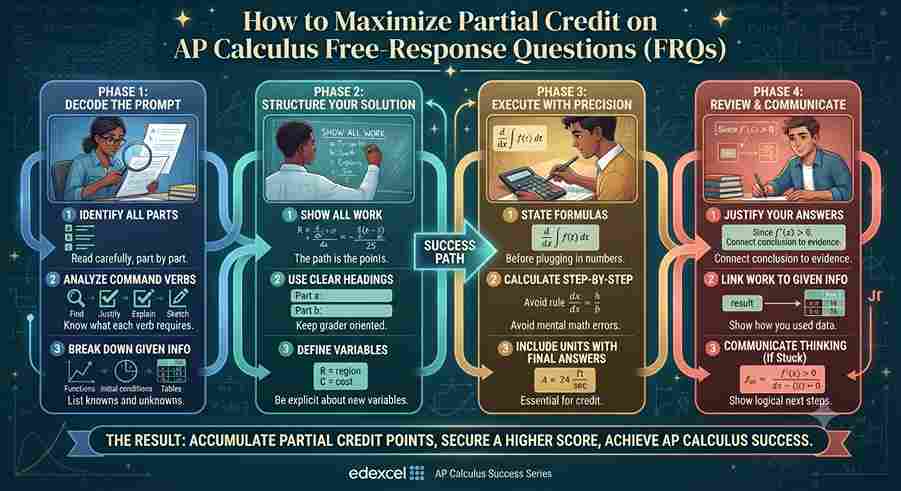
To consistently harvest partial credit and secure a 5, adopt a disciplined approach for every single FRQ part:
Step 1: State the Calculus Operator Explicitly
Never jump straight from a word problem into a numerical computation. Write out the formal calculus operator first:
- If finding a rate of change, write $\frac{dh}{dt}\Big\vert{}_{t=4}$ or $f'(4)$.
- If finding accumulated area or total displacement, write $\int_{0}^{10} v(t) dt$.
- If evaluating a limit, write $\lim_{x \to 2} f(x)$.
Step 2: Show Un-simplified Substitutions
When substituting values into a derivative or integral, write the expression out with numbers plugged in before letting your graphing calculator evaluate it.
- Example: Write $\int_{2}^{5} (3t^2 - 4t) dt$ rather than just typing it into a TI-Nspire and writing down
36. If your calculator syntax causes a typo, showing the un-evaluated integral guarantees you the setup point!
Step 3: Adhere to AP Rounding and Unit Rules
- Rounding: Unless specified otherwise, all non-integer numerical answers must be rounded correctly to three decimal places (or truncated to three decimal places). Do not round intermediate steps! Carry full calculator precision through your working, and only round the final answer.
- Units: Whenever a word problem assigns physical units (e.g., liters per hour, meters per second squared, dollars), include appropriate units in your final answer if requested.
Part 4: Mastering the Big Four Justification Prompts
Calculus FRQs frequently ask qualitative questions that require written justifications. Failing to follow precise phrasing rules results in an automatic deduction.
1. Increasing / Decreasing Functions
- The Prompt: "Is the function increasing or decreasing at $t = 3$?"
- The Mandatory Justification: You must state the sign of the first derivative.
- Exemplar Response: "The function is increasing at $t = 3$ because $f'(3) = 4.2 > 0$." (Simply writing "Yes" or giving the number 4.2 earns zero points).
2. Relative Extrema (Local Max / Min)
- The Prompt: "Does $g(x)$ have a relative maximum, minimum, or neither at $x = 5$?"
- The Mandatory Justification: You must state both that the first derivative equals zero (or undefined) and that the derivative changes sign.
- Exemplar Response: "Relative maximum at $x = 5$ because $g'(5) = 0$ and $g'(x)$ changes from positive to negative at $x = 5$."
3. Concavity and Points of Inflection
- The Prompt: "Find all intervals where $h(x)$ is concave up."
- The Mandatory Justification: You must reference the second derivative.
- Exemplar Response: "The graph of $h(x)$ is concave up on $(2, 6)$ because $h''(x) > 0$ for all $x$ in that interval." For an inflection point, you must explicitly state that $h''(x)$ changes sign.
4. Mean Value Theorem (MVT) or Rolle’s Theorem
- The Prompt: "Show that there must be a value $c$ such that $f'(c) = 3$."
- The Mandatory Justification: You must explicitly verify hypotheses before applying the theorem.
- Exemplar Response: "Since $f(x)$ is continuous on $[0, 5]$ and differentiable on $(0, 5)$, we can apply the Mean Value Theorem. By MVT, $\frac{f(5) - f(0)}{5 - 0} = \frac{18 - 3}{5} = 3$. Therefore, by MVT, there exists at least one value $c$ in $(0, 5)$ where $f'(c) = 3$."
Part 5: Top 4 Traps That Cost AP Calculus Points
- Omitting Indeterminate Forms for L'Hôpital's Rule: Using L'Hôpital's Rule on a limit without explicitly writing down that the limit yields $\frac{0}{0}$ or $\frac{\infty}{\infty}$. Readers will deduct points for unauthorized rule usage.
- Dropping Constant of Integration ($+C$) in Indefinite Integrals: Forgetting the $+C$ on indefinite integration problems in differential equations (Separation of Variables questions). This single omission costs you the entire integration point!
- Mixing Up Absolute Extrema on Closed Intervals: Failing to check endpoints when asked to find absolute maximum or minimum values on a closed interval $[a, b]$. You must test critical numbers and both boundary endpoints.
- Leaving Calculator Settings in Degree Mode: Performing calculus operations (like derivatives of trig functions or integrals of sinusoidal models) while your calculator is in Degree mode instead of Radian mode. Always double-check your mode before starting Exam Part A!
Preparing for AP Calculus AB/BC exams and aiming for a score of 5? EdFlik connects international school students globally with expert, 1-to-1 online AP calculus tutors, helping you master FRQ rubrics, conquer differential equations, and build elite exam-taking confidence. Book a Free Demo Class Today!
Frequently Asked Questions (FAQs)
Q1: What graphing calculators are permitted on AP Calculus FRQs?
Ans: Approved graphing calculators—such as the TI-Nspire CX II (Non-CAS), TI-84 Plus CE, and Casio fx-CG50—are permitted on Calculator-Active FRQ sections (Questions 1 and 2). CAS calculators (Computer Algebra Systems that solve equations symbolically) are strictly prohibited.
Q2: Can I use calculator decimal outputs directly without showing intermediate algebra?
Ans: You can use calculator numerical solvers for definite integrals, derivatives at a point, or finding curve intersections. However, you must write down the mathematical setup (e.g., $\frac{1}{b-a} \int_{a}^{b} f(x) dx$) in your booklet before stating the calculator's decimal output.
Q3: How are follow-through points awarded if I make a mistake in part (a)?
Ans: AP readers use "error carried forward" (ECF) principles. If your answer to part (a) was incorrect due to a minor arithmetic error, but you correctly substitute that incorrect value into the formula required for part (b), you will receive full credit for part (b)'s methodology.
Q4: How does EdFlik support AP Calculus students?
Ans: EdFlik connects international school students worldwide with vetted, expert 1-to-1 online AP tutors specializing in College Board curricula. Our personalized coaching focuses on dissecting past FRQ rubrics, mastering complex calculus concepts, and practicing under timed exam conditions.