Approximating Binomial and Poisson Distributions with Normal Continuity Corrections in Edexcel IAL S2
By EdFlik Team | November 19, 2026
For Key Stage 5 students across Dubai, Abu Dhabi, Sharjah, and the Northern Emirates studying Pearson Edexcel International A-Level (IAL) Mathematics, the Statistics 2 (WST02 / S2) unit represents a pivotal step up from S1. Unlike Statistics 1, which focuses heavily on descriptive statistics and elementary probability, S2 introduces continuous random variables, hypothesis testing, and distributional approximations.
Among the most frequently tested—and most frequently penalized—skills in Edexcel IAL S2 is approximating discrete distributions (Binomial and Poisson) using a Continuous Normal Distribution, paired with the mandatory $\pm 0.5$ continuity correction.
When the number of trials ($n$) in a Binomial distribution becomes too large for statistical tables, or when the mean rate ($\lambda$) in a Poisson distribution exceeds the limits of the Edexcel Formula Booklet (typically $\lambda > 15$), calculating exact cumulative probabilities manually becomes computationally impractical.
However, dropping a simple $+0.5$ or $-0.5$ adjustment, failing to verify the mathematical validity conditions, or misreading strict versus inclusive inequality signs ($<$ vs. $\le$) routinely costs UAE students easy method and accuracy marks on exam day.
This comprehensive masterclass guide breaks down the exact conditions for Normal approximations in Edexcel IAL S2, provides a step-by-step continuity correction cheat sheet, walks through full exam-style worked examples, exposes common mark-scheme traps, and includes 100% copy-paste JSON-LD schema markup.
Key Takeaways
- Verify Validity Conditions First: Always state the mathematical conditions justifying a Normal approximation before calculating parameters—specifically $n$ large and $p$ close to $0.5$ for Binomial, and $\lambda$ large (typically $\lambda > 10$ or $\lambda > 15$) for Poisson.
- Discrete to Continuous Requires $\pm 0.5$: Because Binomial and Poisson distributions model discrete integers while the Normal distribution models continuous intervals, you must expand or contract boundary values by $0.5$ to capture the full probability bar.
- Inequality Signs Dictate Direction: Strict inequalities ($X < 10$ or $X > 10$) exclude the integer $10$, whereas inclusive inequalities ($X \le 10$ or $X \ge 10$) include the integer $10$. Getting this wrong shifts the $z$-score and invalidates the final probability.
- Exact Point Probabilities Become Intervals: Under a continuous Normal model, $P(X = k)$ is zero unless converted into the continuous interval $P(k - 0.5 < Y < k + 0.5)$.
Part 1: Why Continuity Corrections Are Mandatory in Edexcel IAL S2
A discrete random variable $X$ (such as the number of defective microchips in a batch or the number of calls arriving at a Dubai service center per hour) can only take exact integer values: $0, 1, 2, 3, \dots$
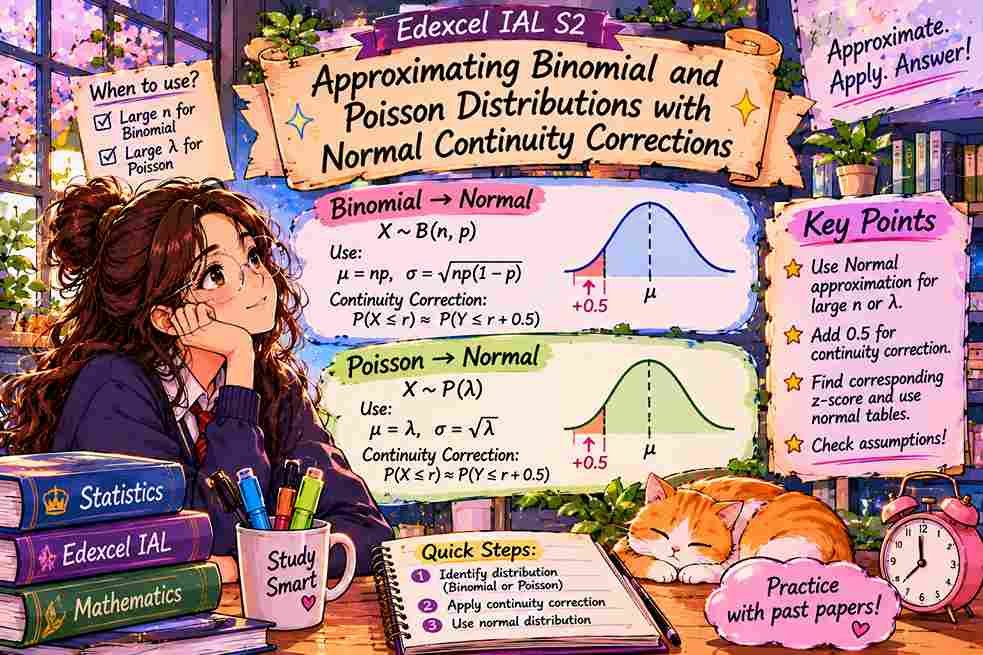
When represented visually on a histogram, each integer $k$ occupies a rectangular bar spanning from $k - 0.5$ to $k + 0.5$ with width $1$. When we approximate this discrete histogram using a smooth, continuous Normal bell curve $Y \sim N(\mu, \sigma^2)$, failing to adjust the boundary by $0.5$ slices straight down the middle of the integer bar—accidentally cutting off half of its probability area.
As shown in the visual above, aligning the continuous Normal curve with the discrete bars requires shifting every integer boundary by $0.5$ so that the shaded area under the curve matches the entire width of the intended discrete bars.
Part 2: Exact Conditions & Parameter Conversions in Edexcel S2
Before applying any approximation in an Edexcel WST02 exam paper, you must check that the approximation is statistically valid and convert the discrete parameters into Normal mean ($\mu$) and variance ($\sigma^2$).
              EDEXCEL IAL S2 NORMAL APPROXIMATION WORKFLOW
                                   |
  +--------------------------------+--------------------------------+
  |                                                                 |
1. BINOMIAL TO NORMAL                                      2. POISSON TO NORMAL
  • Original: X ~ B(n, p)                                    • Original: X ~ Po(λ)
  • Conditions: n is large & p is close to 0.5               • Condition: λ is large (λ > 10 or λ > 15)
    (Rule of thumb: np > 5 and n(1 - p) > 5)                 • Normal Model: Y ~ N(μ, σ²)
  • Normal Model: Y ~ N(μ, σ²)                               • Mean: μ = λ
  • Mean: μ = np                                             • Variance: σ² = λ
  • Variance: σ² = np(1 - p)                                 • Standard Deviation: σ = √λ
Examiner Tip on Variance vs. Standard Deviation:
In Edexcel IAL S2 mark schemes, writing $Y \sim N(40, 24)$ means $\mu = 40$ and variance $\sigma^2 = 24$. When standardizing into a $z$-score, students must divide by the standard deviation $\sigma = \sqrt{24}$, not $24$:
$$Z = \frac{Y - \mu}{\sigma}$$
Part 3: The Ultimate Continuity Correction Cheat Sheet
To eliminate sign errors under exam pressure, always rewrite strict inequalities ($<$ or $>$) as inclusive inequalities ($\le$ or $\ge$) first. Once written inclusively, apply the $\pm 0.5$ rule to include the boundary integer.
| Discrete Probability Statement (X) | Rewrite Inclusively | Continuous Normal Equivalent (Y) | Visual Logic |
| $P(X = k)$ | $P(k \le X \le k)$ | $P(k - 0.5 < Y < k + 0.5)$ | Captures the entire bar centered at $k$. |
| $P(X \le k)$ | $P(X \le k)$ | $P(Y < k + 0.5)$ | Extends past $k$ to include the full $k$ bar. |
| $P(X < k)$ | $P(X \le k - 1)$ | $P(Y < k - 0.5)$ | Stops before $k$, capturing up to $k - 1$. |
| $P(X \ge k)$ | $P(X \ge k)$ | $P(Y > k - 0.5)$ | Starts before $k$ to include the full $k$ bar. |
| $P(X > k)$ | $P(X \ge k + 1)$ | $P(Y > k + 0.5)$ | Starts after $k$, capturing from $k + 1$ onward. |
| $P(a \le X \le b)$ | $P(a \le X \le b)$ | $P(a - 0.5 < Y < b + 0.5)$ | Includes both boundary bars $a$ and $b$. |
| $P(a < X < b)$ | $P(a + 1 \le X \le b - 1)$ | $P(a + 0.5 < Y < b - 0.5)$ | Excludes both boundary bars $a$ and $b$. |
Part 4: Edexcel IAL S2 Worked Exam Examples
Worked Example 1: Binomial to Normal Approximation
Question: A manufacturing plant in Jebel Ali produces solar sensor components, and historical data shows that $40\%$ of components pass an advanced stress test on the first run. A quality control engineer selects a random sample of $n = 150$ components. Using a suitable Normal approximation, find the probability that fewer than $55$ components pass the test on the first run.
Step-by-Step Solution:
- Define the Discrete Random Variable & Validity: Let $X$ be the number of components passing the test out of $150$.$$X \sim B(150, 0.40)$$Since $n = 150$ is large and $p = 0.40$ is reasonably close to $0.5$ ($np = 60 > 5$ and $n(1-p) = 90 > 5$), a Normal approximation is valid.
- Calculate Normal Parameters ($\mu$ and $\sigma^2$):$$\mu = np = 150 \times 0.40 = 60$$$$\sigma^2 = np(1 - p) = 150 \times 0.40 \times 0.60 = 36$$$$\sigma = \sqrt{36} = 6$$Thus, $Y \sim N(60, 6^2)$.
- Apply the Continuity Correction: We require $P(X < 55)$. Because $X$ is discrete, "fewer than $55$" means $P(X \le 54)$. To include the bar for $54$ while excluding $55$, the continuous upper bound is $54.5$:$$P(X < 55) \approx P(Y < 54.5)$$
- Standardize and Lookup in Edexcel Formula Booklet:$$Z = \frac{54.5 - 60}{6} = \frac{-5.5}{6} \approx -0.9167$$Using standard Normal tables (or ClassWiz calculator mode):$$P(Z < -0.92) = 1 - P(Z < 0.92) = 1 - 0.8212 = 0.1788$$(Using exact unrounded $z = -0.9167$ on a calculator gives $0.1797$—Edexcel mark schemes accept values rounding to $0.179$ or $0.180$).
Worked Example 2: Poisson to Normal Approximation
Question: Customer support inquiries arrive at an online portal in Abu Dhabi at an average rate of $4.5$ inquiries every $15$ minutes. Using a Normal approximation, estimate the probability that at least $35$ inquiries arrive during a $2$-hour period.
Step-by-Step Solution:
- Adjust the Rate ($\lambda$) to the New Time Interval: A $2$-hour period contains eight $15$-minute intervals:$$\lambda = 4.5 \times 8 = 36$$Let $X$ be the number of inquiries in $2$ hours, so $X \sim Po(36)$. Since $\lambda = 36$ is large ($\lambda > 15$), a Normal approximation is appropriate.
- Calculate Normal Parameters ($\mu$ and $\sigma^2$):$$\mu = \lambda = 36$$$$\sigma^2 = \lambda = 36 \implies \sigma = \sqrt{36} = 6$$Thus, $Y \sim N(36, 6^2)$.
- Apply the Continuity Correction: "At least $35$" means $P(X \ge 35)$. To include the discrete bar for $35$, we start at the lower edge of the $35$ bar, which is $34.5$:$$P(X \ge 35) \approx P(Y > 34.5)$$
- Standardize and Solve:$$Z = \frac{34.5 - 36}{6} = \frac{-1.5}{6} = -0.25$$$$P(Z > -0.25) = P(Z < 0.25) = 0.5987$$
Part 5: Top 4 Exam Traps That Cost S2 Students Marks
- Forgetting to Scale $\lambda$ Before Approximating: In Poisson questions, students frequently use the per-hour rate directly instead of scaling $\lambda$ to match the total time or spatial interval specified in the question.
- Dividing by Variance ($\sigma^2$) Instead of Standard Deviation ($\sigma$): Writing $Z = \frac{54.5 - 60}{36}$ instead of dividing by $\sqrt{36} = 6$. Always take the square root of $np(1-p)$ or $\lambda$.
- Applying Continuity Corrections in the Wrong Direction: Writing $P(X \ge 35) \approx P(Y > 35.5)$ instead of $P(Y > 34.5)$. Remember: if the inequality includes the boundary number ($\le$ or $\ge$), push the $0.5$ outward to trap that bar inside your shaded region.
- Using Normal Tables When Exact Tables Are Required: Only use a Normal approximation when the question explicitly instructs "Using a suitable approximation..." or when $n$ / $\lambda$ falls outside the Edexcel Formula Booklet tables.
For expert 1-on-1 online tutoring support to master Edexcel IAL Statistics 2, Pure Mathematics, and Mechanics across the UAE, book a class on EdFlik.
Frequently Asked Questions (FAQs)
Q1: When should I use a Normal approximation instead of a Poisson approximation for a Binomial distribution in Edexcel S2?
Ans: Use a Poisson approximation ($X \sim Po(np)$) when $n$ is large and $p$ is very small (typically $n > 50$ and $p < 0.1$, or $np < 10$). Use a Normal approximation ($Y \sim N(np, np(1-p))$) when $n$ is large and $p$ is close to $0.5$ (specifically when both $np > 5$ and $n(1-p) > 5$).
Q2: Do I still apply a continuity correction when using a Poisson approximation to a Binomial distribution?
Ans: No. Both the Binomial and Poisson distributions are discrete random variables. A $\pm 0.5$ continuity correction is only required when approximating a discrete distribution (Binomial or Poisson) with a continuous distribution (Normal).
Q3: How many decimal places should I round $z$-scores to when using Edexcel S2 formula tables?
Ans: The standard Normal distribution table in the Pearson Edexcel Formula Booklet lists $z$-values to 2 decimal places (e.g., $z = 1.64$ or $z = 1.65$). However, if you use an approved scientific calculator (such as the Casio fx-991EX ClassWiz), use the exact unrounded $z$-value and state your final probability to 4 decimal places (or 3 significant figures) for full accuracy marks.