Calculating Equilibrium Constants ($K_c$ and $K_p$): Cambridge A-Level Chemistry Masterclass
Last Updated: October 2026 | By EdFlik Education Team
For students studying Cambridge International AS & A Level Chemistry (9701), chemical equilibria represents one of the most intellectually demanding yet rewarding topics in the physical chemistry syllabus. Whether you are analyzing reversible reactions in closed containers, evaluating industrial processes like the Haber or Contact process, or tackling complex quantitative calculations in Paper 4 (A Level Structured Questions), mastering equilibrium constants ($K_c$ and $K_p$) is essential for securing an $A^*$ grade.
Every exam season, candidates lose valuable marks not because they fail to understand the underlying chemistry, but because of systematic calculation errors: confusing number of moles with concentrations, mishandling partial pressures, omitting state symbols, or incorrectly determining units for equilibrium constants.
In this comprehensive, exam-focused masterclass guide, our expert Cambridge A-Level chemistry educators break down the mathematical foundations of $K_c$ and $K_p$, provide foolproof problem-solving frameworks, and expose the top traps set by CIE examiners.
Part 1: The Fundamentals — What Are $K_c$ and $K_p$?
When a reversible reaction reaches dynamic equilibrium in a closed system, the rate of the forward reaction equals the rate of the reverse reaction, and the concentrations of reactants and products remain constant.
To quantify where the equilibrium position lies (whether it favors products or reactants), chemists use equilibrium constants:
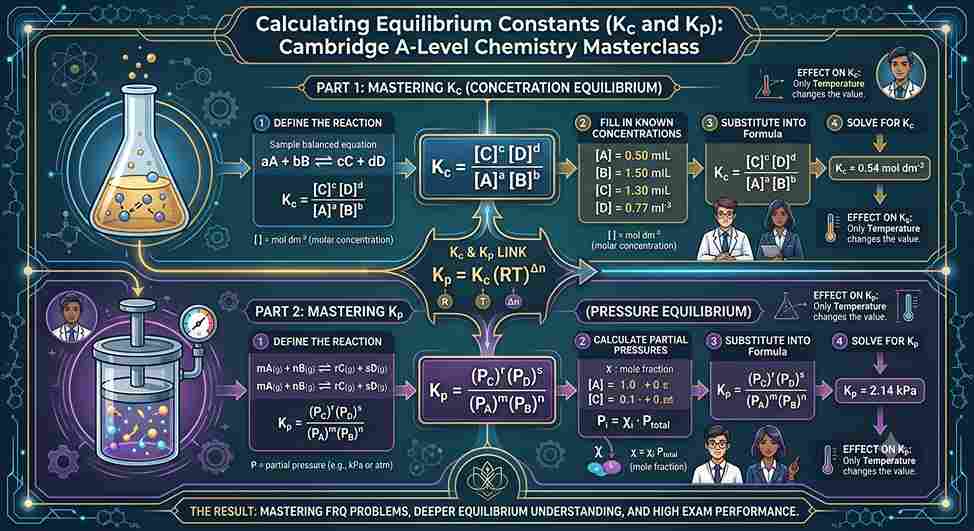
1. The Equilibrium Constant in Terms of Concentration ($K_c$)
For a general homogeneous reaction:
$$aA + bB \rightleftharpoons cC + dD$$
The expression for $K_c$ is given by the Law of Mass Action:
$$K_c = \frac{[C]^c[D]^d}{[A]^a[B]^b}$$
- Square Brackets $[ \ ]$ denote equilibrium concentrations expressed in $\text{mol dm}^{-3}$.
- Pure solids ($s$) and pure liquids ($l$) are omitted from the $K_c$ expression because their concentrations remain constant throughout the reaction. Only aqueous solutions ($\text{aq}$) and gases ($\text{g}$) are included.
2. The Equilibrium Constant in Terms of Partial Pressure ($K_p$)
When dealing with gaseous systems, measuring concentrations in $\text{mol dm}^{-3}$ can be cumbersome. Instead, chemists measure the partial pressures of individual gases. The expression for $K_p$ is:
$$K_p = \frac{(p_C)^c (p_D)^d}{(p_A)^a (p_B)^b}$$
- Where $p_A$, $p_B$, etc., represent the equilibrium partial pressures of each gas, typically measured in Pascals ($\text{Pa}$), kilopascals ($\text{kPa}$), or atmospheres ($\text{atm}$).
Part 2: Step-by-Step ICE Table Framework for $K_c$ Calculations
Complex $K_c$ calculations on Cambridge A-Level papers usually provide initial moles or concentrations and ask you to find $K_c$, or vice versa. The most reliable tool for organizing these calculations is the ICE Table (Initial, Change, Equilibrium).
The Four-Step $K_c$ Workflow:
Step 1: Write the Balanced Chemical Equation and $K_c$ Expression
Always start by writing the balanced equation and stating the $K_c$ expression with correct square brackets.
Step 2: Set Up the ICE Table Using Moles (or Concentrations)
If given initial moles and a fixed container volume ($V \text{ dm}^3$), construct your table in moles first, then convert equilibrium moles to concentrations by dividing by volume ($[X] = \frac{\text{moles}}{V}$).
| Equation | A(g) | + | 2B(g) | ⇌ | C(g) |
| Initial Moles (I) | $0.50$ | $1.20$ | $0.00$ | ||
| Change (C) | $-x$ | $-2x$ | $+x$ | ||
| Equilibrium Moles (E) | $0.50 - x$ | $1.20 - 2x$ | $x$ |
Step 3: Solve for $x$ Using Given Information
If the question states that at equilibrium there are $0.20 \text{ moles}$ of $C$, you know immediately that $x = 0.20$. Substitute $x$ back into the equilibrium row to find the exact equilibrium moles of all species.
Step 4: Calculate Concentrations and Evaluate $K_c$ with Units
Divide each equilibrium mole value by the container volume (e.g., $V = 2.0 \text{ dm}^3$) to get concentrations, plug them into your $K_c$ expression, and calculate both the numerical value and the overall units of $K_c$.
Part 3: Venturing into Gases — Calculating $K_p$ and Mole Fractions
To calculate $K_p$, you must understand how to determine mole fractions and partial pressures.
1. Mole Fraction ($x_i$)
The mole fraction of gas $A$ in a mixture is the ratio of its moles to the total moles of all gases present:
$$x_A = \frac{\text{Moles of Gas A}}{\text{Total Moles of All Gases}}$$
2. Partial Pressure ($p_i$)
According to Dalton's Law of Partial Pressures, the partial pressure of an individual gas is its mole fraction multiplied by the total pressure ($P_{total}$) of the system:
$$p_A = x_A \times P_{total} = \left( \frac{\text{Moles of A}}{\text{Total Moles}} \right) \times P_{total}$$
3. Determining Units for $K_p$ and $K_c$
Cambridge examiners award a dedicated mark for correct units. To find units:
- Substitute pressure units (e.g., $\text{kPa}$) or concentration units ($\text{mol dm}^{-3}$) into your $K_p$ or $K_c$ expression.
- Cancel out matching terms numerator and denominator.
- Write the simplified unit (e.g., $\text{kPa}^{-1}$ or $\text{mol}^{-1}\text{dm}^3$). Note: Some equilibria are completely unitless if the powers in the numerator and denominator cancel out equally!
Part 4: Top 4 Traps That Cost Cambridge A-Level Marks
- Forgetting to Divide Moles by Volume for $K_c$: Plugging raw mole values directly into a $K_c$ expression instead of converting them to molar concentrations ($\text{mol dm}^{-3}$). (Remember: $K_p$ uses moles via mole fractions, but $K_c$ strictly requires concentration!).
- Mishandling Stoichiometric Powers: Forgetting to square or cube concentration or pressure terms when a balanced equation has coefficients greater than 1 (e.g., writing $[B]$ instead of $[B]^2$).
- Including Solids and Liquids in $K_c$ or $K_p$: Writing pure water ($l$) or solid calcium carbonate ($s$) into equilibrium expressions. Their activities are constant and equal to 1.
- Incorrect Total Pressure Summation: Forgetting to sum all equilibrium moles (including unreacted excess reactants) when calculating total moles for mole fraction fractions.
Preparing for Cambridge A-Level Chemistry exams and aiming for an $A^$ grade? EdFlik connects international school students globally with expert, 1-to-1 online A-Level chemistry tutors, helping you master equilibrium calculations, organic reaction mechanisms, and past-paper exam techniques.*Book a Free Demo Class Today!
Frequently Asked Questions (FAQs)
Q1: Does changing temperature alter the value of $K_c$ and $K_p$?
Ans: Yes! Unlike changes in pressure, concentration, or catalysts (which shift equilibrium position without altering the constant), temperature changes change the numerical value of $K_c$ and $K_p$. For exothermic reactions, increasing temperature decreases $K$; for endothermic reactions, increasing temperature increases $K$.
Q2: How do catalysts affect equilibrium constants?
Ans: Catalysts have zero effect on $K_c$ or $K_p$. They speed up the forward and reverse rates equally by providing an alternative pathway with lower activation energy, allowing the system to reach equilibrium faster, but leaving the position and constant unchanged.
Q3: Can $K_c$ and $K_p$ be negative?
Ans: No. Because equilibrium constants are calculated using ratios of concentrations or partial pressures (which are always positive physical quantities), $K_c$ and $K_p$ can never be zero or negative.
Q4: How does EdFlik support Cambridge A-Level Chemistry students?
Ans: EdFlik connects international school students worldwide with vetted, expert 1-to-1 online A-Level tutors specializing in Cambridge International curricula (9701). Our personalized coaching focuses on clarifying complex physical chemistry calculations, organic synthesis pathways, and structured past-paper practice.