Calculating Standard Electrode Potentials ($E^\ominus$) and Nernst Equation in Cambridge A2 Chemistry (9701)
Last Updated: October 2026 | By EdFlik Education Team
For high school students completing the Cambridge International A Level Chemistry (9701) specification, Electrochemistry (Chapter 24) represents one of the most high-yield physical chemistry topics on Paper 4 (A Level Structured Questions).
While students often feel comfortable with basic redox concepts, electrochemistry questions in Paper 4 test precise quantitative mastery: setting up the Standard Hydrogen Electrode (SHE), calculating Standard Cell Potentials ($E^\ominus_{\text{cell}}$), predicting reaction feasibility, applying the Nernst Equation under non-standard conditions, and linking cell potentials to Gibbs Free Energy ($\Delta G^\ominus$).
In this comprehensive, exam-focused masterclass guide, our expert Cambridge A Level chemistry educators break down the core definitions, step-by-step calculation workflows, common examiner mark scheme traps, and complete 100% copy-paste JSON-LD schema markup.
Part 1: Standard Conditions and the Standard Hydrogen Electrode (SHE)
To compare half-cell potentials consistently, all Standard Electrode Potentials ($E^\ominus$) are measured against a universal reference point: the Standard Hydrogen Electrode (SHE), which is arbitrarily assigned a potential of$0.00 \text{ V}$.
                     STANDARD CONDITIONS FOR ELECTROCHEMISTRY
                                        |
      +---------------------------------+---------------------------------+
      |                                 |                                 |
  1. TEMPERATURE                   2. PRESSURE                       3. CONCENTRATION
  • 298 K (25 °C)                  • 101 kPa (1 atm)                 • 1.00 mol dm⁻³
                                     (For gases like H₂ or Cl₂)        for all aqueous ions
The Standard Hydrogen Electrode Half-Cell Setup
The half-equation for the SHE is:
$$2\text{H}^+(\text{aq}) + 2\text{e}^- \rightleftharpoons \text{H}_2(\text{g}) \quad E^\ominus = 0.00 \text{ V}$$
3 Essential Components Required for the SHE Diagram on Paper 4:
- Hydrogen Gas ($\text{H}_2$): Bubbled in at $101 \text{ kPa}$ and $298 \text{ K}$.
- Aqueous Acid ($\text{H}^+$): Solution containing $1.00 \text{ mol dm}^{-3} \text{ H}^+$ ions (e.g., $1.00 \text{ mol dm}^{-3} \text{ HCl}$ or $0.50 \text{ mol dm}^{-3} \text{ H}_2\text{SO}_4$).
- Inert Platinum Electrode: Coated with finely divided platinum (platinum black) to provide a high surface area for electron transfer and establish equilibrium quickly.
Part 2: Calculating Standard Cell Potentials ($E^\ominus_{\text{cell}}$) and Predicting Feasibility
By convention, all standard electrode potentials are listed as reduction half-reactions in the Cambridge Data Booklet.
                        REDOX POLES & ELECTRON FLOW
                                     |
        +----------------------------+----------------------------+
        |                                                         |
  MORE POSITIVE E^⊖ VALUE                                  MORE NEGATIVE E^⊖ VALUE
  • Undergoes REDUCTION (Gains e⁻)                        • Undergoes OXIDATION (Loses e⁻)
  • Acts as CATHODE (+ Pole)                              • Acts as ANODE (- Pole)
  • Stronger Oxidising Agent                              • Stronger Reducing Agent
1. The Standard Cell Potential Formula
To calculate the overall standard cell potential ($E^\ominus_{\text{cell}}$):
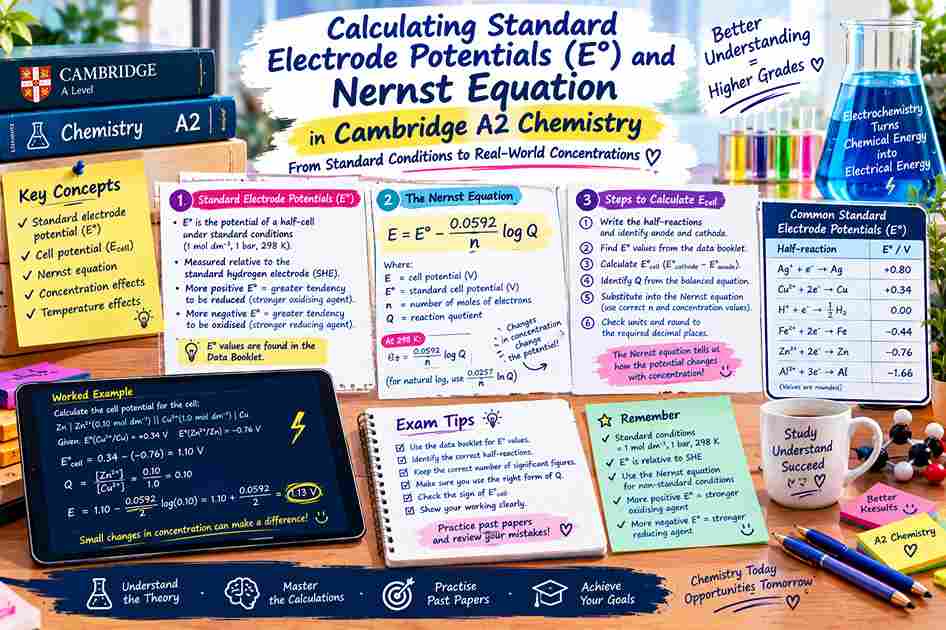
$$E^\ominus_{\text{cell}} = E^\ominus_{\text{reduction (cathode)}} - E^\ominus_{\text{oxidation (anode)}}$$
(Alternatively: $E^\ominus_{\text{cell}} = E^\ominus_{\text{more positive}} - E^\ominus_{\text{more negative}}$)
Step-by-Step Worked Calculation Example:
Question: A voltaic cell is constructed by connecting a $\text{Zn}^{2+}/\text{Zn}$ half-cell to a $\text{Cu}^{2+}/\text{Cu}$ half-cell under standard conditions. Given:$\text{Zn}^{2+}(\text{aq}) + 2\text{e}^- \rightleftharpoons \text{Zn}(\text{s}) \quad E^\ominus = -0.76 \text{ V}$$\text{Cu}^{2+}(\text{aq}) + 2\text{e}^- \rightleftharpoons \text{Cu}(\text{s}) \quad E^\ominus = +0.34 \text{ V}$Calculate $E^\ominus_{\text{cell}}$.Write the overall balanced ionic equation.Deduce the direction of electron flow in the external circuit.
Step 1: Calculate $E^\ominus_{\text{cell}}$
The$\text{Cu}^{2+}/\text{Cu}$ system has the more positive$E^\ominus$ ($+0.34 \text{ V}$), so it undergoes reduction at the cathode. The$\text{Zn}^{2+}/\text{Zn}$ system undergoes oxidation at the anode.
$$E^\ominus_{\text{cell}} = +0.34 - (-0.76) = +1.10 \text{ V}$$
Step 2: Combine Half-Equations for the Overall Reaction
- Cathode (Reduction): $\text{Cu}^{2+}(\text{aq}) + 2\text{e}^- \rightarrow \text{Cu}(\text{s})$
- Anode (Oxidation - Reversed): $\text{Zn}(\text{s}) \rightarrow \text{Zn}^{2+}(\text{aq}) + 2\text{e}^-$
- Overall Redox Equation:
$$\text{Zn}(\text{s}) + \text{Cu}^{2+}(\text{aq}) \rightarrow \text{Zn}^{2+}(\text{aq}) + \text{Cu}(\text{s})$$
Step 3: Determine Electron Flow
Electrons flow spontaneously through the external circuit from the negative electrode (Zinc anode) to the positive electrode (Copper cathode).
2. Linking Cell Potential to Gibbs Free Energy ($\Delta G^\ominus$)
Cambridge 9701 examiners frequently test the thermodynamic relationship connecting $E^\ominus_{\text{cell}}$ to the standard Gibbs free energy change ($\Delta G^\ominus$):
$$\Delta G^\ominus = -n F E^\ominus_{\text{cell}}$$
- $\Delta G^\ominus$: Standard Gibbs free energy change in Joules per mole ($\text{J mol}^{-1}$) (convert to $\text{kJ mol}^{-1}$ by dividing by 1,000).
- $n$: Number of moles of electrons transferred in the balanced redox equation.
- $F$: The Faraday constant ($96,500 \text{ C mol}^{-1}$).
- $E^\ominus_{\text{cell}}$: Standard cell potential in Volts ($\text{V}$).
Feasibility Criterion: A reaction is thermodynamically feasible under standard conditions if $E^\ominus_{\text{cell}} > 0 \text{ V}$, which results in a negative $\Delta G^\ominus < 0 \text{ kJ mol}^{-1}$.
Part 3: The Nernst Equation Under Non-Standard Conditions
When aqueous ion concentrations deviate from $1.00 \text{ mol dm}^{-3}$, standard $E^\ominus$ values are no longer valid. To calculate the non-standard electrode potential ($E$), we apply the Nernst Equation.
1. The Cambridge Simplified Nernst Equation (at $298 \text{ K}$)
In the CAIE 9701 syllabus, the Nernst equation is evaluated at$298 \text{ K}$:
$$E = E^\ominus + \frac{0.059}{z} \log_{10} \left( \frac{[\text{oxidised species}]}{[\text{reduced species}]} \right)$$
- $E$: Electrode potential under non-standard conditions ($\text{V}$).
- $E^\ominus$: Standard electrode potential ($\text{V}$).
- $z$: Number of electrons transferred in the half-equation.
- $[\text{oxidised}]$ & $[\text{reduced}]$: Concentrations of oxidized and reduced species in $\text{mol dm}^{-3}$.
Important Rule for Pure Solids and Water: Pure solid metals (e.g., $\text{Cu}(\text{s})$, $\text{Zn}(\text{s})$) or liquid water have an effective activity of $1$. Thus, for a simple metal/metal-ion electrode $\text{M}^{z+}(\text{aq}) + z\text{e}^- \rightleftharpoons \text{M}(\text{s})$:$$E = E^\ominus + \frac{0.059}{z} \log_{10} [\text{M}^{z+}]$$
Step-by-Step Worked Nernst Equation Calculation:
Question: Calculate the electrode potential ($E$) of a$\text{Cu}^{2+}/\text{Cu}$ half-cell at$298 \text{ K}$ when$[\text{Cu}^{2+}] = 0.020 \text{ mol dm}^{-3}$.
Given: $\text{Cu}^{2+}(\text{aq}) + 2\text{e}^- \rightleftharpoons \text{Cu}(\text{s}) \quad E^\ominus = +0.34 \text{ V}$.
Step 1: Identify Parameters
- $E^\ominus = +0.34 \text{ V}$
- $z = 2$ (2 electrons transferred)
- $[\text{Cu}^{2+}] = 0.020 \text{ mol dm}^{-3}$
Step 2: Substitute into the Nernst Equation
$$E = 0.34 + \frac{0.059}{2} \log_{10}(0.020)$$$$E = 0.34 + 0.0295 \times (-1.699)$$$$E = 0.34 - 0.0501 = +0.290 \text{ V}$$
Qualitative Check (Le Chatelier's Principle): Lowering$[\text{Cu}^{2+}]$ from$1.00 \text{ mol dm}^{-3}$ to$0.020 \text{ mol dm}^{-3}$ shifts the equilibrium$\text{Cu}^{2+} + 2\text{e}^- \rightleftharpoons \text{Cu}$ to the left (favors oxidation), making the reduction potential less positive ($+0.290 \text{ V}$ compared to$+0.34 \text{ V}$).
Part 4: Top 4 Traps That Cost Students Marks in Paper 4
- Multiplying $E^\ominus$ Values When Balancing Electrons: When doubling a half-equation to balance electrons for an overall equation, NEVER multiply the $E^\ominus$ value! $E^\ominus$ is an intensive property ($J C^{-1}$) and remains constant regardless of stoichiometry.
- Confusing Units in $\Delta G^\ominus = -nFE^\ominus_{\text{cell}}$: Forgetting that $\Delta G^\ominus$ calculated directly from $-nFE^\ominus$ gives Joules per mole ($\text{J mol}^{-1}$), NOT $\text{kJ mol}^{-1}$. Dividing by $1,000$ to report in $\text{kJ mol}^{-1}$ is mandatory for full marks.
- Misidentifying $z$ in Multi-Ion Nernst Problems: Using the wrong electron charge transfer $z$. For example, in$\text{Fe}^{3+}(\text{aq}) + \text{e}^- \rightleftharpoons \text{Fe}^{2+}(\text{aq})$,$z = 1$, whereas in$\text{Sn}^{4+}(\text{aq}) + 2\text{e}^- \rightleftharpoons \text{Sn}^{2+}(\text{aq})$,$z = 2$.
- Incorrect Salt Bridge Electrolyte Choice: Using potassium chloride ($\text{KCl}$) in a salt bridge connected to a silver ($\text{Ag}^+$) or lead ($\text{Pb}^{2+}$) half-cell. Chloride ions react to form insoluble precipitates ($\text{AgCl}$ or $\text{PbCl}_2$), altering ion concentrations. Always specify potassium nitrate ($\text{KNO}_3$) as the universal salt bridge electrolyte.
Preparing for Cambridge International A Level Chemistry (9701) Paper 4 and aiming for an $A^$ grade? EdFlik connects international school students globally with expert, 1-to-1 online A Level chemistry tutors, helping you master electrochemistry, reaction kinetics, equilibria, and past-paper mark scheme techniques. *Book a Free Demo Class Today!
Frequently Asked Questions (FAQs)
Q1: What is the function of a salt bridge in an electrochemical cell?
Ans: A salt bridge completes the electrical circuit by allowing the flow of ions between the two half-cells while maintaining electrical neutrality. It prevents direct mixing of the two electrolyte solutions.
Q2: How do I know whether a reaction is feasible using $E^\ominus$ values?
Ans: Calculate$E^\ominus_{\text{cell}} = E^\ominus_{\text{reduction}} - E^\ominus_{\text{oxidation}}$. If$E^\ominus_{\text{cell}} > 0$, the reaction is thermodynamically feasible. However, a positive $E^\ominus_{\text{cell}}$ does not guarantee an observable reaction if the activation energy is too high (kinetic stability).
Q3: When should I use the $0.059$ form of the Nernst equation versus the full $RT/zF$ form?
Ans: The simplified form $E = E^\ominus + \frac{0.059}{z} \log_{10} \frac{[\text{ox}]}{[\text{red}]}$ is strictly valid at $298 \text{ K}$ ($25 ^\circ\text{C}$). Unless the exam explicitly specifies a non-standard temperature, always use $0.059$ as standard for Cambridge 9701 Paper 4.
Q4: How does EdFlik support Cambridge A Level Chemistry students?
Ans: EdFlik connects international school students worldwide with vetted, expert 1-to-1 online tutors specializing in CAIE A Level Chemistry (9701). Our personalized coaching covers physical, inorganic, and organic chemistry, providing tailored past-paper drilling and mark-scheme alignment.