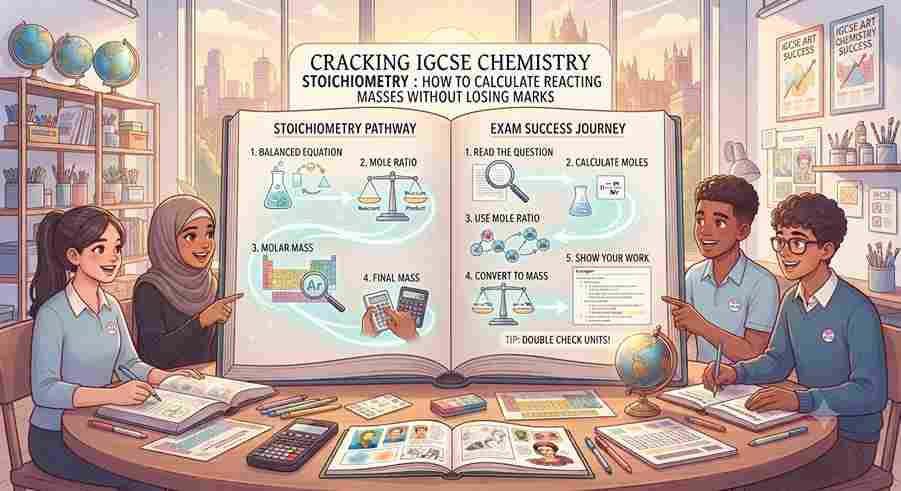
Cracking IGCSE Chemistry Stoichiometry: How to Calculate Reacting Masses Without Losing Marks
Last Updated: September 2026 | By EdFlik Education Team
For students studying Cambridge IGCSE Chemistry (0620) or Edexcel IGCSE Chemistry (4CH1), stoichiometry calculations represent one of the highest-yield—yet most frequently botched—sections on Paper 2 and Paper 4.
Every exam session, thousands of students lose easy marks not because the chemistry is overwhelmingly difficult, but due to avoidable mechanical errors: unbalanced equations, premature rounding, mixed-up molar masses, or failing to show a clear chain of working.
In this comprehensive, exam-focused masterclass guide, our expert IGCSE chemistry educators break down the foolproof 3-step mole method, expose the top traps set by examiners, and provide a systematic framework to secure full marks on reacting mass questions.
Part 1: The Core Philosophy of Stoichiometry
The word stoichiometry originates from Greek elements meaning element (stoicheion) and measure (metron). In chemistry, it is the mathematical heartbeat of a reaction.
Chemical equations do not just tell you what reacts; they tell you in what exact proportion (ratio) particles interact. When a balanced equation states:
$$\text{N}_2(g) + 3\text{H}_2(g) \rightarrow 2\text{NH}_3(g)$$
It means 1 mole of nitrogen gas reacts precisely with 3 moles of hydrogen gas to produce 2 moles of ammonia. Reacting mass calculations simply translate these molar ratios into measurable laboratory quantities (grams).
Part 2: The Foolproof 3-Step Method for Reacting Mass Calculations
Whenever an exam question asks, "Calculate the mass of product Y formed when X grams of reactant Z reacts completely," you must deploy the Three-Step Mole Roadmap:
Step 1: Write and Balance the Equation
- The Rule: Never attempt any calculation until you have checked that the chemical equation is fully balanced.
- Examiner Trap: If the question describes a reaction in words, you must write out the correct chemical formulae first, then balance it. A single missing coefficient ruins your mole ratio entirely.
Step 2: Convert Given Quantities into Moles
You cannot compare masses directly using coefficients because different atoms and compounds have different molar masses. You must translate grams into moles using the core formula:
$$\text{Moles } (n) = \frac{\text{Mass } (m)}{\text{Molar Mass } (Mr)}$$
- Pro Tip: Always calculate relative molecular mass ($Mr$) accurately. Watch out for diatomic elements like$\text{O}_2$,$\text{H}_2$,$\text{Cl}_2$, and$\text{N}_2$ where students mistakenly use atomic mass ($Ar = 16$ instead of$Mr = 32$ for oxygen).
Step 3: Use the Molar Ratio to Find Target Moles, Then Convert Back to Mass
- Use the stoichiometric coefficients from your balanced equation to scale your moles:$$\text{Target Moles} = \text{Given Moles} \times \left( \frac{\text{Coefficient of Target}}{\text{Coefficient of Given}} \right)$$
- Finally, convert the target moles back into mass in grams:$$\text{Mass} = \text{Moles} \times \text{Molar Mass } (Mr)$$
Part 3: Worked Examination Example
Let’s walk through a classic high-tariff IGCSE calculation question:
Example: Calculate the mass of iron (III) oxide ($\text{Fe}_2\text{O}_3$) that must be heated with excess carbon monoxide to produce $16.8\text{ g}$ of iron metal, according to the following equation:$$\text{Fe}_2\text{O}_3(s) + 3\text{CO}(g) \rightarrow 2\text{Fe}(s) + 3\text{CO}_2(g)$$
(Relative atomic masses: $\text{Fe} = 56$, $\text{O} = 16$)
Step 1: Verify the Equation
The equation is already provided and balanced:
$$\text{Fe}_2\text{O}_3 + 3\text{CO} \rightarrow 2\text{Fe} + 3\text{CO}_2$$
Step 2: Find Moles of the Known Substance (Iron)
- Mass of $\text{Fe} = 16.8\text{ g}$
- $Ar$ of $\text{Fe} = 56$
- $\text{Moles of Fe} = \frac{16.8}{56} = 0.30\text{ moles}$
Step 3: Apply the Molar Ratio and Calculate Mass of Reactant
- From the balanced equation, 2 moles of $\text{Fe}$ are produced by 1 mole of $\text{Fe}_2\text{O}_3$ (Ratio $1:2$).
- Therefore, moles of $\text{Fe}_2\text{O}_3$ required = $0.30 \times \left(\frac{1}{2}\right) = 0.15\text{ moles}$.
- Calculate the $Mr$ of $\text{Fe}_2\text{O}_3$:$$Mr = (56 \times 2) + (16 \times 3) = 112 + 48 = 160$$
- Calculate the required mass:$$\text{Mass} = \text{Moles} \times Mr = 0.15 \times 160 = 24.0\text{ g}$$
Part 4: Top 4 Traps That Lose IGCSE Chemistry Marks
- Premature Rounding: Never round intermediate decimal numbers on your calculator. Keep the full unrounded value in your calculator memory and only round your final answer to 2 or 3 significant figures as requested by the exam paper.
- Confusing $Ar$ and $Mr$: Use relative atomic mass ($Ar$) for single elements and relative molecular mass ($Mr$) for bonded compounds.
- Ignoring State Symbols or Diatomic Molecules: Writing $\text{O}$ instead of $\text{O}_2$ wrecks your molar mass calculation instantly.
- Omitting Units: Always attach proper units ($\text{g}$, $\text{mol}$, $\text{g/mol}$) to your final numerical answers. Examiners frequently dock marks for naked numbers.
Struggling with IGCSE Chemistry stoichiometry, mole calculations, limiting reactants, or titration problems? EdFlik connects international school students globally with expert, 1-to-1 online chemistry tutors, helping you master calculation frameworks and secure top grades.Book a Free Demo Class Today!
Frequently Asked Questions (FAQs)
Q1: What is the easiest way to remember the mole formulas for IGCSE Chemistry?
Ans: Use a triangle memory helper where Moles ($n$) equals Mass ($m$) divided by Molar Mass ($Mr$). For solutions, Moles equals Concentration multiplied by Volume in $\text{dm}^3$. For gases at room temperature and pressure, Moles equals Volume divided by$24\text{ dm}^3$.
Q2: How many significant figures should I use in my final chemistry calculation answer?
Ans: Unless the question specifies otherwise, standard IGCSE convention dictates rounding your final numerical answer to 3 significant figures. Avoid rounding to 1 or 2 s.f. unless all numbers in the prompt dictate it.
Q3: What should I do if a reacting mass question involves a limiting reactant?
Ans: If masses for both reactants are provided in the question, you must calculate the moles of each and compare them against the balanced equation coefficients to find which reactant limits the reaction before calculating product mass.
Q4: How does EdFlik support IGCSE Chemistry students?
Ans: EdFlik connects international school students worldwide with vetted, expert 1-to-1 online tutors specializing in Cambridge and Edexcel IGCSE Chemistry. Our sessions focus on simplifying complex calculations, mark scheme breakdown, and targeted past-paper practice.