Digital SAT Punctuation Rules (Colons, Dashes, Semicolons): Practice Guide for Abu Dhabi Test-Takers
By EdFlik Team | November 20, 2026
For high school students across Abu Dhabi—from Al Reem Island and Saadiyat Island to Khalifa City, Al Mushrif, and Mohammed Bin Zayed City—preparing for the Digital SAT is a major step toward competitive university admissions in the United States, the UAE, and around the world. Within the Reading and Writing section of the Digital SAT, Standard English Conventions (specifically Boundaries questions) tests punctuation precision across short, targeted passages.
Among the punctuation marks tested on the Digital SAT—commas, semicolons, colons, and em dashes—colons (:), dashes (—), and semicolons (;) are among the most dependable high-scoring rules once you learn how to check clause structure rather than guessing "by ear" or relying on pauses. In fact, many Digital SAT answer choices test whether you can spot an independent clause (a complete thought that can stand alone as a sentence with a subject and finite verb) versus a dependent clause or phrase.
Securing a top Reading and Writing score on the Digital SAT means knowing two crucial test-taking principles: semicolons and periods link independent clauses, colons follow a complete independent clause, and dashes can either act like a colon (single em dash after a complete clause) or pair up to set off nonessential information. Furthermore, if two choices perform the exact same grammatical job in identical ways and neither is needed for context, test-takers can eliminate both quickly.
This practice guide breaks down semicolons, colons, and dashes for the Digital SAT, provides a side-by-side comparison and practice drill set with explanations, highlights common traps, and includes 100% copy-paste JSON-LD schema markup.
Key Takeaways
- Semicolon Rule (
;): Use a semicolon primarily to join two closely related independent clauses without a coordinating conjunction (FANBOYS: for, and, nor, but, or, yet, so)—it functions similarly to a period between two complete sentences. (Semicolons can also separate complex list items that already contain commas.) - Colon Rule (
:): A colon must come immediately after a complete independent clause. What follows a colon can be a list, a single word/phrase, an explanation, or another independent clause that elaborates on what came before. - Dash Rules (
—): A single em dash after a complete independent clause can introduce an explanation, example, or list much like a colon. Paired em dashes set off nonessential (parenthetical) information mid-sentence—and must match each other (don't pair a dash with a comma). - Always Check Before and After the Blank: Before selecting a semicolon, colon, or single dash, check whether the words before the punctuation form a complete independent clause.
Part 1: Semicolons, Colons, and Dashes Compared
When four answer choices on the Digital SAT differ mainly in punctuation marks, the test is asking you to inspect clause boundaries and sentence structure.
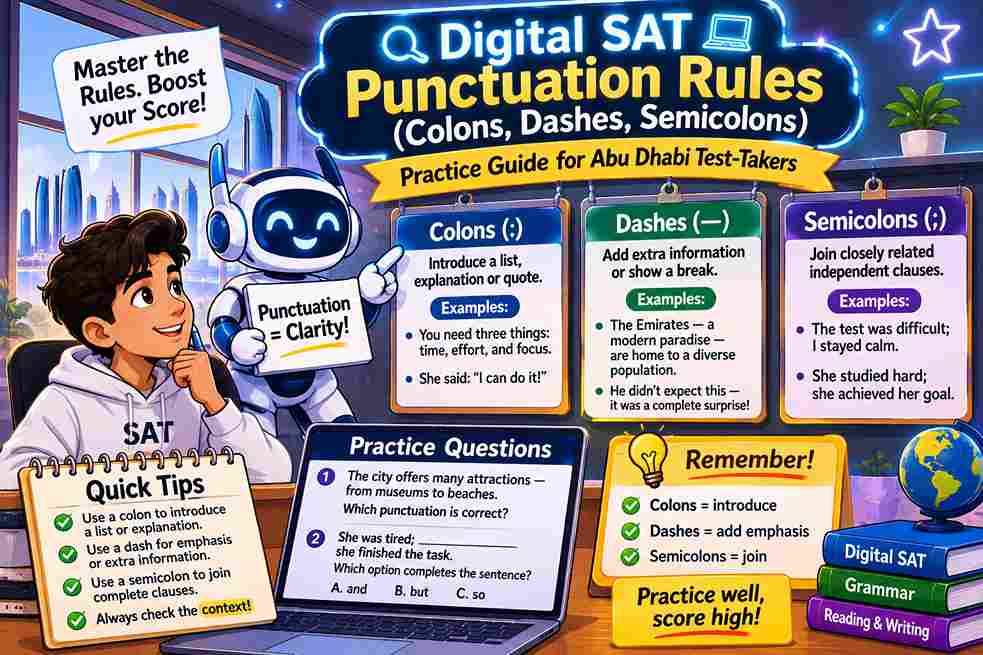
As shown in the punctuation reference visual above, marks like the semicolon and colon have distinct roles—and mixing up their structural rules is one of the fastest ways to lose points on Boundaries items.
Quick Reference Table: Semicolons vs. Colons vs. Dashes
| Punctuation Mark | What Must Come BEFORE It | What Can Come AFTER It | Classic Digital SAT Example |
Semicolon (;) | Independent clause (complete sentence). | Independent clause (complete sentence). | The lab equipment arrived early; the researchers began calibration immediately. |
Colon (:) | Independent clause (complete sentence). | A list, explanation, elaboration, or second independent clause. | The coastal study focused on one key factor: seasonal water salinity. |
Single Em Dash (—) | Independent clause (complete sentence). | An explanation, example, or emphasis (often acting like a colon). | The team needed one reliable instrument—a calibrated digital scale. |
Paired Em Dashes (— ... —) | First half of the sentence leading into a nonessential interruption. | Closing dash followed by the rest of the sentence. | The marine sample—collected near Saadiyat at dawn—showed high clarity. |
Part 2: Step-by-Step Decision Workflow for Punctuation Questions
When you hit a punctuation question during Module 1 or Module 2 of Digital SAT Reading and Writing, use this 4-step check:
              4-STEP DIGITAL SAT PUNCTUATION CHECK
                                  |
  Step 1: Check Left of Blank   ---> Can the words before the blank stand alone as a
                                       complete sentence (independent clause)?
  Step 2: Check Right of Blank  ---> Is the segment after the blank another independent clause,
                                       a list/explanation, or a nonessential element?
  Step 3: Eliminate Rule Breakers ---> Cross off semicolons if either side isn't an independent
                                       clause; cross off colons if the lead-in is incomplete.
  Step 4: Verify Pairing & Sense  ---> Ensure paired dashes/commas match and read the full
                                       completed sentence for clear logic.
Part 3: Digital SAT Practice Questions (Colons, Dashes, Semicolons)
Try each question on your own first, then check the step-by-step explanation below.
Practice Question 1 (Semicolon vs. Comma Splice)
Urban planners in Abu Dhabi have expanded shaded pedestrian walkways across several districts ______ these routes encourage walking even during warmer months.
Which choice completes the text so that it conforms to the conventions of Standard English?
A) walkways across several districts, these routes
B) walkways across several districts; these routes
C) walkways across several districts, so, these routes
D) walkways across several districts—and these routes
Practice Question 2 (Colon After an Independent Clause)
During the field survey, ecologists recorded a surprising pattern along the shoreline ______ mangrove seedlings thrived in sheltered tidal channels.
Which choice completes the text so that it conforms to the conventions of Standard English?
A) shoreline, such as
B) shoreline:
C) shoreline; because
D) shoreline, while
Practice Question 3 (Single Dash vs. Incomplete Lead-In)
The archival exhibition highlights three essential instruments used in early navigation ______
Which choice completes the text so that it conforms to the conventions of Standard English?
A) navigation—the astrolabe, the magnetic compass, and the sextant.
B) navigation; the astrolabe, the magnetic compass, and the sextant.
C) navigation, which are: the astrolabe, the magnetic compass, and the sextant.
D) navigation, including: the astrolabe, the magnetic compass, and the sextant.
Practice Question 4 (Paired Em Dashes for Nonessential Information)
The newly renovated museum wing ______ opened to students last autumn features interactive climate models.
Which choice completes the text so that it conforms to the conventions of Standard English?
A) wing, which
B) wing—which
C) wing—which,
D) wing: which
(Assume the full sentence reads: "The newly renovated museum wing—which opened to students last autumn—features interactive climate models.")
Answers & Explanations
- Correct Answer: B (
walkways across several districts; these routes)- Why: Both "Urban planners in Abu Dhabi have expanded shaded pedestrian walkways across several districts" and "these routes encourage walking even during warmer months" are independent clauses. Choice A creates a comma splice, Choice C adds awkward extra commas around so, and Choice D pairs a dash with and unnecessarily. A semicolon properly joins two complete sentences.
- Correct Answer: B (
shoreline:)- Why: The part before the blank ("During the field survey, ecologists recorded a surprising pattern along the shoreline") is a complete independent clause, and the clause after it explains what that pattern was. A colon correctly introduces an explanation after an independent clause.
- Correct Answer: A (
navigation—the astrolabe, the magnetic compass, and the sextant.)- Why: The lead-in before the blank ("The archival exhibition highlights three essential instruments used in early navigation") is a complete independent clause, so a single em dash (like a colon) can introduce the list of items. Choice B puts a semicolon before a non-sentence list; Choices C and D place a colon after an incomplete phrase ("which are:" / "including:").
- Correct Answer: B (
wing—which) (completing the paired em dashes around "which opened to students last autumn")- Why: "which opened to students last autumn" is a nonessential relative clause interrupting the main clause ("The newly renovated museum wing ... features interactive climate models"). When setting off nonessential information with em dashes, you must use matching dashes on both sides—never a dash on one side and a comma or colon on the other.
Part 4: Top 4 Punctuation Traps on the Digital SAT
- Putting a Colon After "Such As," "Including," or a Verb/Preposition: "The study examined: water, soil, and air" is incorrect because "The study examined" is not a complete standalone statement before the colon. Remove the colon so the sentence flows naturally into the list.
- Using a Semicolon When Only One Side Is a Complete Sentence: A semicolon cannot join an independent clause to a fragment or dependent phrase. Always check that both sides could stand alone as sentences.
- Mismatching Paired Punctuation (Dash + Comma): If a nonessential phrase opens with an em dash (
—), close it with an em dash (—), not a comma (,). - Over-Relying on "Pauses" Instead of Clause Structure: Reading quickly in test conditions can make a pause sound right where no punctuation belongs—such as between a subject and its verb. Always verify subjects, verbs, and clause boundaries.
For expert 1-on-1 online tutoring support to master Digital SAT Reading and Writing conventions, timed pacing, and practice strategies in Abu Dhabi, book a class on EdFlik.
Frequently Asked Questions (FAQs)
Q1: Can a colon or single dash be used between two independent clauses on the Digital SAT?
Ans: Yes, when the second independent clause explains, defines, or elaborates on the first independent clause—and the part before the colon or single dash is a complete sentence on its own.
Q2: How do I know whether to use paired dashes or paired commas for nonessential information?
Ans: Grammatically, paired em dashes (— ... —) and paired commas (, ... ,) both set off nonessential information, though em dashes often appear when the parenthetical phrase contains internal commas or adds stronger emphasis. On the Digital SAT, the key is consistency: match dash with dash or comma with comma rather than mixing them.
Q3: What is the most common mistake students make with semicolons on the SAT?
Ans: Using a semicolon when one side of the punctuation is not an independent clause (a complete thought with a subject and verb), or picking a semicolon when two choices are both grammatically valid ways to join two independent clauses without any other difference.