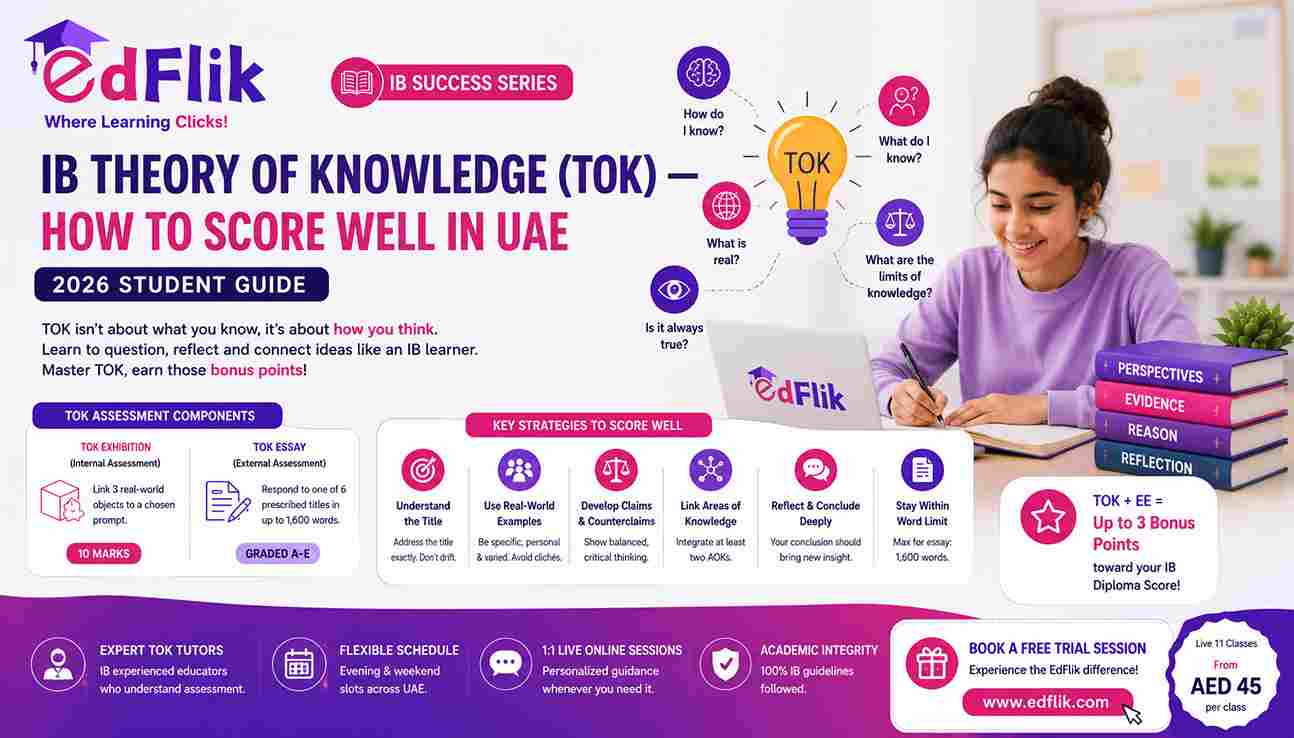
How to Connect Real-World Objects to Knowledge Questions in IB TOK Exhibition (Dubai Guide)
By EdFlik Team | November 20, 2026
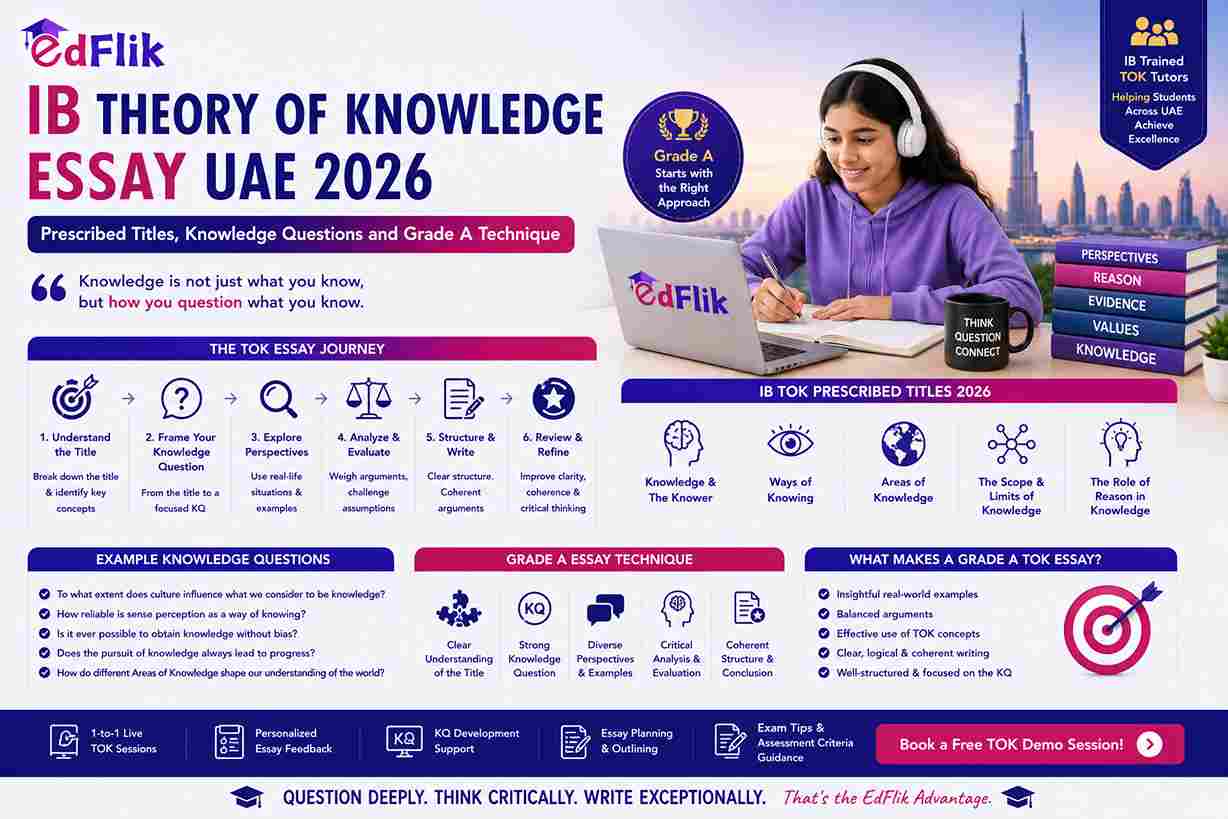
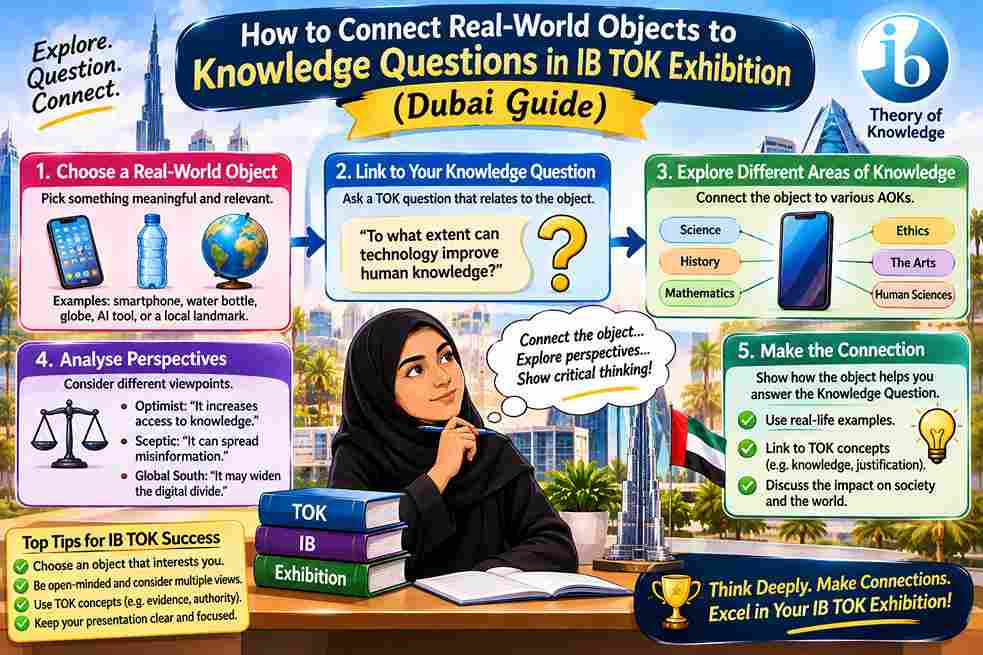
For Diploma Programme (DP) students across Dubai—from Dubai International Academic City and Jumeirah to Emirates Hills, Dubai Hills, and Al Barsha—the Theory of Knowledge (TOK) Exhibition is one of the most creative and personal assessments of the IB DP. Worth one-third of the overall TOK grade (alongside the 1,600-word TOK essay) and marked out of 10 holistic points, the exhibition asks you to select one of the 35 prescribed IA prompts (without altering its wording), choose three specific real-world objects, and write up to 950 words total (roughly 300 words per object) showing how each object illuminates the prompt.
Many IB students in Dubai find the exhibition deceptively tricky. Because the prompt itself is already a broad knowledge question—such as "Is bias inevitable in the production of knowledge?", "What counts as good evidence for a claim?", or "How might the context in which knowledge is presented influence whether it is accepted or rejected?"—students often fall into two traps: either picking generic stock concepts ("a book", "social media", "a science textbook") instead of a specific, situated object, or writing a mini-essay trying to "solve" the prompt instead of showing how TOK manifests in the real world through that object.
Securing top marks in the IB TOK Exhibition—a strong boost toward your DP core points for competitive university admissions in the UAE, UK, US, Europe, or Asia—depends on anchoring each object in a concrete real-world context and building a clear, analytical link back to the exact wording of your chosen IA prompt.
This comprehensive guide explains how to connect real-world objects to knowledge questions in the IB TOK Exhibition, offers practical selection and commentary frameworks tailored for Dubai DP students, highlights common pitfalls, and provides 100% copy-paste JSON-LD schema markup.
Key Takeaways
- Specific Beats Generic Every Time: Choose a concrete, real-world object with a clear time, place, and purpose—such as a specific museum plaque, a dated transit card, or a particular lab calibration log—rather than a vague category like "a phone" or "history".
- Illustrate the Prompt Rather Than Writing a Mini-Essay: Examiner guidance does not require an introduction or conclusion, and trying to give a final "answer" to the prompt misses the point; focus on contextualizing the object and explaining its link to the prompt.
- Ensure All Three Objects Add Distinct Value: All three objects must connect to the same IA prompt, and each should offer a fresh angle, perspective, or tension rather than repeating the exact same point three times.
- Stay Within the 950-Word Ceiling: Examiners stop reading after 950 words across your three object commentaries (titles, image labels, and references are excluded from the word count).
Part 1: Understanding Prompts, Objects, and Knowledge Questions
In the IB TOK Exhibition, your chosen IA prompt sets the overarching conceptual frame. Rather than inventing a brand-new abstract question from scratch, you use the exact wording of one of the 35 prescribed prompts as your exhibition title and unpack what that question is asking about how knowledge is produced, justified, interpreted, or shared.
               OBJECT-TO-PROMPT LINKAGE IN THE TOK EXHIBITION
                                      |
  Prescribed IA Prompt (Exact Wording) ---> Unpack key terms (e.g., "reliability", "context",
                                            "bias", "evidence", or "values").
                 |
                 v
  Specific Real-World Object         ---> Ground in real time, place, & use (not a generic
                                            stock symbol).
                 |
                 v
  Analytical Commentary (~300 wds)   ---> Show *how* this specific object's context & details
                                            illuminate the prompt's tension or nuance.
Practical Object-to-Prompt Pairings for Dubai Students
Living in a global city like Dubai gives students rich, authentic access to everyday objects that carry interesting knowledge questions when examined critically:
| Prescribed IA Prompt Idea | Strong Specific Object Choice | Why the Link Works |
| "How might the context in which knowledge is presented influence whether it is accepted or rejected?" | A specific bilingual exhibition label seen at a cultural/heritage venue or museum in Dubai. | Lets you examine how framing, audience, language, and setting shape how visitors trust or interpret information. |
| "What counts as good evidence for a claim?" | A dated Metro/Nol trip receipt or a calibrated laboratory measurement log from a school science investigation. | Allows you to compare concrete documentary/empirical records against personal memory or informal claims. |
| "What is the relationship between knowledge and culture?" | A family recipe card or traditional Ramadan/Eid culinary note passed down across generations. | Connects lived cultural practice and inherited know-how with how communities preserve and pass on knowledge. |
| "What role do experts play in influencing our consumption or acquisition of knowledge?" | A specific public health advisory notice or pharmacy dosage leaflet. | Highlights authority, technical expertise, and how non-experts rely on—or question—specialist guidance. |
Part 2: Step-by-Step Formula for Each Object Commentary
Because your total commentary across all three objects is capped at 950 words, aiming for roughly 280–320 words per object keeps every commentary focused and substantive. Use this four-part structure for each object:
- Name the Prompt & Target Angle: State the exact prompt (as your exhibition title) and identify which aspect of the prompt this specific object helps explore.
- Contextualize the Object Precisely: Describe the exact object—what it is, where/when it exists or was used, and what concrete details are visible—so the reader understands its real-world context.
- Build the Analytical Link to the Prompt: Explain how specific features of this object illuminate the knowledge question, using clear reasoning and concrete evidence rather than vague assertions.
- Justify Its Distinct Role (Optional Nuance): Show why this object adds a distinct perspective alongside your other two objects, introducing a relevant limitation or counter-perspective only where it sharpens the link.
Part 3: Avoiding Common TOK Exhibition Traps in Dubai Schools
Even strong IB students across Dubai's international schools can lose marks on avoidable mistakes:
- Picking Hypothetical or Generic Objects: Saying "a hypothetical social media post" or showing a generic stock photo of a smartphone weakens authenticity. Use a real, specific object you can describe accurately and photograph/present clearly.
- Turning Commentaries Into Subject Essays: Focusing heavily on textbook facts from Biology, History, or Economics without tying those details back to the knowledge question shifts the writing away from TOK.
- Forcing an Essay Introduction and Conclusion: Examiners do not require an introduction or conclusion, and writing a neat "final answer" to a complex knowledge question often oversimplifies the inquiry.
- Exceeding 950 Words: Always check your exact word count before submitting—any text past the 950-word limit is not read by examiners.
For expert 1-on-1 online tutoring support to brainstorm TOK exhibition objects, sharpen commentary structure, and build confidence across your IB Diploma subjects in Dubai, book a class on EdFlik.
Frequently Asked Questions (FAQs)
Q1: How many objects and words are required for the IB TOK Exhibition?
Ans: You must select three specific real-world objects linked to one prescribed IA prompt and write a combined commentary of no more than 950 words (typically around 300 words per object).
Q2: Can I change the wording of the TOK exhibition prompt to fit my objects better?
Ans: No. You must select one of the 35 prescribed IA prompts and keep its wording unchanged—choosing objects that naturally fit the prompt rather than bending the prompt to fit an object.
Q3: Do I need a formal introduction and conclusion in my TOK exhibition commentary?
Ans: Neither an introduction nor a conclusion is required, and examiners specifically advise against using a conclusion to claim a simple "answer" to the prompt. Keep your sections clearly separated by object and focused on contextualizing each object and linking it to the prompt.