IB Theory of Knowledge Essay UAE 2026 — Prescribed Titles, Knowledge Questions and Grade A Technique
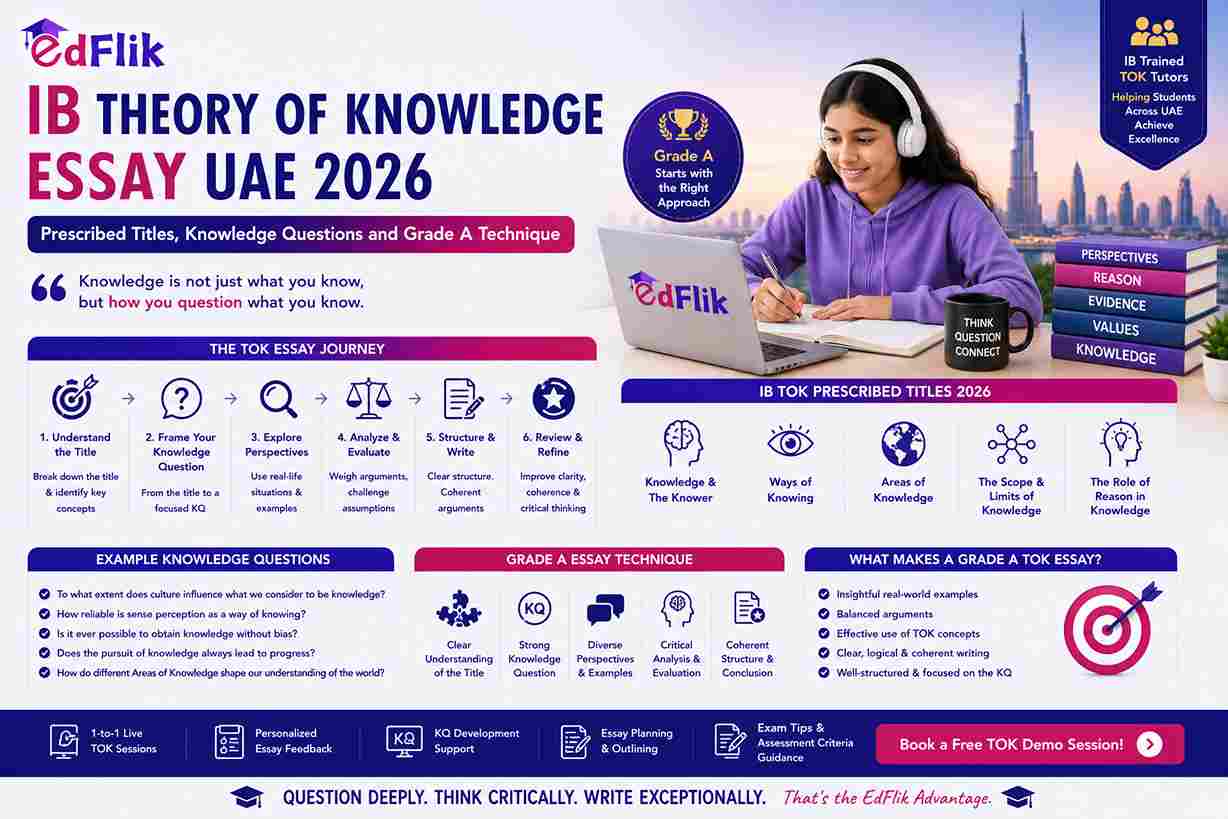
The IB Theory of Knowledge Essay is simultaneously one of the most important and most misunderstood IB Diploma components. At 1,600 words, it is the shortest substantial piece of academic writing in the Diploma — but it is assessed against the most abstract criteria of any IB component, requires a completely different thinking style from all other IB work, and contributes to the crucial bonus points that can determine whether a student receives 38 or 40 Diploma points. This guide covers what the TOK Essay actually requires and the specific writing approach that earns Grade A.
TOK Essay vs Other IB Writing — The Key Difference
The TOK Essay asks students to think about knowledge itself — not about the content of any specific subject. Every other IB essay is first-order: "Evaluate the causes of World War One." The TOK Essay is second-order: "How do we know?" or "What are the limits of this type of knowledge?" This shift from object-level content to meta-level epistemology is what most UAE IB students find disorienting, and what the TOK Essay specifically develops.
|
The most
common UAE IB student TOK Essay error: writing an essay about the content of
an IB subject rather than about knowledge itself. An essay titled "To
what extent is certainty possible in mathematics?" that spends most of
its 1,600 words discussing specific mathematical theorems is not a TOK Essay
— it is a Mathematics essay. A TOK Essay on this title discusses what
"certainty" means as an epistemological concept, how mathematicians
define proof, and whether formal proof constitutes certainty or merely high
confidence — with mathematics as the evidence, not the subject. |
How to Choose the Right Prescribed Title
Six prescribed titles are released each year in September/October of IB Year 1 (Grade 11). Students choose one and write their essay on it. The choice is consequential — a poorly chosen title makes a Grade A essay much harder.
|
Title
characteristic |
What to look
for |
What to avoid |
|
Personal
connection |
A title that
connects to your IB subject combination or genuine intellectual interests —
because you will write 1,600 words on it and genuine interest produces better
analysis |
Titles that
sound impressive but connect to nothing in your academic or personal
experience |
|
Knowledge
question potential |
Generates 2-3
genuine knowledge questions naturally when you read it |
Titles that
seem to be asking for content knowledge (which subjects are best studied
empirically?) rather than epistemological questions |
|
Real-world
example accessibility |
You can
immediately identify 4-6 specific examples from IB subjects, history,
personal experience, or wider reading |
Titles where
all your examples are vague ("scientists have discovered..."
"historians believe...") |
|
Scope
appropriateness |
Focused enough
that you can explore one or two knowledge questions in genuine depth in 1,600
words |
Titles so
broad that your essay can only skim the surface of the epistemological
question |
The Knowledge Question — The Heart of Every TOK Essay
Every TOK Essay must develop at least one central knowledge question. A knowledge question asks about the nature, scope, or limits of knowledge — not about specific facts within a field. Developing knowledge questions from prescribed titles:
• Prescribed title: "The quality of knowledge produced by an academic discipline is directly proportional to the use of mathematics." → Knowledge questions: What do we mean by "quality" of knowledge? Is quantification the same as precision? Are there types of understanding that mathematics cannot capture?
• Prescribed title: "The historian's task is to understand the past; the human scientist, by contrast, is looking to change the future." → Knowledge questions: What distinguishes understanding from explanation? Can knowledge of the past genuinely change the future? Are historical knowledge and social scientific knowledge methodologically distinct?
• Prescribed title: "Too much caution is the greatest risk of all." → Knowledge questions: How do we assess risk in knowledge claims? What role does certainty play in knowledge production? Is epistemic caution a virtue or a limitation?
Real-World Knowledge Claims — What Makes Them Strong
Real-world knowledge claims are the specific examples that ground the TOK Essay in concrete knowledge rather than abstract philosophical assertions. The difference:
• Weak RWK claim: "Scientists use the scientific method to generate reliable knowledge." (generic, non-specific, no person, no study, no event)
• Strong RWK claim: "Ignaz Semmelweis's 1847 discovery that handwashing prevented puerperal fever was rejected by the medical establishment for decades — demonstrating that empirical evidence alone is insufficient without a plausible mechanistic explanation that the scientific community can accept." (specific, named, dated, illuminates the limits of empirical knowledge in a concrete historical case)
TOK Essay Structure — The Four Sections
|
Section |
Word Count
(approx.) |
What It
Contains |
|
Introduction |
150-200 words |
Unpack the
prescribed title (what are its key terms?); introduce the central knowledge
question; indicate the line of argument |
|
Body 1 — First
position |
400-500 words |
One position
on the knowledge question; 2-3 specific real-world knowledge claims as
evidence; genuine evaluation of this position (what does it assume? what are
its limits?) |
|
Body 2 —
Contrasting position or nuance |
400-500 words |
A contrasting
position or a significant qualification; 2-3 different real-world knowledge
claims; evaluate; explain how this interacts with Body 1 |
|
Conclusion |
150-200 words |
Synthesise
across both positions; reach a specific, qualified answer to the prescribed
title that acknowledges the complexity the essay has revealed |
|
EdFlik
provides IB Theory of Knowledge Essay guidance — title selection, knowledge
question development, real-world knowledge claim identification, and essay
structure coaching — all within IB Academic Integrity Policy. TOK Essay
support from AED 65 per session. Free consultation. Book at www.edflik.com or
WhatsApp +91 88788 96600. |
Frequently Asked Questions
Q: What is the IB Theory of Knowledge Essay?
A 1,600-word externally assessed essay on a prescribed title selected from six IB-released titles. 33% of TOK grade; combined with EE for up to 3 bonus Diploma points. Assessed on five criteria: Understanding, Knowledge Questions, Analysis, Connections, Structure.
Q: How do I choose the right TOK Essay prescribed title?
Choose based on: genuine personal connection; generates 2-3 knowledge questions naturally; immediately identifiable specific real-world examples; scope manageable in 1,600 words. Wrong choice makes Grade A significantly harder.
Q: What is a knowledge question in TOK?
A second-order question about knowledge itself — not about specific content. "How do we know?" rather than "What do we know?" Open-ended, general, focused, and connected to real-world knowledge claims. The central knowledge question is the heart of the TOK Essay.
Q: What real-world knowledge claims should a UAE student include?
Specific (named study, historical event, concrete experience), personal where genuine (UAE students have distinctive international vantage points), and genuinely connected to the knowledge question — illustrating something about the nature of knowledge, not just topic-related.
Q: How should a TOK Essay be structured?
Introduction (150-200 words: title unpacking, knowledge question, argument line); Body 1 (400-500 words: first position, 2-3 RWK claims, evaluation); Body 2 (400-500 words: contrasting position, different RWK claims, evaluation); Conclusion (150-200 words: synthesis, qualified answer to title).