How to Score A* in IGCSE Maths — 8 Proven Tips from Expert Online Tutors (UAE Guide 2026)
Scoring an A* in Cambridge IGCSE Mathematics (0580) comes down to three things: mastering the structure of the exam, being systematic about your weak areas, and practising under real conditions. Students who reach the A* grade boundary — typically 75 percent or above on the Extended tier — do not simply know more mathematics. They understand exactly what Cambridge Assessment International Education (CAIE) is looking for and they prepare accordingly. Whether you are sitting the May/June series or the October/November series in the UAE, the eight strategies below are what EdFlik's Cambridge 0580 specialist tutors teach every student aiming for the top grade.
Why IGCSE Maths A* Is Achievable With the Right Approach
Cambridge IGCSE 0580 Extended has two core papers: Paper 2 (1 hour 30 minutes, 70 marks) and Paper 4 (2 hours 30 minutes, 130 marks). Together they cover Algebra, Geometry, Statistics, Probability, and Trigonometry across a predictable syllabus. Because the paper structure is consistent from year to year, students who prepare strategically — rather than broadly — gain a measurable advantage. Here is exactly how to do it.
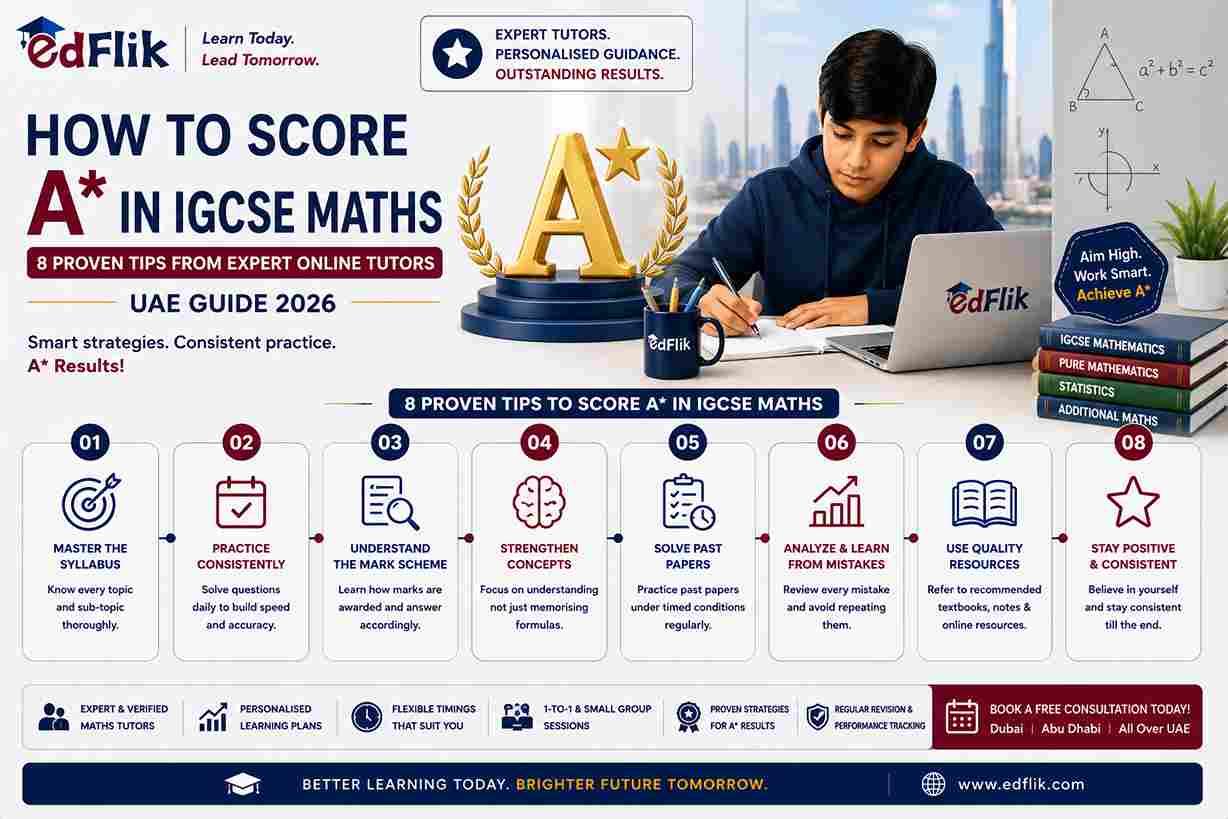
8 Proven Tips to Get A* in IGCSE Maths
Tip 1: Master the Mark Scheme, Not Just the Answer
Most students check whether their final answer is correct and move on. Students aiming for A* read the mark scheme to understand how CAIE awards method marks (M marks), accuracy marks (A marks), and follow-through marks (FT marks). When you study past papers, sit beside the mark scheme and ask: where exactly would I lose a mark, and why? Pay particular attention to instruction words — 'show that', 'prove', and 'hence' each carry specific mark-scheme expectations that differ from a general 'find' question.
Tip 2: Practise Past Papers From the Last 5 Years (0580/42 and 0580/22)
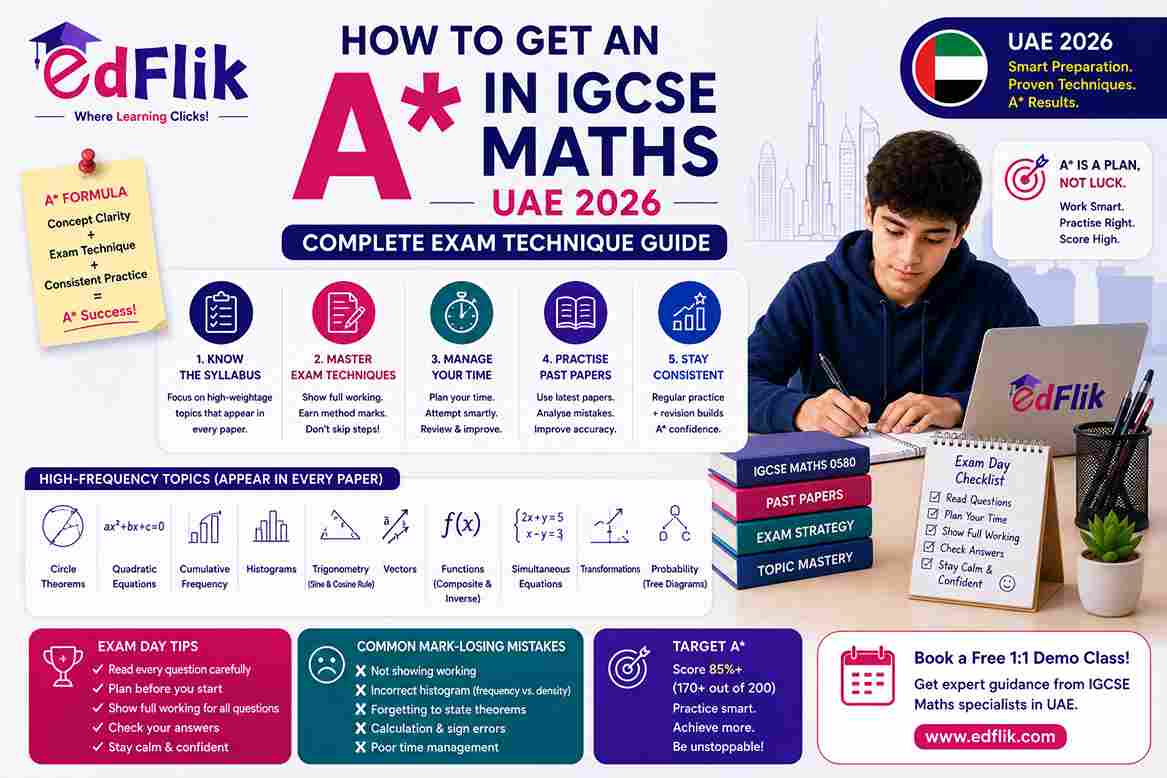
The most efficient revision resource available to any IGCSE Maths student is the CAIE past paper archive. Focus specifically on 0580/42 (Paper 4, variant 2) and 0580/22 (Paper 2, variant 2), which are the most widely sat variants among UAE schools. Work through at least five years of papers under timed conditions. Note which topic areas recur every year: functions and transformations in Algebra, circle theorems in Geometry, cumulative frequency in Statistics, and the sine and cosine rules in Trigonometry all appear with high frequency.
Tip 3: Never Skip Method Marks — Show Every Step
IGCSE Maths Paper 4 rewards working, not just answers. A student who writes down the correct final answer with no working shown can receive zero marks if that answer happens to be wrong. Conversely, a student who makes an arithmetic error but demonstrates correct method will still earn the M mark. Make it a rule to write out every step, label every substitution, and never skip from a formula to a final number in one jump.
Tip 4: Identify Your Weak Topics Early and Attack Them Systematically
In the first two months of your preparation, complete a full diagnostic: attempt one past Paper 4 and mark it rigorously against the mark scheme. Record every question you lose marks on and group them by topic. Most UAE students lose marks in the same three or four areas — Vectors and transformations, probability trees, and simultaneous equations with non-linear terms are common examples. Dedicate focused revision sessions to those topics before returning to mixed practice.
Tip 5: Learn to Manage Time — Paper 4 Is 2 Hours 30 Minutes for 130 Marks
Paper 4 allocates roughly 1.15 minutes per mark. A 5-mark question should take no longer than 6 minutes; a 10-mark question no longer than 12 minutes. Many students lose the A* not because they cannot do the mathematics, but because they spend 20 minutes on a difficult early question and run out of time before reaching high-value questions at the end. Practise strict time management from your first mock paper: write the target finish time next to each question before you start, and move on when you reach it.
Tip 6: Use the IGCSE Formula Sheet Strategically — Know What Is NOT on It
CAIE provides a list of formulae in Paper 2 and Paper 4, but the sheet is deliberately incomplete. The formula sheet includes the quadratic formula, trigonometric identities, and standard area and volume formulae. It does NOT include: the equation of a straight line in various forms, laws of indices, rules for probability, properties of similar triangles, and transformation matrices. Build a personal 'not on the formula sheet' revision card and review it weekly in the final two months before your exam.
Tip 7: Practise Under Timed, Exam Conditions — Not Just Casual Revision
Reviewing worked examples is useful for learning concepts, but it does not prepare you for exam performance. Reading worked solutions and following along is a fundamentally different cognitive task from producing a correct solution under time pressure. From at least eight weeks before your exam, shift the majority of your Maths revision to timed, unseen past papers completed in silence with no calculator permitted for Paper 2. Mark your own work immediately afterwards and record your score.
Tip 8: Work With an Expert Tutor Who Knows Cambridge 0580 Inside Out
The single most efficient way to close the gap between your current grade and A* is working with a tutor who has deep, specific knowledge of Cambridge IGCSE 0580 — not a general Maths tutor. A specialist tutor can diagnose your mark-scheme errors, target your revision to the highest-yield topics for your specific sitting, and walk you through the reasoning behind examiner guidance. For UAE students, most IGCSE cohorts sit the May/June series, which means structured tutor support should begin no later than February to allow sufficient time for topic consolidation and full mock-paper cycles.
Frequently Asked Questions
What is the A* grade boundary for Cambridge IGCSE Maths Extended (0580)?
CAIE sets grade boundaries after each examination series based on the difficulty of that year's paper, so there is no single fixed number. As a general guide, A* on the Extended tier has historically required approximately 75 to 80 percent of the total available marks across Paper 2 and Paper 4 combined. For the most accurate and up-to-date boundary information for a specific series, check the CAIE grade threshold documents published on the official Cambridge website after results are released.
How many past papers should an IGCSE Maths student practise before the exam?
As a minimum, complete one full set of Paper 2 and Paper 4 from each of the last five years — that is at least ten timed papers in total. Students targeting A* benefit from going further: working through both Variant 2 and Variant 4 papers from recent years provides broader question exposure without departing from the 0580 syllabus. More important than the quantity of papers is the quality of review: every paper must be marked against the official CAIE mark scheme, and every lost mark must be understood before moving to the next paper.
Is it possible to go from a C grade to an A* in IGCSE Maths with tutoring?
Yes, and it happens regularly. The jump from C to A* is genuinely achievable in one academic year with structured, targeted work — provided the student has sufficient time before their exam sitting and commits to consistent practice. The key is a tutor who can accurately diagnose where marks are being lost, prioritise the highest-impact topics, and build exam technique alongside content knowledge. EdFlik students working with Cambridge 0580 specialists have made significant grade improvements across a single term when tutoring sessions are combined with regular timed paper practice and mark-scheme review.
What topics are most commonly tested in IGCSE Maths Paper 4?
Paper 4 consistently includes questions on Algebra (solving equations, functions, sequences, and inequalities), Geometry (circle theorems, similar shapes, and constructions), Trigonometry (right-angled and non-right-angled triangles using the sine and cosine rules), Statistics (cumulative frequency, histograms, mean from frequency tables), and Probability (combined events, conditional probability, and tree diagrams). Vectors and transformations also appear regularly in the later sections of the paper.
Book a Free IGCSE Maths Trial Class
Book a free trial class with an EdFlik IGCSE Maths specialist today. Our tutors are Cambridge 0580 experts — experienced in both the Extended and Core tiers — and work with students across the UAE, including Dubai, Sharjah, Ajman, and Abu Dhabi, for both the May/June and October/November series. Trial classes are available now, with no commitment required. Visit edflik.com to get started.