How to Get an A* in IGCSE Maths UAE 2026 — Complete Exam Technique Guide
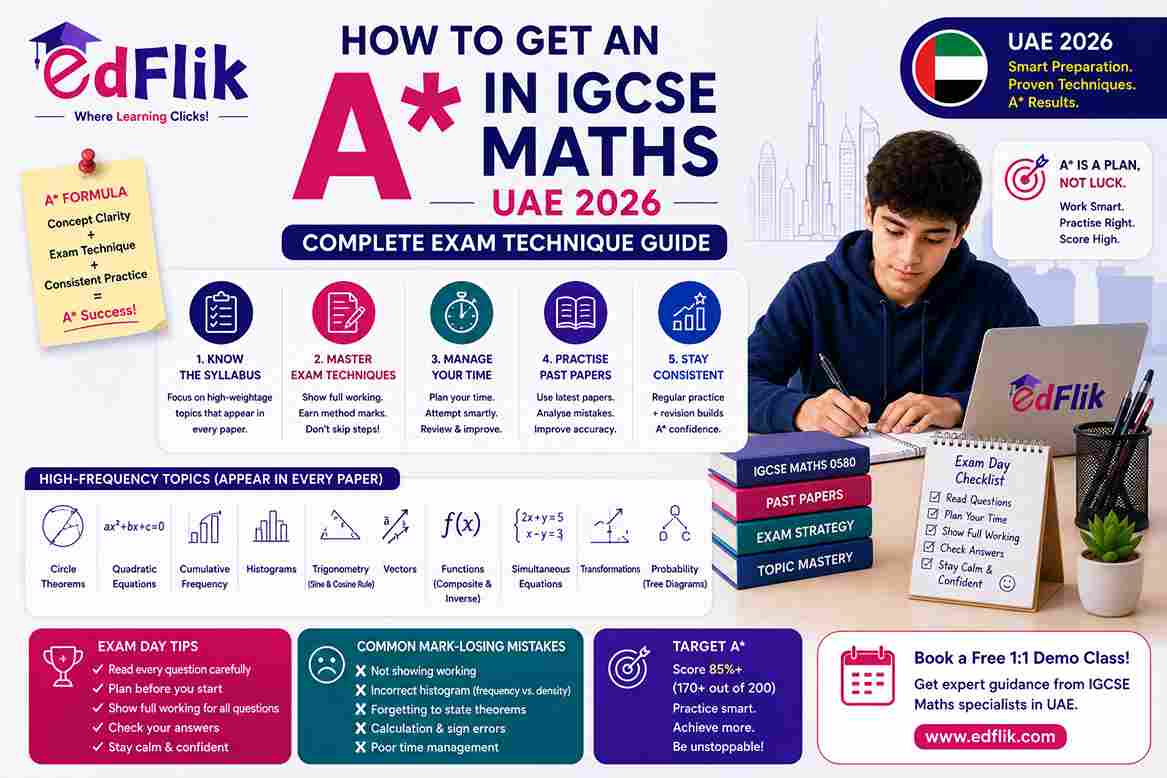
An A* in Cambridge IGCSE Mathematics 0580 is the most requested outcome from UAE families who enrol with EdFlik for IGCSE Maths tutoring. It is achievable for students who understand the mathematics — but it requires more than subject knowledge. Three specific technique differences consistently separate A* performance from A performance in Cambridge 0580, based on analysis of Cambridge Principal Examiner Reports from 2019 to 2025. This guide explains what those three differences are, how to close each gap, and what a structured A* preparation programme looks like for a UAE student at a Dubai, Abu Dhabi, or Sharjah British-curriculum school.
What the A* Grade Actually Requires — The Mark Targets
Cambridge IGCSE Mathematics 0580 Extended total: 200 marks across Paper 2 (70 marks, non-calculator from June 2025) and Paper 4 (130 marks, calculator). Historical A* boundary ranges:
|
Grade |
Approximate
Mark Range |
Percentage |
What This
Means in Practice |
|
A* |
~175 to 195 / 200 |
87.5 to 97.5% |
Very high accuracy across all topics; full method marks; circle
theorem reasoning marks; histograms correct |
|
A |
~145 to 174 / 200 |
72.5 to 87% |
Strong performance; some method mark losses; minor technique
errors |
|
B |
~115 to 144 / 200 |
57.5 to 72% |
Good content knowledge; consistent method mark and technique
losses |
|
C |
~85 to 114 / 200 |
42.5 to 57% |
Core algebra and arithmetic competent; consistent losses on
extended topics |
These are approximate historical ranges. Cambridge publishes official grade thresholds at cambridgeinternational.org after each August results release. UAE students targeting A* should aim to score consistently above 170/200 (85%) in practice to have a reliable buffer.
The Three Technique Differences Between A and A* in Cambridge 0580
Difference 1: Method Mark Compliance
The most consistent finding in Cambridge Principal Examiner Reports for 0580 across every year from 2019 to 2025 is this: a significant proportion of candidates lose marks by writing only final answers to multi-step questions, without showing the working that earns method marks.
Cambridge 0580 uses three mark types in calculation questions: M marks (method marks — awarded for correct method shown in writing, zero if no working shown), A marks (accuracy marks — for the correct final answer), and B marks (independent marks for specific intermediate values). A 5-mark simultaneous equations question typically carries 1B + 2M + 2A marks. A student who solves correctly but shows no working earns 1B + 0M + 1A = 2 marks out of 5. The same student who writes every step earns 1B + 2M + 2A = 5 marks.
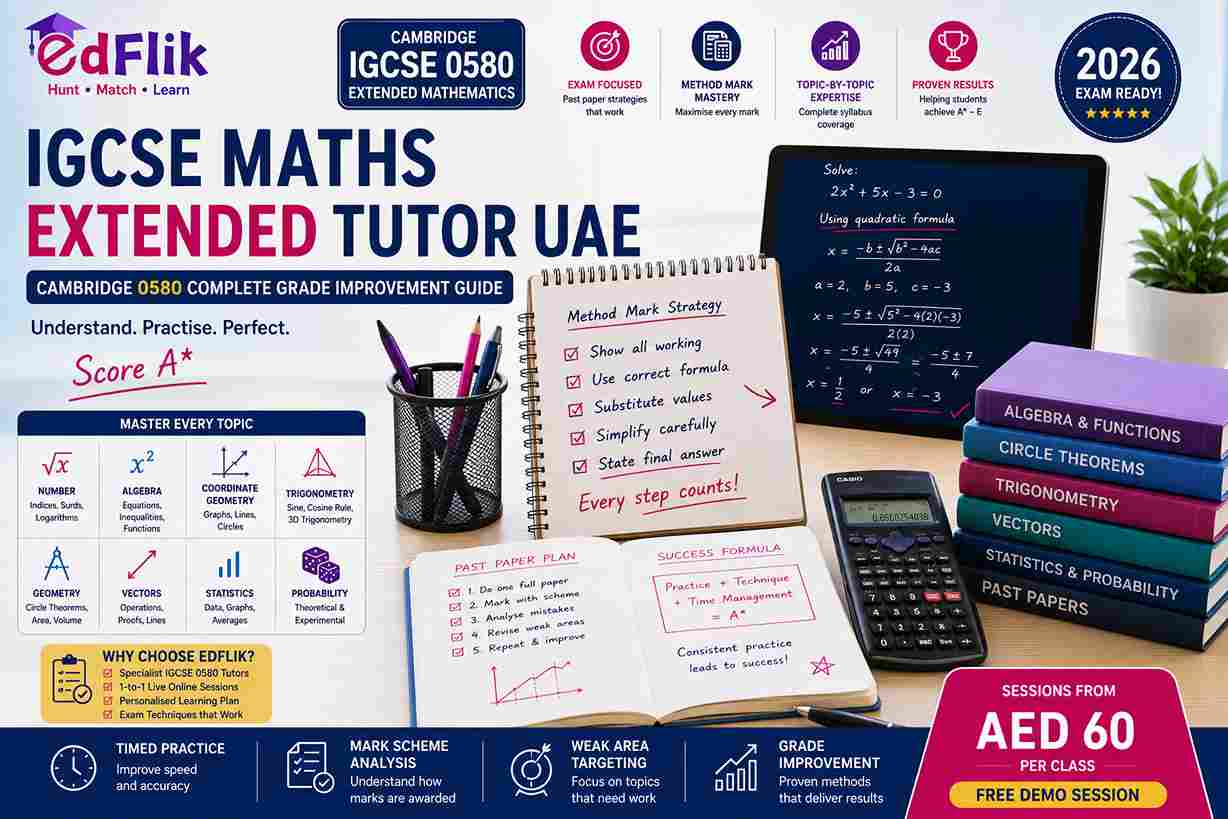
The A* rule: for every calculation question, write the formula used, write the substitution of values, show every algebraic or arithmetic step, circle or underline the final answer. This is non-negotiable. It is the single habit that most reliably moves UAE students from A to A*.
|
Question Type |
What to Write |
What Not to
Write |
|
Solving a quadratic |
Write: x² + 5x + 6 = 0; (x+2)(x+3) = 0; x = –2 or x = –3 |
Write: x = –2 or –3 (no working shown — earns answer mark only) |
|
Trigonometry calculation |
Write: sin rule formula; substitute values; rearrange; calculate
angle |
Write: 47.3° (correct answer, no method — earns 1 mark of 3) |
|
Circle theorem angle |
Write: angle in same segment are equal; angle ABC = 35° |
Write: 35° (correct but no theorem stated — loses reasoning mark) |
|
Histogram |
Write: frequency density = frequency ÷ class width; calculate
each class; draw bars with frequency density on y-axis |
Draw bars with frequency on y-axis — earns zero for diagram |
Difference 2: Circle Theorem Reasoning Marks
Circle theorem questions appear in every Paper 4 and are worth 5 to 15 marks per sitting. The mark scheme for every circle theorem question includes at least one 'reason' mark — awarded specifically for stating the name or description of the theorem used. A student who calculates the correct angle but does not state the theorem loses this mark every time. Over a full Paper 4, this can cost 4 to 8 marks.
The A* technique: for every circle theorem angle, write the angle and the theorem together. Example: 'angle OAB = 90° [tangent meets radius at 90°]'. The theorem statement in brackets is what earns the reasoning mark. Acceptable phrasings are listed in the Cambridge mark scheme — they are variations of the standard theorem descriptions listed below.
|
Theorem |
Stated Reason
(Cambridge Mark Scheme Language) |
|
Angle at centre |
Angle at centre is twice angle at circumference [subtended by
same arc] |
|
Angles in same segment |
Angles in same segment are equal |
|
Angle in semicircle |
Angle in semicircle = 90° [angle subtended by diameter] |
|
Cyclic quadrilateral |
Opposite angles of cyclic quadrilateral sum to 180° |
|
Tangent-radius |
Tangent meets radius at 90° [at point of contact] |
|
Tangent from external point |
Tangent lengths from external point are equal |
|
Alternate segment |
Alternate segment theorem [angle between tangent and chord =
angle in alternate segment] |
|
Perpendicular from centre |
Perpendicular from centre bisects chord |
Difference 3: Paper 2 Non-Calculator Accuracy
From June 2025, Paper 2 is a non-calculator paper. This changes the profile of A* performance on Paper 2 — it now rewards non-calculator arithmetic fluency and exact form answers. UAE students who reach for their calculator instinctively and write decimal approximations consistently lose accuracy marks that require exact form.
Three specific Paper 2 non-calculator habits for A* performance:
• Leave surds exact: 3√2 not 4.243; √75 = 5√3 not 8.66. When a question does not specify a decimal form, exact surd is required for full marks.
• Leave π answers exact: 6π cm not 18.85 cm. Only round to a decimal when the question specifies 'correct to n decimal places' or 'correct to n significant figures.'
• Exact trig values from memory — no calculator: sin 30° = 0.5, cos 30° = √3/2, sin 45° = √2/2, tan 45° = 1, sin 60° = √3/2, cos 60° = 0.5. These must be instant recall. Build a flashcard for each and review daily until automatic.
A* Preparation Programme for UAE IGCSE Maths Students
|
Phase |
When |
Daily/Weekly
Focus |
A* Target |
|
Foundation |
Sep–Nov Year 10 |
45 min/day: one high-frequency topic per week — circle theorems,
quadratics, cumulative frequency, histograms, vectors, functions,
trigonometry, simultaneous equations, transformations, probability |
All 10 core topics understood and all 8 circle theorems memorised |
|
Topic past paper questions |
Nov Year 10 – Jan Year 11 |
Topic-specific past paper questions — 20 questions per topic,
marked against Cambridge mark scheme. Log every error type. |
Method step habit established; circle theorem reasoning marks
automatic |
|
Full timed paper practice |
Jan – April Year 11 |
Full Paper 2 + Paper 4 pair per week under strict timed
conditions. Mark immediately. Track score per paper. |
Consistent 85%+ (170/200). Non-calculator Paper 2 exact form
answers automatic |
|
Consolidation |
April – exam |
Circle theorem flashcard review daily. Exact trig values drill.
One full paper pair per subject per week. No new topics. |
Confidence through repetition. Exam technique automatic. |
Frequently Asked Questions — How to Get A* in IGCSE Maths UAE
Q: What mark do UAE students need for an A* in IGCSE Maths 0580?
A: Approximately 175 to 195 out of 200 marks (87 to 97 percent) based on historical grade thresholds 2019 to 2025. The exact boundary varies each series. UAE students should target consistently scoring above 170/200 (85%) in practice to have a reliable buffer above any year's A* threshold.
Q: What is the single biggest difference between A and A* in IGCSE Maths?
A: Three specific technique differences: (1) Method mark compliance — writing complete working for every calculation question, not just the final answer. (2) Circle theorem reasoning marks — stating the theorem name alongside every angle calculation. (3) Paper 2 exact form answers — leaving surds, fractions, and π answers in exact form rather than rounding to decimals. All three are technique habits, not subject knowledge gaps — they can be changed in weeks.
Q: How should UAE students prepare for the non-calculator Paper 2?
A: Four skills: exact arithmetic (surds, fractions, multiples of π); exact trig values from memory (sin 30°, cos 45°, tan 60° etc.); algebraic manipulation without calculator; index laws and standard form arithmetic. Practice: complete pre-2025 Paper 2 papers without a calculator to build the habit even though those papers originally allowed calculators.
Q: How many past papers should UAE students complete for A*?
A: 8 to 12 full Paper 2 + Paper 4 pairs under timed conditions, most recent series first. Quality of mark-scheme review matters more than volume. After each paper: categorise every lost mark as method presentation, knowledge gap, or arithmetic error. Address the specific gap before the next paper.
Q: Which topics should UAE students focus on first?
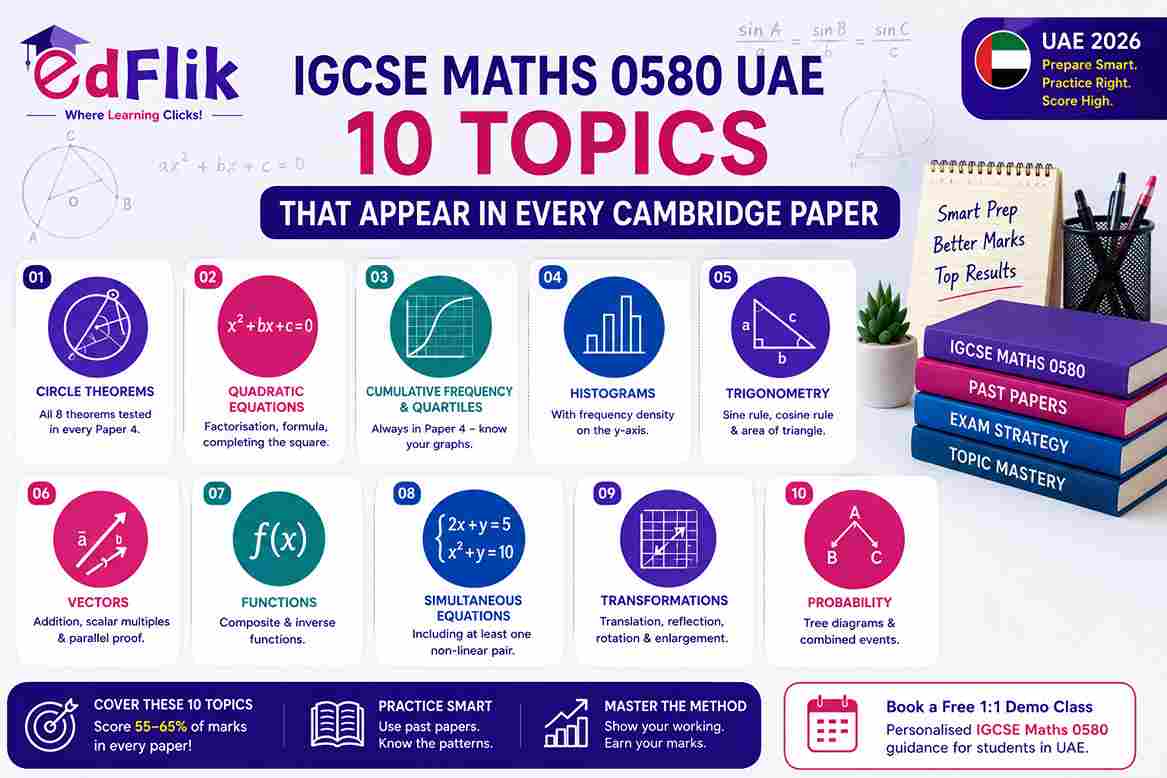
A: The 10 high-frequency topics that appear in every series: circle theorems (all 8), cumulative frequency, histograms (frequency density), vectors, quadratics (all 3 methods), trigonometry (sine and cosine rule), functions (composite, inverse, domain, range), simultaneous equations including non-linear, transformations (all 4 types with full descriptions), probability with tree diagrams. These account for over half of all available marks.
How EdFlik Supports UAE Students Targeting A* in IGCSE Maths
EdFlik IGCSE Maths tutors use past papers with mark-scheme correction in every session. The first session identifies whether the gap is presentation (method marks — the most common A vs A* differentiator) or topic knowledge. From AED 60 per class. Free demo. www.edflik.com.