How to Synthesize 3+ Sources Without Sounding Robotic in the AP Lang Argument Essay
Last Updated: October 2026 | By EdFlik Education Team
For high school students enrolled in Advanced Placement (AP) English Language and Composition, the Synthesis Essay (Question 1 of the free-response section) is often the most daunting writing task on the exam.
Unlike a standard persuasive essay where you rely entirely on your own opinions and general knowledge, the AP Lang Synthesis prompt requires you to read six disparate sources—ranging from historical essays and political cartoons to academic studies and newspaper editorials—and synthesize at least three of them into a cohesive, sophisticated argument of your own.
The single biggest trap that prevents students from earning a score of 5 on this essay is falling into the "Source-Summary Robot" trap. When students feel intimidated by the prompt, they default to a rigid, mechanical formula: Source A says this. Source B says that. Source C agrees. The essay reads less like an intellectual argument and more like a disjointed book report.
In this comprehensive, exam-focused masterclass guide, our expert AP English educators break down the College Board synthesis rubric, reveal advanced integration techniques, and provide a step-by-step framework to help you weave multiple sources together seamlessly without ever sounding robotic.
Part 1: Decoding the AP Lang Synthesis Rubric
Before examining how to weave sources together, you must understand what AP readers (graders) are looking for in a top-scoring essay. The 6-point rubric awards points across three distinct categories:
- Thesis (1 Point): A defensible, nuanced claim that responds directly to the prompt.
- Evidence and Commentary (4 Points): Selecting and citing evidence from at least three sources, and more importantly, providing deep commentary that explains how that evidence supports your line of reasoning.
- Sophistication (1 Point): Demonstrating a complex understanding of the prompt through nuanced arguments, insightful connections across sources, or an exceptional stylistic command.
Notice what is not on the rubric: A requirement to quote every source verbatim or summarize each source in a separate paragraph. The operative word in the prompt is synthesize—which literally means to combine separate elements to form a coherent whole. Think of yourself not as a security guard checking off sources one by one, but as a symphony conductor bringing different instruments together into a single harmony.
Part 2: The 3 Conversational Techniques to Eliminate Robotic Writing
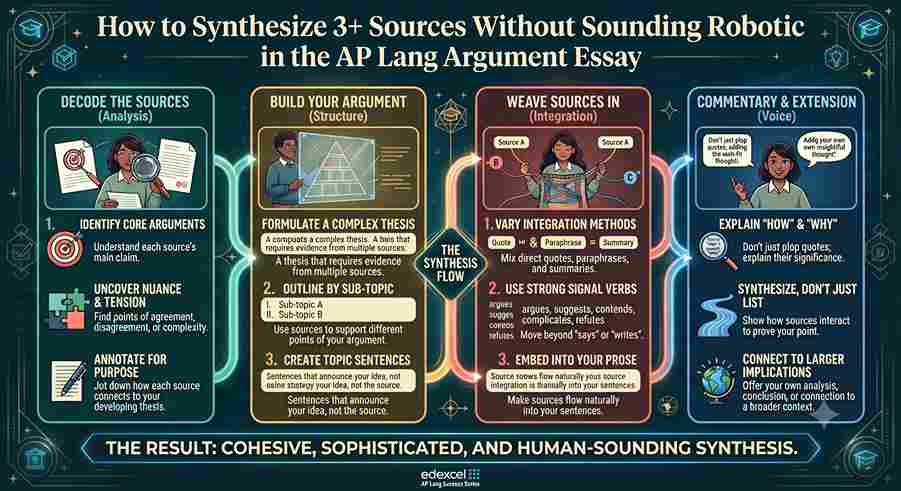
To transform your essay from a choppy list of source summaries into a sophisticated argumentative synthesis, master these three writing techniques:
1. Source-to-Source Dialogue (The Roundtable Discussion)
Never treat your sources as isolated islands. Instead, imagine placing them around a dinner table and having them talk to one another.
- Robotic: "Source A says technology harms attention spans. Source B agrees. Source C gives statistics about social media."
- Sophisticated Synthesis: "While cultural critics like Author A lament the erosion of deep reading in the digital age, technologist B counters that online platforms merely foster new, decentralized forms of digital literacy—a tension illuminated by the empirical data in Source C..."
2. Attribution Embedded Within Your Own Syntax
Avoid dumping formal, clumsy attribution tags at the beginning or end of every sentence (e.g., "According to Source 1, ... In Source 4, the author states that ..."). Instead, embed the author’s credentials or perspective naturally into the flow of your own sentence structure.
- Robotic: "Source D is an article by a historian. He says libraries are dying."
- Sophisticated Synthesis: "Writing from the perspective of institutional history, architectural historian Marcus Vance (Source D) argues that public libraries have evolved far beyond mere book repositories into vital community anchors."
3. Using Sources as Subordinate Support, Not the Main Driver
Your voice, your thesis, and your line of reasoning must drive the essay. The sources should act as witnesses in your courtroom argument—they provide testimony and data, but you are the attorney making the overarching case to the jury. Never let a source speak for itself; every single quotation or data point must be immediately followed by your own analytical commentary explaining its significance.
Part 3: Step-by-Step Writing Workflow for the Synthesis Essay
To execute a seamless synthesis essay under strict 40-minute time constraints, use this structured four-part writing blueprint:
Step 1: The 10-Minute Source Audit & Thesis Formulation
- Do not start writing immediately. Spend the reading period skimming all six sources.
- Categorize them into camps (e.g., Sources supporting the shift vs. Sources warning against it).
- Formulate a complex thesis that takes a clear stand and acknowledges potential counter-arguments. Never write a simplistic "yes/no" thesis.
Step 2: The Conversational Introduction (Paragraph 1)
- Hook the reader by framing the broader societal debate or tension surrounding the prompt.
- Introduce brief context without copying sentences verbatim from the prompt background info.
- Conclude with your robust, defensible thesis statement.
Step 3: Body Paragraphs Driven by Sub-Claims, Not Source Names (Paragraphs 2–4)
- Never name your body paragraphs after sources (e.g., “Paragraph 2: Source A and B”). Instead, name your body paragraphs after sub-claims that support your thesis.
- Within each body paragraph, seamlessly weave in evidence from two or three different sources to substantiate your sub-claim. Use transitional phrases like “Expanding upon this economic reality,” “Conversely, institutional perspectives suggest,” or “This quantitative trend is corroborated by...”
Step 4: The Synthesis Conclusion (Final Paragraph)
- Step back from the specific details of the sources and synthesize the broader implications of your argument.
- Answer the perennial "so what?" question: Why does this debate matter for society moving forward?
Part 4: Top 4 Traps That Destroy AP Lang Synthesis Scores
- Over-Quoting and Long Block Quotes: Dropping massive three-sentence quotes into your paragraph and expecting the reader to figure out what they mean. Rule of thumb: Never quote more than 5 to 8 words consecutively without embedding them into your own grammatical structure. Paraphrase when possible!
- Failing to Cite Sources: Forgetting to include parenthetical citations (e.g., [Source C]) or author attributions. While AP readers won't fail you for missing a citation format, failing to credit your sources makes your evidence unverified.
- Using Fewer Than 3 Sources: Accidentally relying on only 2 sources. The official College Board rubric has a strict ceiling—if you integrate fewer than 3 sources, you cannot earn above a certain score in evidence, regardless of how brilliantly written your essay is.
- Agreeing Too Submissively with Every Source: Assuming that because a source is provided in the exam packet, you must praise it. Feel free to challenge a source, critique its methodology, or point out its limitations to strengthen your own argument!
Preparing for the AP English Language exam and aiming for a score of 5? EdFlik connects international school students globally with expert, 1-to-1 online AP English tutors, helping you master rhetorical analysis, synthesis argumentation, and timed exam strategies. Book a Free Demo Class Today!
Frequently Asked Questions (FAQs)
Q1: How many sources must I use on the AP Lang Synthesis Essay?
Ans: The official College Board requirement states you must cite a minimum of 3 sources. However, top-scoring students typically integrate 4 to 5 sources to build a robust, multi-faceted argument without overloading the essay.
Q2: Can I use outside knowledge in the AP Lang Synthesis Essay?
Ans: Yes! While the primary foundation of your evidence must come from the provided sources, expertly weaving in relevant historical, literary, or current-events outside knowledge is a hallmark of sophistication on the rubric.
Q3: Is it better to paraphrase or quote directly from the sources?
Ans: Paraphrasing is almost always superior to direct quoting. Paraphrasing demonstrates that you truly comprehend the source material and allows you to maintain your own unique voice and essay rhythm. Reserve direct quotes only for striking phrases or definitive statistics.
Q4: How does EdFlik support AP Lang students?
Ans: EdFlik connects international school students worldwide with vetted, expert 1-to-1 online AP English tutors. Our personalized coaching focuses on dissecting rhetorical strategies, refining essay structures, and practicing under timed exam conditions.