IB Biology HL UAE 2026 — IA Guide, Molecular Biology Technique and Command Terms
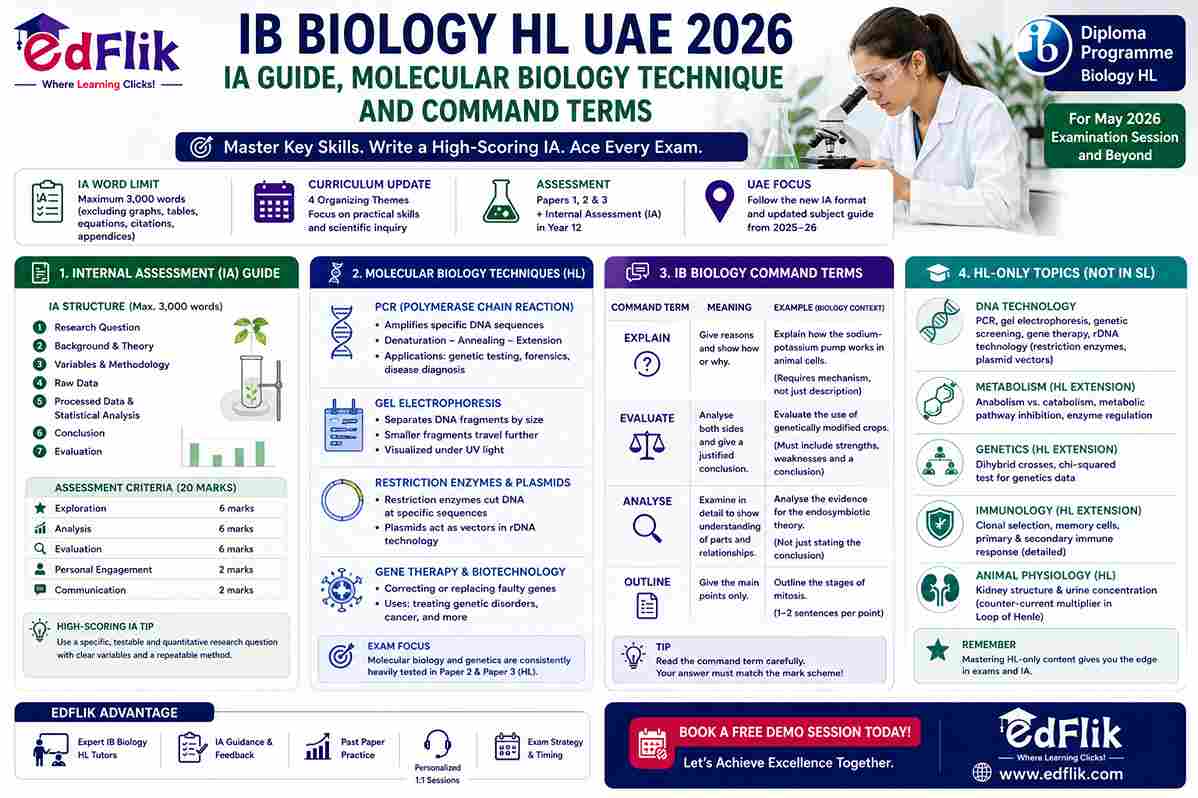
IB Biology HL is the fourth most requested IB tutoring subject from UAE families at IB schools — after Maths AA HL, Chemistry HL, and Economics HL. It is also the subject with the most common mismatch between what students study and what the IB examination actually assesses: students who have genuinely learned the biology consistently lose marks on Paper 2 extended response questions by answering with description when 'explain' requires mechanism, or by writing one-sided responses when 'evaluate' requires two-sided analysis. This guide addresses the two most significant mark-improvement opportunities for UAE IB Biology HL students: IA structure under the new 2026 guidelines and command term compliance.
IB Biology HL Internal Assessment — Updated 2026 Structure
|
IA Section |
Word Limit
Guidance |
Criterion
Assessed |
What Earns
Top Marks |
|
Research question |
Not counted in 3,000 words — stated clearly and separately |
Exploration (Criterion A) |
Specific, testable, quantitative — names both independent and
dependent variables with measurement units and controlled conditions |
|
Background information |
~300 words |
Exploration — personal engagement |
Links directly to the research question; references relevant
biological theory; shows genuine student interest rather than textbook copy |
|
Variables and methodology |
~400 words |
Exploration |
Independent, dependent, and minimum 3 controlled variables all
named with specific measurement methods; method replicable from description
alone; risk assessment relevant to materials used |
|
Raw data |
Not counted (tables) |
Analysis (Criterion B) |
Clear table with quantity and unit in column headings (not in
data cells); data to appropriate precision; no calculations in raw data table |
|
Processed data and statistics |
~500 words + graphs |
Analysis |
Mean and standard deviation calculated and shown; error bars on
graphs; appropriate statistical test (t-test, chi-squared) applied and
interpreted; one clear graph per trend |
|
Conclusion |
~300 words |
Evaluation (Criterion C) |
States whether data supports hypothesis; links specific data
values to the conclusion; connects findings to biological theory from
background |
|
Evaluation |
~400 words |
Evaluation |
Names 3 to 4 specific sources of error with the direction of each
error's effect; proposes specific improvements with realistic alternatives;
avoids generic 'human error' |
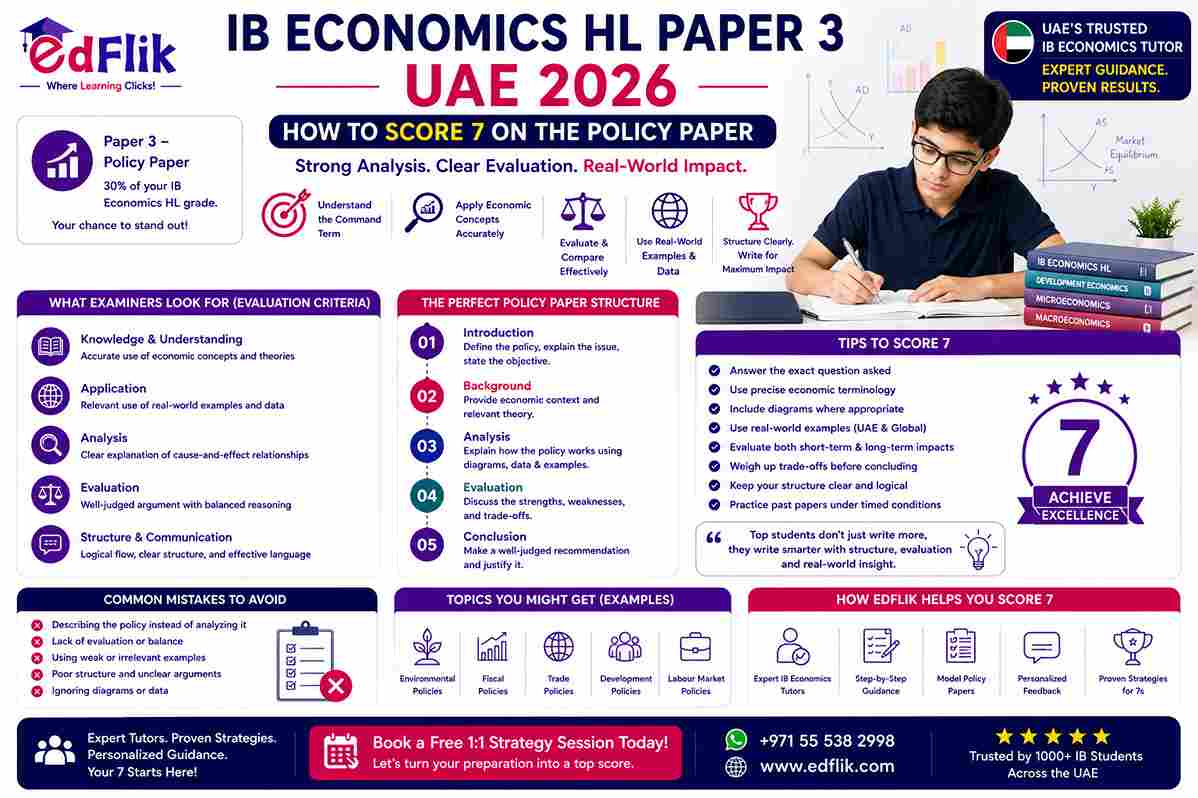
Command Term Compliance — The Highest-Yield Improvement for UAE IB Biology HL
Every IB Biology question uses a command term that specifies exactly how much and what type of response is required. Students who respond to a 4-mark 'explain' question with the same type of answer they give to a 2-mark 'state' question consistently score 2 out of 4. The mark scheme awards marks per step — not holistically — and each command term changes what those steps are.
|
Command Term |
What IB Means
By It |
Marks
Typically Awarded |
UAE Student
Error |
|
State / Identify |
Give a specific, concise factual answer — one point per mark |
1–2 marks |
Writing a full paragraph for a 'state' question — wastes time
without earning more marks |
|
Outline |
Give a brief account — 1 to 2 sentences per mark point |
2–3 marks |
Treating 'outline' as 'explain' — writing the mechanism when only
the summary is required |
|
Describe |
Give a detailed account without requiring explanation of cause |
3–4 marks |
Confusing 'describe' and 'explain' — mechanism not needed for
'describe'; describing instead of explaining for 'explain' |
|
Explain |
Give a detailed account of the cause-and-effect mechanism — each
step earns a mark |
4–6 marks |
Stating the outcome without the mechanism: 'active transport
requires ATP' (earns 1). Full mechanism with conformational change, gradient
direction, ion numbers (earns 3–4) |
|
Analyse |
Break down and examine the components and their relationships |
4–5 marks |
Presenting only the conclusion without analysing the components
that lead to it |
|
Evaluate |
Give a balanced account of advantages and disadvantages, or
limitations, reaching a conclusion |
5–8 marks |
Writing only advantages — 'evaluate' requires both sides;
one-sided responses earn marks for only the side presented |
|
Compare and contrast |
Give an account of similarities AND differences between two
things |
4–6 marks |
Writing only similarities or only differences — the command
requires both; 'compare' alone requires only similarities |
HL-Only Topics — What UAE IB Biology HL Students Must Know Beyond SL
DNA Technology — The Most Tested HL Extension
DNA technology is the HL extension topic that appears most consistently in IB Biology HL Paper 2 and Paper 3 questions — and it is the topic where UAE students most frequently have only partial knowledge. The complete HL DNA technology requirement:
• PCR (Polymerase Chain Reaction): three stages — denaturation (94°C — hydrogen bonds between strands broken), annealing (50–65°C — primers bind to complementary sequences on each strand), extension (72°C — Taq polymerase synthesises new strands from each primer). Each cycle doubles the number of DNA copies. After 30 cycles, approximately 2³⁰ = 10⁹ copies.
• Gel electrophoresis: DNA fragments separated by size (smaller fragments travel further in the gel toward the positive electrode); fragments visualised under UV light using ethidium bromide or similar stain; gel run at a set voltage for a set time; DNA ladder (known size markers) run alongside for comparison.
• Recombinant DNA: restriction enzymes cut DNA at specific palindromic sequences, creating sticky ends; sticky ends allow complementary DNA fragments to be joined using DNA ligase; the recombinant DNA is inserted into a vector (typically a plasmid or virus) for introduction into a host cell.
• Genetic screening: using gene probes (complementary DNA sequences labelled with radioactive or fluorescent markers) to detect the presence of specific alleles; Southern blotting technique; prenatal and carrier testing applications.
Dihybrid Crosses and Chi-Squared Test
Dihybrid crosses appear regularly in IB Biology HL Paper 3. The key skill: determining whether two genes assort independently (Mendel's second law) or are linked. The chi-squared test: calculate the expected frequencies based on the null hypothesis of independent assortment; calculate χ² = Σ[(O–E)²/E]; compare to the critical value at p=0.05 with degrees of freedom = (number of phenotype classes – 1); if χ² exceeds the critical value, the null hypothesis is rejected — genes are not assorting independently (i.e. they are linked).
UAE-Accessible IB Biology HL IA Topics
|
Topic Area |
Sample
Research Question |
Why It Works
for UAE Students |
|
Enzyme kinetics |
How does hydrogen peroxide concentration (0.5, 1.0, 1.5, 2.0,
2.5% v/v) affect the rate of catalysis (cm³ O₂ produced per minute) by
catalase extracted from potato at 25°C? |
Accessible materials; clear quantitative measurement; allows
statistical analysis; strong link to enzyme biology HL extension |
|
Osmosis in plant tissue |
How does sucrose concentration (0.0, 0.2, 0.4, 0.6, 0.8 mol/dm³)
affect the percentage change in mass of potato cylinders after 30 minutes at
25°C? |
Classic, well-understood method; reliable data; allows water
potential calculation and comparison to theoretical values |
|
Photosynthesis rate |
How does light intensity (250, 500, 750, 1000, 1500 lux) affect
the rate of photosynthesis (bubbles per minute) in Elodea canadensis at 20°C
in 1.5% NaHCO₃? |
Clear limiting factor application; accessible setup; strong link
to photosynthesis theory; measurable dependent variable |
|
Heart rate response |
How does a 5-minute period of moderate aerobic exercise affect
heart rate (beats per minute) recovery time in 16-year-old students 5 minutes
after exercise cessation? |
Relevant to human physiology HL extension; personally engaging;
allows ethical design with informed consent |
Frequently Asked Questions — IB Biology HL UAE 2026
Q: What changed in IB Biology HL Internal Assessment from May 2026?
A: The word limit is now a maximum of 3,000 words (excluding graphs, tables, equations, citations, appendices). The structure remains the same. The revised curriculum is also organised around four broad themes with greater emphasis on practical skills and scientific inquiry. UAE students starting IB Biology HL from 2025–26 must use the new subject guide and IA format.
Q: How should UAE IB Biology HL students structure their Internal Assessment?
A: Five criteria: Exploration (6 marks — specific quantitative research question, variables, method), Analysis (6 marks — raw data table, processed data with mean/SD/error bars, statistical test), Evaluation (6 marks — conclusion linked to data, specific limitations with improvements), Personal Engagement (2 marks), Communication (2 marks). Most important: research question must name the independent variable, dependent variable, measurement unit, and controlled conditions — 'How does light affect plants?' earns zero for Exploration.
Q: What IB command terms do UAE Biology HL students most misuse?
A: 'Explain' — requires the mechanism, not just the outcome. 'Evaluate' — requires both sides (advantages and disadvantages) with a conclusion; one-sided answers earn only partial marks. 'Outline' — brief summary only; writing a full explanation for an 'outline' wastes time. 'Compare and contrast' — must include both similarities and differences.
Q: What HL-only topics must UAE IB Biology HL students master?
A: DNA technology (PCR — 3 stages, gel electrophoresis, recombinant DNA, genetic screening); dihybrid crosses and chi-squared statistical test; competitive vs non-competitive enzyme inhibition (Lineweaver-Burk plots); detailed immunology (clonal selection, memory cells, secondary immune response); kidney HL extension (counter-current multiplier in loop of Henle). Molecular biology and genetics are consistently the highest-mark HL extension topics on Papers 2 and 3.
How EdFlik Supports IB Biology HL Students Across UAE
EdFlik IB Biology HL tutors cover command term compliance, IA structure under the new 3,000-word limit, and HL extension topics including DNA technology and dihybrid crosses. From AED 70 per class. Free demo. www.edflik.com.