IGCSE English Language 0500 UAE — How to Answer Comprehension Questions for A*
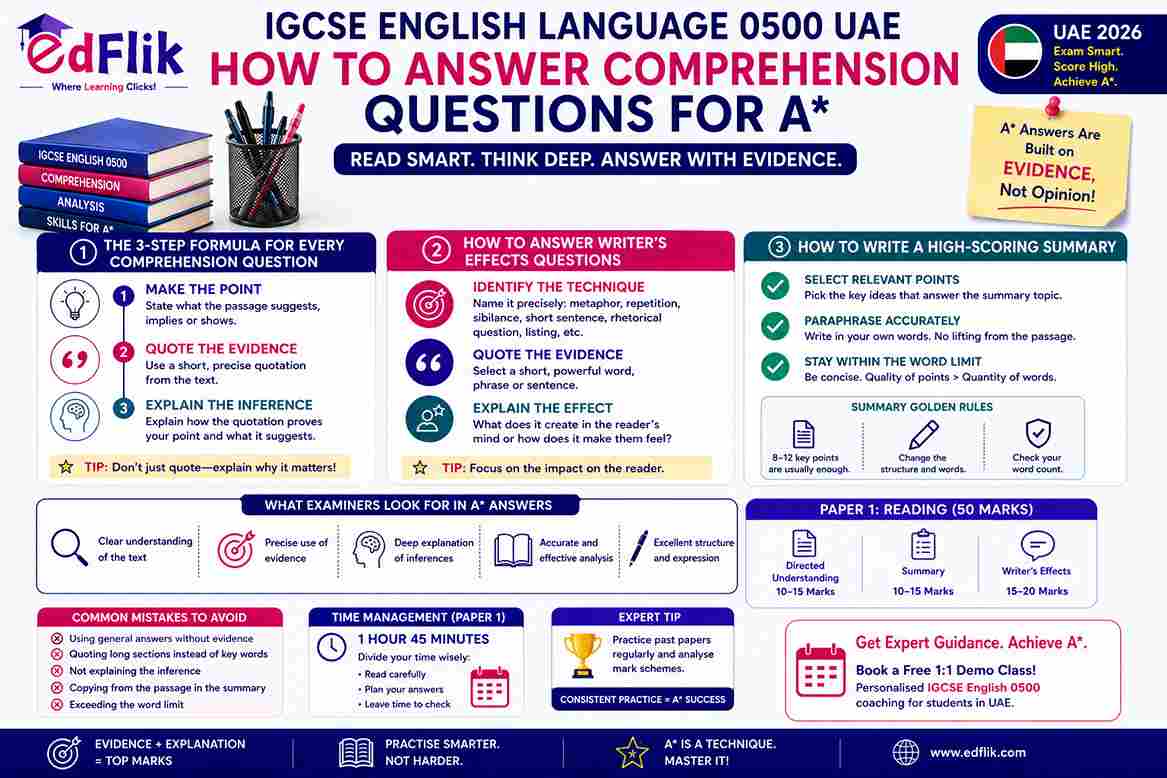
IGCSE English Language 0500 is one of the most consistently underestimated subjects in UAE British-curriculum schools. Parents and students who see a confident, articulate English speaker regularly expect high marks — and are genuinely surprised when mock results come back with B grades rather than A*. The gap is almost never about language ability. UAE students who are strong conversational English speakers, wide readers, and clear writers consistently lose marks in comprehension because they are answering in the wrong mode: describing the text rather than inferring from it; paraphrasing rather than quoting; explaining generally rather than specifically. This guide addresses each mode error directly.
The Cambridge 0500 Paper 1 Structure — What is Actually Being Tested
|
Question Type |
Typical Marks |
What
Cambridge is Testing |
Most Common
UAE Error |
|
Directed understanding / inference |
10–15 |
Reading the text precisely; drawing accurate inferences from
specific words and phrases; evidence-based conclusions |
Describing what happens rather than inferring what the text
implies or suggests |
|
Summary |
10–15 |
Selecting only relevant points; paraphrasing genuinely (not
lifting); staying within the word limit |
Copying the passage's exact words (lifting) and exceeding the
word count |
|
Writer's effects / language analysis |
15–20 |
Identifying specific techniques by name; quoting precise
evidence; explaining the effect on the reader specifically |
Naming general techniques ('descriptive language', 'figurative
language'); explaining effects vaguely ('more interesting') |
The Three-Step Inference Formula — For Every Comprehension Mark
Every mark on Cambridge 0500 Paper 1 is earned by a combination of three elements. Every answer — for every question type — should follow this formula:
|
Step |
What to Do |
What it Looks
Like |
What to Avoid |
|
1. Point |
State what the text suggests, implies, or shows — your
interpretation |
'The writer suggests the character is overwhelmed by the
situation...' |
'The character is overwhelmed' (states, does not infer; no
evidence) |
|
2. Quote |
Find the specific word or short phrase that proves the point —
quote it precisely in inverted commas, integrated into your sentence |
'...shown by the phrase "unable to lift his own thoughts
above the noise"...' |
Copying an entire sentence ('The writer says "He was
overwhelmed and couldn't think and the noise was everywhere"') — too
long; no selectivity |
|
3. Explain |
Why does this word or phrase prove the point? What does it imply
that was not directly stated? |
'...which implies that the noise is not merely external but has
colonised his thinking, suggesting psychological rather than physical
paralysis.' |
'This shows he is overwhelmed' — repeating the point without
adding inferential reasoning |
This three-step structure — Point, Quote, Explain — must be applied to every comprehension mark you write. It applies to inference questions, character analysis questions, attitude and tone questions, and language effect questions. The mark scheme for every 0500 question rewards evidence-based inference at every mark level.
Applied Examples — Strong vs Weak Answers for UAE 0500 Students
Example Question: 'What impression do you get of the market in paragraph 2? Use evidence from the text to support your answer.'
Passage extract (illustrative): 'The market pressed itself against the walls of the narrow lane, each stall a small country with its own competing smells. Voices overlapped and collided. No one moved without touching someone else.'
Weak answer (typical UAE B-grade response): 'The market was very busy and crowded. There were many stalls and people. It was noisy.' — This describes what is directly stated in the text. It earns 1 mark out of a possible 4 to 6 for making simple observations.
Strong answer (A*/A-grade response): 'The writer creates the impression of a market that is almost aggressively alive — the phrase "each stall a small country with its own competing smells" implies that the individual stalls have their own identities and territories, suggesting the market is not a unified space but a collection of conflicting presences. The word "competing" is particularly significant: it suggests the stalls are in rivalry, not just co-existing, giving the impression that the market has its own internal politics. The phrase "voices overlapped and collided" reinforces this — "collided" is a word usually associated with physical impact, implying the noise is almost violent in its intensity.' — This earns full marks because each point is inferred from specific textual evidence and the explanation links the language choice to its implied meaning.
Writer's Effects — The Identify-Quote-Explain Framework in Detail
Writer's effects questions are the highest-value questions on Paper 1 and the ones where the difference between A and A* is most clearly technique, not language knowledge. The framework:
|
Element |
How to Do It |
Example
(Strong) |
What Earns
Zero |
|
Identify the technique |
Name it precisely — 'metaphor', 'personification',
'tripling/listing for cumulative effect', 'short sentence for abrupt
emphasis', 'sibilance', 'repetition of [specific word]' |
'The writer uses personification in the phrase...' |
'The writer uses descriptive language' / 'figurative language' /
'literary devices' |
|
Quote the evidence |
Short, integrated quotation — one key word or a phrase of 3 to 7
words is usually more precise than a long extract |
'..."the building had begun its slow surrender"...' |
Copying an entire paragraph; not quoting at all; paraphrasing
instead of quoting |
|
Explain the effect on the reader |
What does this make the reader feel, think, or visualise? Be
specific to this quotation — not a general comment |
'The word "surrender" implies the building has given up
resistance voluntarily, creating a sense of defeat that is sadder than simple
decay — the reader is made to feel sympathy for an inanimate object' |
'This creates imagery' / 'this makes it more vivid' / 'this shows
the building is old' |
Summary Questions — The Own-Words Rule
Summary marks are awarded only for points expressed in genuine paraphrase — not lifted from the passage. The mark scheme specifies this explicitly: candidates who copy or closely paraphrase the original text without demonstrating understanding receive no marks for those points, even when the information selected is correct.
What 'own words' actually means: it is not enough to replace individual words with synonyms while keeping the same sentence structure. Genuine paraphrase rewrites the idea in a completely different sentence structure and vocabulary. If the passage says 'the expedition faced severe and unexpected climatic deterioration', own-words paraphrase is 'the team encountered weather that was far worse than they had anticipated' — different vocabulary, different sentence structure, same meaning.
The word limit rule: Cambridge examiner reports consistently note that exceeding the word limit does not add marks — it adds time spent writing content that receives no credit. Count your words. Stop at the stated limit. If you are over, remove points rather than compressing language — shorter, well-chosen points score better than many weak points squeezed into fewer words.
Frequently Asked Questions — IGCSE English 0500 Comprehension UAE
Q: Why do UAE students underperform in IGCSE English comprehension despite good English?
A: The gap is technique, not language. UAE students who are articulate English speakers lose marks by describing the text rather than inferring from it, and by not showing the specific quotation-based evidence that Cambridge mark schemes require. A fluent response with no specific textual evidence earns very few comprehension marks regardless of how well-written it is.
Q: What is the correct formula for answering 0500 comprehension questions?
A: Three steps every time: (1) Make the point — what does the text suggest or imply? (2) Quote the specific word or short phrase that proves it — use inverted commas, keep it short. (3) Explain the inference — why does this word prove the point? What does it imply that is not directly stated? Every mark on Paper 1 rewards evidence-based inference, not description.
Q: How should UAE students answer writer's effects questions?
A: Three elements: (1) Identify the technique precisely — 'metaphor', 'repetition', 'short sentence for emphasis'. Not 'descriptive language' or 'figurative language'. (2) Quote the specific word or phrase — short, integrated. (3) Explain the effect on the reader specifically — what feeling or impression does this create and why? 'Creates imagery' earns nothing. 'Creates the impression of X in the reader because Y' earns full marks.
Q: How should UAE students write summary answers?
A: Select only relevant points. Paraphrase genuinely — different sentence structure and vocabulary, not just synonym replacement. Count your words and stop at the stated limit. Cambridge awards no marks for points lifted from the passage. Quality and relevance matter more than quantity.
How EdFlik Supports IGCSE English Language 0500 Students Across UAE
EdFlik 0500 tutors use official past papers in every session. The inference formula (point-quote-explain) and writer's effects framework are built into the first session. Written feedback on student responses is provided after every practice question. From AED 60 per class. Free demo. www.edflik.com.