IB Computer Science Tutor UAE 2026 — HL and SL Programming IA, Algorithms and Exam Technique Guide
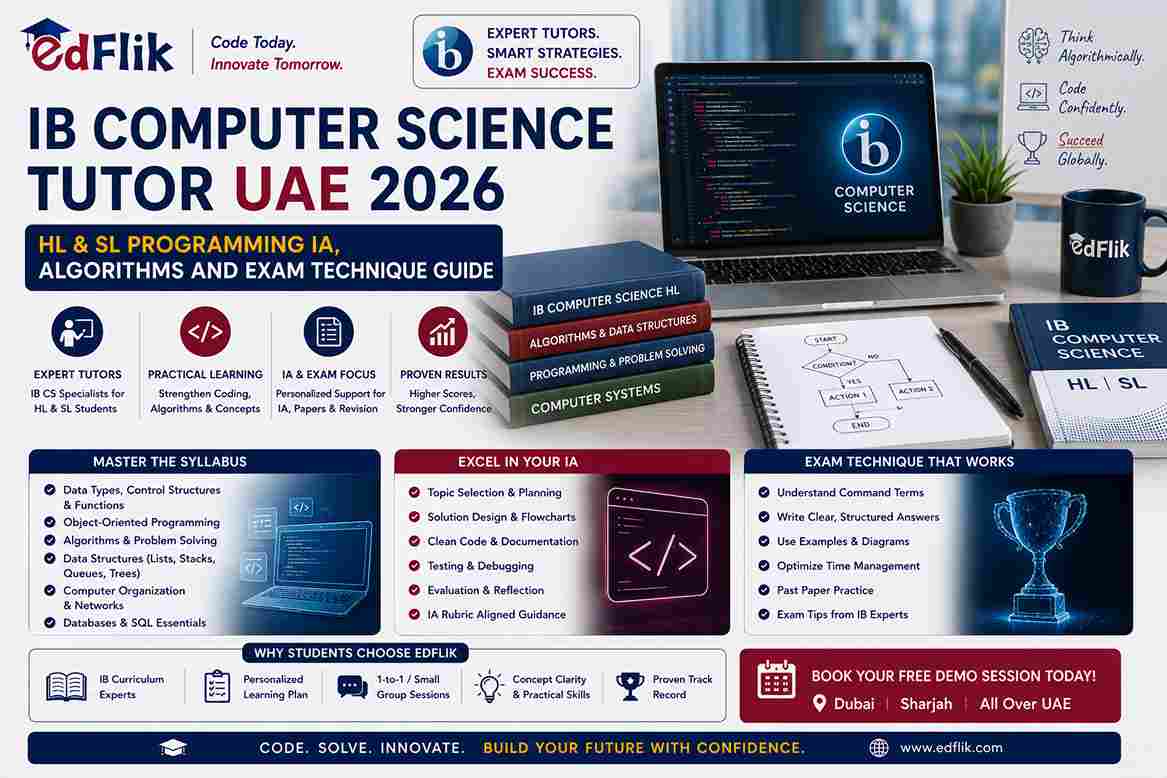
IB Computer Science (HL and SL) is one of the fastest-growing IB subjects at UAE schools, particularly at IB-exclusive schools like Dubai International Academy, NLCS Dubai, and Greenfield International. It combines programming skills with a broader computer science curriculum covering networks, system architecture, algorithms, and abstract data structures. The IA programming project is the most complex component UAE students face — this guide covers all of it.
IB Computer Science HL vs SL — Key Differences
|
Feature |
HL |
SL |
|
Additional
topics |
Abstract data
types (stacks, queues, linked lists, binary trees); HL extension (databases,
modelling, web science, or OOP) |
Core topics
only |
|
Written papers |
Paper 1 (45%),
Paper 2 (25%), Paper 3 HL extension (20%) |
Paper 1 (45%),
Paper 2 (25%) |
|
Internal
Assessment |
Programming
project — same for HL and SL (30%) |
Programming
project (30%) |
|
Algorithm
complexity |
Expected to
write and trace more complex algorithms including tree traversals and
recursive ADT operations |
Standard
algorithms — sorting, searching, recursive functions |
|
University
relevance |
Recommended
for CS, Engineering, Data Science degree applications |
Acceptable as
a supporting science for many degrees |
The IB Computer Science IA — The Most Important Component
The IA is worth 30% of the final grade and is the component UAE students most consistently underestimate in difficulty and time requirements. It involves developing a software solution for a real client, documented across five criteria. Common UAE student errors:
• Criterion A: The client interview must produce specific, measurable success criteria — not vague goals like "the program should work well." Each success criterion must be testable against the finished product.
• Criterion B: UML class diagrams, flowcharts, and data structure explanations must be present. Many UAE students skip the design documentation and code first — this reverses the intended order and results in poor Criterion B marks regardless of code quality.
• Criterion C: Annotated code must explain each technique used — students lose marks by describing what the code does rather than why each design decision was made and what makes it good.
• Criterion D: A video showing the working product meeting each success criterion. This must be planned, not improvised — students who rush the video after completing code often fail to demonstrate all success criteria clearly.
• Criterion E: Evaluation must reference the original success criteria specifically, include genuine client feedback, and discuss limitations with proposed future developments.
Algorithms — What Must Be Known and Traced
|
Algorithm |
Type |
Key
Requirements |
Common Exam
Question Type |
|
Bubble Sort |
Sorting |
Understand the
comparison-swap mechanism; know worst-case is O(n²); trace through a given
array step by step |
Trace through
3-4 passes on a given array; identify number of comparisons |
|
Selection Sort |
Sorting |
Find minimum,
swap to front; know it is O(n²) even in best case |
Trace through
a given list showing each selection |
|
Binary Search |
Searching |
Requires
sorted array; halves the search space each iteration; O(log n) |
Trace through
showing middle element and which half is discarded each time |
|
Recursive
functions |
Control flow |
Must know base
case, recursive case, and how the call stack works |
Trace through
a recursive factorial or Fibonacci showing call stack depth |
|
Stack
operations (HL) |
ADT |
Push adds to
top, Pop removes from top; LIFO structure; know overflow and underflow |
Trace through
a sequence of push/pop operations showing stack state |
|
Queue
operations (HL) |
ADT |
Enqueue adds
to rear, Dequeue removes from front; FIFO structure |
Trace through
enqueue/dequeue operations on a circular queue |
IB Pseudocode — What Must Be Written in Exams
IB Computer Science exams require answers in IB pseudocode notation, not in Python or Java. Key pseudocode elements:
• Assignment: A = 5 or output ← input + 1
• Selection: IF condition THEN ... ELSE ... END IF
• Loops: LOOP N TIMES ... END LOOP; WHILE condition DO ... END WHILE; LOOP UNTIL condition ... END LOOP
• Arrays: arr[0], arr[1]... (0-indexed); output arr.length for length
• Methods/Procedures: PROCEDURE name(parameters) ... END PROCEDURE; FUNCTION name(parameters) RETURNS type ... END FUNCTION
System Fundamentals and Networks — Non-Programming Topics
Paper 1 Section A (and some of Paper 2) tests non-programming Computer Science topics. UAE students who focus only on programming preparation consistently lose marks in these sections. Key areas requiring explicit revision: CPU architecture (ALU, control unit, registers, clock speed, cores); memory types (RAM, ROM, cache, virtual memory, the memory hierarchy); network topologies and protocols (TCP/IP, HTTP, HTTPS, DNS); data representation (binary, hexadecimal, ASCII, Unicode); Boolean algebra and logic gates (AND, OR, NOT, NAND, NOR, XOR with truth tables and circuit simplification).
|
EdFlik IB
Computer Science tutors are HL and SL specialists covering programming,
algorithms, system fundamentals, and IA project guidance (within IB Academic
Integrity Policy). Sessions from AED 70. Free diagnostic trial. Book at
www.edflik.com or WhatsApp +91 88788 96600. |
Frequently Asked Questions
Q: What is the difference between IB Computer Science HL and SL?
HL covers abstract data types (stacks, queues, linked lists, binary trees), HL extension topics, and sits an additional Paper 3. Both complete the same programming IA. HL is recommended for CS and Engineering degree applicants.
Q: What is the IB Computer Science Internal Assessment?
A programming project worth 30% of the grade. Students develop software for a real client, documented across five criteria: Planning, Design, Development, Functionality, and Evaluation. The most consistently underestimated component.
Q: Which programming languages are used in IB Computer Science?
Typically Java or Python (both accepted). Exam pseudocode uses IB pseudocode notation — not Java or Python — which must be learned separately.
Q: What algorithms must IB Computer Science students know?
Bubble sort, selection sort, binary search, recursive algorithms, and (HL) stack and queue operations with abstract data types. All must be traceable by hand in the exam.
Q: What topics does IB Computer Science cover beyond programming?
System Fundamentals (hardware, memory, OS), Computer Organisation (binary, logic gates, CPU), Networks (protocols, transmission, security), and Computational Thinking (algorithms, pseudocode, data structures).