IB DP Biology in Sharjah: Glycolysis, Krebs Cycle & Chemiosmosis Explained
By EdFlik Team | November 27, 2026
For Diploma Programme (DP) students across Sharjah—from Al Majaz, Al Khan, and Al Nahda to Muwaileh, University City, and Al Taawun—studying IB DP Biology (Standard Level and Higher Level) builds deep mechanistic understanding of how living cells harvest chemical energy from organic molecules. Within cellular energetics (including the updated IB Biology syllabus themes of Unity and Diversity and Continuity and Change under Cell Respiration), glycolysis, the link reaction and Krebs cycle (citric acid cycle), and oxidative phosphorylation / chemiosmosis appear across Paper 1 (Multiple Choice and Data-Based Questions), Paper 2 (Short-Answer and Extended-Response Questions), and Internal Assessment (IA) investigations into respiration rates, temperature/pH effects on enzymes, or yeast/mitochondrial metabolism.
Many capable Sharjah IB Biology students lose valuable marks on structured and extended-response questions because they confuse cellular locations (glycolysis in the cytoplasm vs. Krebs cycle in the mitochondrial matrix vs. proton accumulation in the intermembrane space), treat ATP as a long-term energy storage molecule rather than a short-term energy currency coupling exergonic and endergonic reactions, or describe chemiosmosis vaguely without naming the proton ($\text{H}^+$) electrochemical gradient, ATP synthase, and oxygen as the final electron acceptor.
Earning a Grade 6 or 7 in IB DP Biology requires knowing where each stage happens, what enters and leaves each pathway, and how electron transport establishes the proton-motive force that drives ATP synthesis.
This masterclass guide breaks down Glycolysis, The Link Reaction & Krebs Cycle, Electron Transport & Chemiosmosis, worked IB-style exam answers, common mark-scheme traps, FAQs, SEO meta tags, and 100% copy-paste JSON-LD schema markup.
Key Takeaways
- Know the Exact Cellular Compartments of Each Stage: Glycolysis takes place in the cytoplasm (cytosol) and does not require oxygen; the link reaction and Krebs cycle occur in the mitochondrial matrix; the electron transport chain (ETC) and chemiosmosis operate across the inner mitochondrial membrane into the intermembrane space.
- Track Net Energy Yield and Reduced Electron Carriers Accurately: Per glucose molecule, glycolysis yields a net gain of 2 ATP (via substrate-level phosphorylation), 2 reduced $\text{NAD}^+$ ($\text{NADH} + \text{H}^+$), and 2 pyruvate; one full turn of the Krebs cycle (per acetyl-CoA, so twice per glucose) generates reduced $\text{NAD}^+$ and $\text{FAD}$, ATP (or GTP) by substrate-level phosphorylation, and releases $\text{CO}_2$ via decarboxylation.
- Explain Chemiosmosis Through the Proton Gradient and ATP Synthase: Electrons from reduced carriers pass along membrane carriers, releasing energy used to pump protons ($\text{H}^+$) from the mitochondrial matrix into the intermembrane space, creating an electrochemical (proton) gradient; protons flow back down their gradient through ATP synthase, driving the phosphorylation of $\text{ADP} + \text{P}_i \to \text{ATP}$.
- State Oxygen's Exact Role at the End of Aerobic Respiration: Oxygen acts as the final electron acceptor at the end of the electron transport chain and combines with electrons and protons to form water ($\text{H}_2\text{O}$)—keeping the chain flowing so $\text{NAD}^+$ and $\text{FAD}$ can be regenerated for glycolysis and the Krebs cycle.
Part 1: Glycolysis, Link Reaction & Krebs Cycle
Aerobic cell respiration breaks down glucose step by step so energy is released in controlled increments rather than all at once.
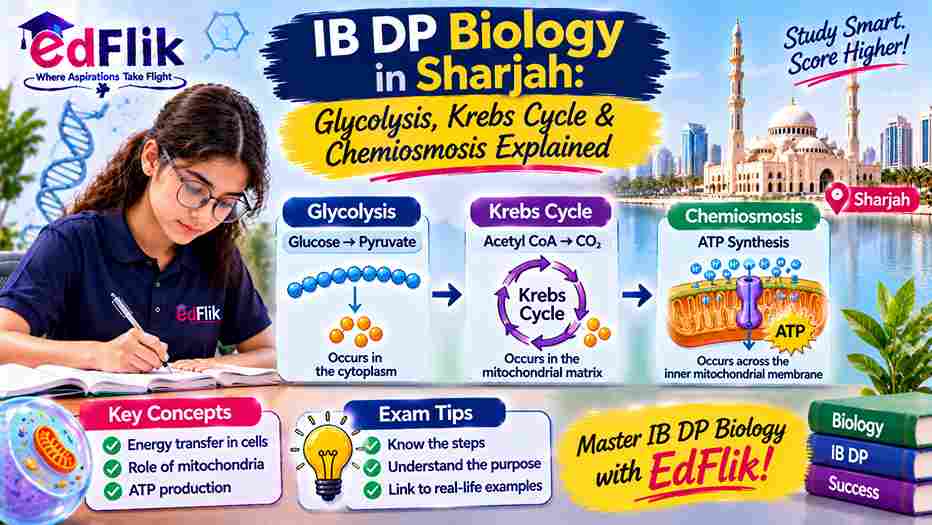
As illustrated in the cellular respiration overview diagram above, glycolysis splits six-carbon glucose in the cytoplasm into pyruvate, which then enters mitochondria for the Krebs cycle and electron transport chain.
Stage-by-Stage Comparison: Glycolysis vs. Link Reaction vs. Krebs Cycle
| Stage | Location in Cell | Key Inputs (Per Glucose / Equivalent) | Key Outputs & Fate |
| Glycolysis | Cytoplasm (cytosol) | $1\text{ glucose}$ ($6\text{C}$), $2\text{ ATP}$ (invested), $2\text{ NAD}^+$, $4\text{ ADP} + 4\text{P}_i$ | Net $2\text{ ATP}$, $2\text{ NADH} + 2\text{H}^+$, and $2\text{ pyruvate}$ ($3\text{C}$ each). Does not use $\text{O}_2$ directly. |
| Link Reaction (per pyruvate; $\times 2$ per glucose) | Mitochondrial matrix | $\text{Pyruvate}$ ($3\text{C}$), $\text{Coenzyme A}$ ($\text{CoA}$), $\text{NAD}^+$ | Produces $\text{acetyl-CoA}$ ($2\text{C}$), $\text{CO}_2$ (decarboxylation), and $\text{NADH} + \text{H}^+$ (oxidation/dehydrogenation). |
| Krebs Cycle (1 turn per acetyl-CoA; $\times 2$ per glucose) | Mitochondrial matrix | $\text{Acetyl-CoA}$ ($2\text{C}$) combines with $4\text{C}$ oxaloacetate to form $6\text{C}$ citrate; $\text{NAD}^+$, $\text{FAD}$, $\text{ADP} + \text{P}_i$ | Regenerates $4\text{C}$ oxaloacetate; releases $\text{CO}_2$, produces ATP (substrate-level), and loads reduced $\text{NAD}^+$ and reduced $\text{FAD}$. |
Part 2: Electron Transport & Chemiosmosis
While glycolysis and the Krebs cycle extract energy through substrate-level phosphorylation and transfer high-energy electrons to $\text{NAD}^+$ and $\text{FAD}$, the vast majority of ATP in aerobic respiration comes from oxidative phosphorylation coupled to chemiosmosis.
As shown in the chemiosmosis and ATP synthesis diagram above, redox energy from electron transfer powers proton pumps that move $\text{H}^+$ into the intermembrane space, establishing a proton (electrochemical) gradient across the inner mitochondrial membrane that drives ATP synthase to synthesize ATP from $\text{ADP}$ and inorganic phosphate ($\text{P}_i$).
           CHEMIOSMOSIS & OXIDATIVE PHOSPHORYLATION SEQUENCE
                                   |
  1. Electron Donation  ---> Reduced NAD and reduced FAD donate high-energy
                             electrons to carriers in the inner membrane.
  2. Proton Pumping    ---> Energy released as electrons pass from carrier to
                             carrier pumps H+ ions from the MATRIX into the
                             INTERMEMBRANE SPACE (creating a proton gradient).
  3. Proton Return     ---> H+ ions cannot diffuse freely across the lipid
     Via ATP Synthase      bilayer; they flow back down their electrochemical
                             gradient through ATP SYNTHASE channels.
  4. ATP Synthesis &   ---> Flow through ATP synthase drives phosphorylation of
     Final Acceptor        ADP + Pi -> ATP; at the end of the chain, O2 acts
                             as the FINAL ELECTRON ACCEPTOR with H+ to form H2O.
Part 3: Exam-Style Worked Answers (IB DP Biology Style)
Worked Question 1: Explaining Chemiosmosis & ATP Synthesis (6–7 Marks)
Question: Explain how the electron transport chain and chemiosmosis generate ATP in respiring mitochondria. [6 marks]
Top-Band Model Answer:
- Electron transfer: Reduced electron carriers (such as $\text{NADH} + \text{H}^+$ and $\text{FADH}_2$) deliver high-energy electrons to electron carriers embedded in the inner mitochondrial membrane, releasing energy as electrons move along the chain.
- Proton gradient formation: Energy released during electron transport is used to pump protons ($\text{H}^+$) from the mitochondrial matrix into the intermembrane space, building a higher concentration/electrochemical gradient of $\text{H}^+$ in the intermembrane space.
- Chemiosmosis through ATP synthase: Because the inner membrane is impermeable to charged $\text{H}^+$ ions except via specific channels, protons diffuse back into the matrix down their electrochemical gradient through ATP synthase.
- Phosphorylation & final electron acceptor: The movement of protons through ATP synthase drives the synthesis of ATP from $\text{ADP}$ and $\text{P}_i$; oxygen acts as the final electron acceptor at the end of the chain, combining with electrons and $\text{H}^+$ to form water ($\text{H}_2\text{O}$) and keeping electron flow continuous.
Worked Question 2: Comparing Anaerobic Fate When Oxygen Is Absent (3–4 Marks)
Question: Explain why ATP production drops sharply when a cell lacks oxygen. [3 marks]
Top-Band Model Answer:
- Without oxygen as the final electron acceptor, electrons back up along the electron transport chain, halting proton pumping and stopping oxidative phosphorylation (which normally produces most of the ATP).
- Because the electron transport chain slows or stops, $\text{NAD}^+$ is not regenerated via oxidative phosphorylation, limiting the link reaction and Krebs cycle.
- The cell can then sustain only a small net yield of 2 ATP per glucose via glycolysis (using fermentation/anaerobic pathways to regenerate $\text{NAD}^+$ so glycolysis can continue).
Part 4: Top 4 Exam Traps That Cost Sharjah IB Biology Students Marks
- Swapping the Matrix and Intermembrane Space Locations: Protons are pumped into the intermembrane space (creating high $[\text{H}^+]$ there) and flow back into the matrix through ATP synthase—reversing these compartments costs mark-scheme points.
- Saying Oxygen "Produces ATP Directly": Oxygen does not directly phosphorylate $\text{ADP}$—it accepts low-energy electrons at the end of the chain and combines with $\text{H}^+$ to form water, allowing the chain and $\text{NAD}^+$ regeneration to continue.
- Calling ATP a "Long-Term Energy Storage Molecule": Cells store energy long-term in glycogen, starch, or triglycerides (lipids); ATP is an immediate, short-term energy currency for cellular work.
- Writing That Glycolysis Happens in Mitochondria: Glycolysis occurs in the cytoplasm—only the link reaction, Krebs cycle, and mitochondrial oxidative phosphorylation occur inside mitochondria.
For 1-on-1 online tutoring to master IB DP Biology cellular energetics, genetics, ecology, data-based questions, and Internal Assessment (IA) design in Sharjah, book a session on EdFlik.
Frequently Asked Questions (FAQs)
Q1: Where do glycolysis, the Krebs cycle, and chemiosmosis take place in a eukaryotic cell?
Ans: Glycolysis occurs in the cytoplasm, the Krebs cycle (and link reaction) occurs in the mitochondrial matrix, and chemiosmosis via ATP synthase occurs across the inner mitochondrial membrane as protons return from the intermembrane space to the matrix.
Q2: Why is oxygen essential for aerobic respiration?
Ans: Oxygen acts as the final electron acceptor at the end of the electron transport chain and combines with electrons and protons to form water, preventing the chain from backing up and allowing $\text{NAD}^+$ to be regenerated so glycolysis and the Krebs cycle can keep running.
Q3: How can Sharjah students revise metabolic pathways like respiration without getting overwhelmed?
Ans: Build a single 1-page pathway table listing Location, Starting Molecule, Key Products ($\text{ATP}$, $\text{CO}_2$, reduced carriers), and Role of $\text{O}_2$ for each stage, then practice writing crisp 4-to-6-point explanations for chemiosmosis and anaerobic vs. aerobic differences.