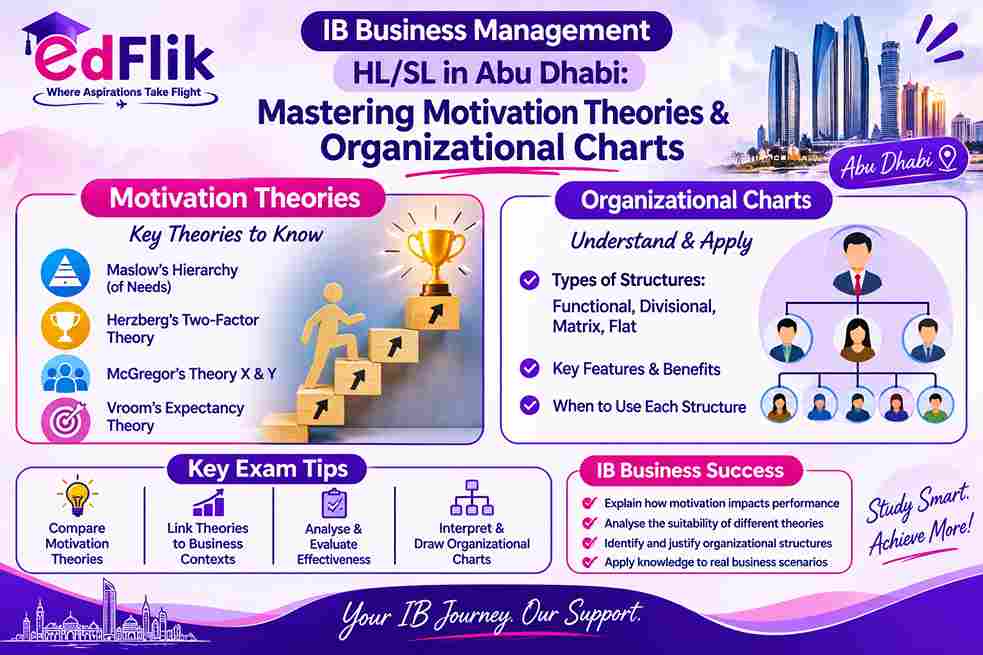
IB Business Management HL/SL in Abu Dhabi: Mastering Motivation Theories & Organizational Charts
By EdFlik Team | November 23, 2026
For Diploma Programme (DP) students across Abu Dhabi—from Al Reem Island, Saadiyat Island, and Al Raha Beach to Khalifa City, Al Mushrif, and Mohammed Bin Zayed City—IB Business Management (Higher Level and Standard Level) is one of the most popular Group 3 (Individuals and Societies) subjects. Within the IB Business Management syllabus, Unit 2: Human Resource Management—specifically Topic 2.2 (Organizational Structure) and Topic 2.4 (Motivation and Demotivation)—appears across Paper 1 (Pre-seen Statement & Case Study), Paper 2 (Quantitative & Structured Case Questions), and HL Paper 3 (Social Enterprise Decision-Making), while also serving as a favorite focus area for the Internal Assessment (IA) on real Abu Dhabi businesses.
Across Abu Dhabi's dynamic economy—spanning aviation, renewable energy, sovereign investment, hospitality, healthcare, and fast-growing tech startups—students see organizational charts and workforce motivation strategies in action every day. Yet in IB Business Management mark schemes, descriptive textbook summaries rarely score above a 4 or 5. Whether asked to "Examine how a tech firm in Abu Dhabi could improve staff retention using Herzberg's two-factor theory" or "Evaluate the decision to flatten an organization's hierarchy", examiners reward students who link accurate theoretical frameworks directly to case-study context, weigh short-term vs. long-term trade-offs, and tie decisions back to the IB's four core concepts: Change, Creativity, Ethics, and Sustainability.
Securing a Grade 6 or 7 in IB Business Management HL/SL—a strong asset for university applications in Business, Management, Finance, Economics, Entrepreneurship, and Law across the UAE, UK, US, Europe, and Asia—requires mastering both classical and modern motivation theories (including HL extensions like Adams' Equity Theory and Vroom's Expectancy Theory) alongside structural chart terminology.
This masterclass guide breaks down Motivation Theories (SL & HL) and Organizational Charts for IB Business Management, compares key theorists and chart types, walks through a 10-mark Paper 2 evaluation question, exposes common mark-scheme traps, and includes 100% copy-paste JSON-LD schema markup.
Key Takeaways
- Separate Hygiene Factors from Motivators (Herzberg) Before Throwing Money at Turnover: Offering higher salaries or nicer offices removes dissatisfaction (hygiene factors), but lasting intrinsic drive comes from motivators such as achievement, recognition, responsibility, and meaningful growth—a classic 6- to 10-mark IB distinction.
- Know the HL-Only Motivation Theories Inside Out: Standard Level candidates must master Taylor, Maslow, Herzberg, McClelland, Deci & Ryan (Self-Determination Theory), plus financial and non-financial rewards; Higher Level (HL) candidates must additionally apply Adams' Equity Theory (input-to-output fairness ratios) and Vroom's Expectancy Theory (Motivation=Expectancy×Instrumentality×Valence\text{Motivation} = \text{Expectancy} \times \text{Instrumentality} \times \text{Valence}Motivation=Expectancy×Instrumentality×Valence).
- Use Exact Structural Terminology When Reading or Drawing Organizational Charts: Always distinguish levels of hierarchy, chain of command (vertical authority line), span of control (number of direct subordinates per manager), delegation, delayering, centralization vs. decentralization, and matrix structures.
- Link Organizational Structure Directly to Workforce Motivation: On 10-mark "Discuss" or "Evaluate" questions, connect delayering and decentralization to Maslow's esteem/self-actualization needs, Herzberg's empowerment, and Deci & Ryan's autonomy—while weighing risks like manager overload and loss of career progression rungs.
Part 1: Mastering IB Business Management Motivation Theories (SL & HL)
In Topic 2.4 (Motivation and Demotivation), IB examiners test how different psychological and economic models explain employee productivity, absenteeism, and labor turnover—and why a strategy that works in a routine manufacturing plant fails in a creative software agency.
Maslow's five-tier Hierarchy of Needs from basic survival to self-actualization. Source: petrroudny / Getty ImagesExplore
As illustrated in Maslow's Hierarchy of Needs pyramid above, lower-order physiological and safety needs (met through fair pay and job security) must be reasonably satisfied before employees are motivated by love and belonging (teamwork), esteem (recognition and status), and self-actualization (creative autonomy and personal mastery) [image_agent_tag_6420169774972305687]
Complete Reference Table of IB Motivation Theorists (SL & HL)
| Theorist & Level | Core Model & Mechanism | Practical Business Application | Key Evaluation / IB Exam Critique |
|---|---|---|---|
F.W. Taylor (SL & HL — Scientific Management) | Workers are motivated primarily by money ("economic man"); break tasks into standardized steps and pay piece-rate wages. | Useful in repetitive, measurable output roles (e.g., assembly lines or delivery quotas). | Ignores non-financial needs, creativity, and teamwork; repetitive specialization causes boredom, alienation, and high turnover. |
Abraham Maslow (SL & HL — Hierarchy of Needs) | Five ascending levels: Physiological Safety Love/Belonging Esteem Self-Actualization. | Match rewards to career stage—e.g., job security and housing/medical benefits first, then leadership and creative projects. | Needs are not strictly sequential across cultures; difficult for managers to measure when a lower tier is "fully" satisfied. |
Frederick Herzberg (SL & HL — Two-Factor Theory) | Separates Hygiene Factors (pay, working conditions, company policy, supervision) from Motivators (achievement, recognition, responsibility, advancement). | Fix poor pay/conditions first to stop dissatisfaction, then use job enrichment and empowerment to drive intrinsic motivation. | Applies better to skilled/professional staff than low-paid manual roles; what one employee views as enrichment, another may see as extra unpaid work. |
David McClelland (SL & HL — Acquired Needs Theory) | Three learned needs drive behavior in varying proportions: Achievement (), Affiliation (), and Power (). | Assign challenging solo targets to high staff, collaborative team roles to high , and leadership roles to high . | Requires managers to assess individual psychological profiles accurately, which is time-consuming in large firms. |
Deci & Ryan (SL & HL — Self-Determination Theory) | Intrinsic motivation thrives when three psychological needs are met: Autonomy, Competence, and Relatedness. | Give staff flexible workflow choices, skill-building training, and supportive peer culture rather than rigid micromanagement. | Over-reliance on external bonuses can undermine intrinsic interest ("overjustification effect") in creative roles. |
John Stacey Adams (HL Only — Equity Theory) | Employees compare their Input-to-Output ratio (effort, skills, loyalty vs. pay, recognition, perks) against referent peers. | Ensure transparent pay bands, fair promotion criteria, and equitable workload distribution across teams. | Perceptions of "fairness" are subjective—employees often overestimate their own inputs or underestimate peers' contributions. |
Victor Vroom (HL Only — Expectancy Theory) | (effort leads to performance performance earns reward reward is valued). | Provide training so targets feel achievable (Expectancy), honor bonus promises reliably (Instrumentality), and personalize rewards (Valence). | Assumes rational calculation before acting; if any single factor drops to zero, overall motivation collapses to zero. |
Part 2: Organizational Charts & Structural Design (Topic 2.2)
In Topic 2.2 (Organizational Structure), students must interpret visual organizational charts, calculate spans of control, and evaluate structural reforms such as delayering or shifting toward a matrix structure.
Tall vs. flat organizational structures: chain of command and span of control. Source: Made with Google AI
As shown in the comparative diagram above, a Tall Structure features many layers of management, a long chain of command, and a narrow span of control, whereas a Flat Structure removes middle management layers, creating a short chain of command and a wide span of control that encourages delegation and faster communication [image_agent_tag_6420169774972305872]
Comparing Organizational Chart Structures in IB Business Management
| Structure Type | Key Characteristics | Advantages (Exam Strengths) | Disadvantages (Exam Limitations) |
|---|---|---|---|
| Tall / Hierarchical Structure | Many vertical levels; narrow span of control; clear top-down authority. | • Close supervision and clear accountability. • Clear promotion ladder (motivates career-focused staff). | • Slow vertical communication and decision-making. • High managerial salary overhead; employees may feel micromanaged. |
| Flat / Horizontal Structure | Few management layers; wide span of control; greater decentralization. | • Faster communication and agile response to market changes. • Empowers employees (autonomy and esteem), cutting management costs. | • Managers can become overstretched supervising too many subordinates. • Fewer vertical promotion opportunities for ambitious staff. |
Matrix Structure (Project-Based) | Employees report to two managers simultaneously—a functional department head (e.g., Marketing) and a project team leader. | • Encourages cross-departmental creativity and collaboration. • Flexible allocation of specialist talent across client projects. | • Dual chain of command creates role conflict, competing priorities, and stress. • Requires strong communication and self-discipline. |
Shamrock Organization (Charles Handy — HL/Context) | Three flexible leaves: Core Managerial/Technical Staff, Contractual Fringe (outsourced specialists), and Flexible Labor Force (part-time/temporary). | • Keeps fixed payroll costs low and adapts rapidly to seasonal demand fluctuations. | • Peripheral workers may lack loyalty, organizational culture alignment, or intrinsic commitment. |
Part 3: Linking Organizational Charts to Motivation (The IB Synthesis Trick)
Top IB Business Management essays never treat Topic 2.2 (Organizational Structure) and Topic 2.4 (Motivation) in isolated silos. Whenever a case study involves restructuring, use this analytical bridge:
          BRIDGING ORGANIZATIONAL STRUCTURE TO MOTIVATION (IB SYNTHESIS)
                                      |
  Structural Change (e.g., Delayering / Decentralization / Matrix Teams)
                 |
                 +---> Positive Motivational Impact:
                 |     • Wider span of control forces DELEGATION -> boosts Herzberg's
                 |       "responsibility" & Deci & Ryan's "autonomy".
                 |     • Cross-functional teams satisfy Maslow's "belonging" & McClelland's "n-Aff".
                 |
                 +---> Negative / Demotivational Risk:
                       • Fewer hierarchy layers remove promotion steps -> hurts Maslow's
                         "esteem" & Vroom's "instrumentality" (no clear reward path).
                       • Heavier workload without extra pay triggers Adams' "inequity".
Part 4: Full 10-Mark Exam-Style Worked Question (Paper 2 Style)
Case Extract: Saadiyat Solar Tech (SST) is a growing clean-energy consultancy in Abu Dhabi employing 120 engineers and analysts across six hierarchical layers. Recently, project approvals have slowed down and skilled mid-level engineers have complained of micromanagement, resulting in rising labor turnover. The CEO proposes delayering two middle-management tiers to create a flatter organizational structure.
Question: Evaluate the CEO's proposal to delayer Saadiyat Solar Tech in order to improve employee motivation and organizational efficiency. [10 marks]
Model Top-Band IB Response Outline (9–10/10 Marks):
- Define Key Terms & Anchor in Context (AO1 + AO2):
- Delayering involves removing one or more levels of middle management from SST's six-tier hierarchy, shortening the chain of command and widening spans of control for remaining managers.
- Arguments in Favor of Delayering (AO2 + AO3):
- Faster Decision-Making & Efficiency: Cutting two layers eliminates communication bottlenecks, allowing SST's engineers to respond faster to client tenders in Abu Dhabi's competitive clean-energy sector while reducing fixed middle-management salary costs.
- Higher Intrinsic Motivation: Wider spans of control require senior leads to delegate greater project ownership to engineers—directly addressing their complaints of micromanagement by satisfying Herzberg's motivators (responsibility and achievement) and Deci & Ryan's need for autonomy, reducing voluntary turnover.
- Arguments Against / Risks of Delayering (AO2 + AO3):
- Managerial Overload & Demotivation: Remaining managers at SST may face unmanageably wide spans of control, leading to stress, inadequate feedback, and a drop in Vroom's expectancy if junior analysts lack coaching.
- Reduced Promotion Opportunities & Perceived Inequity: Removing two tiers eliminates traditional career progression rungs (hurting Maslow's esteem needs), and if engineers take on extra decision-making duties without pay adjustments, Adams' Equity Theory (HL) predicts dissatisfaction over an unfavorable input-to-output ratio.
- Redundancy & Change Resistance: Laying off middle managers can damage Maslow's safety needs among surviving staff ("survivor syndrome") unless handled transparently.
- Substantiated Judgment / Conclusion (AO3):
- Delayering is likely to succeed in the long run for a knowledge-intensive consultancy like SST because skilled engineers thrive on autonomy and faster project execution—provided the CEO pairs the restructuring with leadership training for wider spans of control, transparent horizontal career/pay progression (avoiding Adams' inequity), and clear communication to protect morale during the transition.
Part 5: Top 4 Exam Traps That Cost IB Business Management Students Marks
- Writing a Generic Theory Essay Without Mentioning the Case Company: In IB Paper 1 and Paper 2, every paragraph must weave in specific evidence from the stimulus (industry, workforce skill level, financial position, or stakeholder tensions)—otherwise marks are capped in the mid-band.
- Confusing "Span of Control" with "Chain of Command": Span of control is the number of subordinates reporting directly to one manager (wide vs. narrow); chain of command is the vertical line of authority through which orders pass from top to bottom (long vs. short).
- Assuming Financial Rewards Always Fail Because of Herzberg: Herzberg classified base salary as a hygiene factor, not irrelevant—if an Abu Dhabi firm pays below market rate relative to living costs, non-financial praise alone will never retain staff until hygiene needs are met.
- Writing One-Sentence Conclusions: On 10-mark "Evaluate" or "Discuss" questions, your conclusion must weigh the competing arguments, explain what the outcome depends on (short-term cost vs. long-term culture, training, or budget), and directly answer the prompt.
For expert 1-on-1 online tutoring support to master IB Business Management HL & SL theory, quantitative Paper 2 tools, HL Paper 3 social enterprise strategy, and a 7-scoring Internal Assessment in Abu Dhabi, book a class on EdFlik.
Frequently Asked Questions (FAQs)
Q1: What is the difference between SL and HL motivation theories in IB Business Management?
Ans: Both Standard Level (SL) and Higher Level (HL) cover Taylor, Maslow, Herzberg, McClelland, and Deci & Ryan (Self-Determination Theory) alongside financial and non-financial rewards. HL students must also master Adams' Equity Theory and Vroom's Expectancy Theory (as well as deeper organizational culture and industrial relations topics).
Q2: How does delayering affect an organizational chart's span of control and chain of command?
Ans: Delayering removes one or more levels of hierarchy, which shortens the chain of command (speeding up vertical communication) and widens the span of control (increasing the number of direct reports per remaining manager and encouraging delegation).
Q3: How can Abu Dhabi IB Business Management students pick a strong Internal Assessment (IA) topic using Unit 2?
Ans: Choose a real, accessible local or regional organization undergoing a clear strategic shift—such as evaluating how a new employee retention or hybrid-work policy affects staff motivation, or analyzing how a structural reorganization improved operational efficiency—supported by primary interviews/surveys and secondary documents.