IB History HL/SL in Abu Dhabi: Structuring Cause-and-Effect Essays on Modern Warfare

By EdFlik Team | November 27, 2026
For Diploma Programme (DP) students across Abu Dhabi—from Al Reem Island, Saadiyat Island, and Al Raha Beach to Khalifa City, Al Mushrif, and Mohammed Bin Zayed City—studying IB History (Higher Level and Standard Level) offers rigorous preparation for university degrees in History, International Relations, Law, Political Science, Journalism, and Public Policy. Within Paper 2 (World History Topics)—specifically Topic 11: Causes and Effects of 20th-Century Wars—students write two timed 45-minute essays (90 minutes total, worth 45% of the SL grade and 25% of the HL grade) evaluating why modern conflicts erupted, how they were fought, and how they reshaped states, societies, and international order.
In Abu Dhabi's globally minded IB World Schools, students compare conflicts across at least two different IB regions—such as the First World War (1914–1918) and Second World War (1939–1945) in Europe and Asia-Pacific, the Spanish Civil War (1936–1939), the Chinese Civil War (1927–1937 / 1946–1949), the Korean War (1950–1953), or the Vietnam War (1946–1975).
Yet many bright Abu Dhabi IB History students stall at a Grade 4 or 5 on Paper 2 because they fall into chronological storytelling—recounting battles, treaties, and dates from start to finish without evaluating relative causal weight (which factor was the root precondition vs. the immediate trigger?) or differentiated effects (short-term vs. long-term; political, economic, social, and territorial).
Securing a Grade 6 or 7 in IB History HL/SL depends on organizing every essay thematically rather than chronologically, ranking causal and consequential factors explicitly in your thesis, deploying precise historical evidence, and integrating historiographical debate naturally into your analysis.
This masterclass guide breaks down Thematic Cause-and-Effect Essay Architecture for IB History Paper 2 (Topic 11: Modern Warfare), provides causal/effect frameworks, worked thesis and body-paragraph models, common mark-scheme traps, FAQs, SEO meta tags, and 100% copy-paste JSON-LD schema markup.
Key Takeaways
- Never Write a Chronological Narrative on Paper 2: IB History Paper 2 markbands reward thematic, analytical structure over storytelling—group causes into Long-Term Structural Factors, Medium-Term Catalysts, and Immediate Triggers, or group effects into Political, Economic, Social/Demographic, and Territorial/International impacts.
- Take a Ranked, Nuanced Thesis Stance in Paragraph 1: On "To what extent..." or "Evaluate the role of..." prompts, never sit on the fence—state clearly which factor carried the greatest causal or consequential weight and explain how it interacted with secondary factors.
- Pair Every Analytical Claim with Concrete Evidence + Explicit Link Back to the Prompt: Use the PEEL-H (Point – Evidence – Explanation – Historiography – Link) structure so every paragraph proves why a treaty, economic crisis, ideology, or military shift produced the outcome asked in the question.
- Check the "Two Different Regions" Rule Whenever a Prompt Requires Cross-Regional Comparison: Many Paper 2 prompts specify "with reference to two wars, each chosen from a different region"—choosing two European wars (such as WWI and the Spanish Civil War) automatically caps your marks below the top band!
Part 1: Deconstructing IB History Paper 2 Prompts on Modern Warfare
Before outlining a single paragraph in the 45-minute Paper 2 window, dissect the command term, scope, and regional constraint of the prompt:
- Command Term:
- "Evaluate..." / "Assess..." / "To what extent..." $\implies$ Weigh the named factor against competing factors and reach a substantiated judgment on relative importance.
- "Compare and contrast..." $\implies$ Integrate both similarities and differences thematically across two wars (never write Essay A on War 1 followed by Essay B on War 2!).
- "Examine the impact / consequences of..." $\implies$ Analyze multi-dimensional effects (political, economic, social, geopolitical) across short- and long-term horizons.
- Focus Scope: Is the question testing Causes (origins, mobilization, breakdown of diplomacy), Practices (total war, technological change, home front, air/naval power), or Effects (peacemaking, decolonization, social/gender shifts, Cold War realignment)?
- Regional Check: Confirm whether the question asks for one war, two wars, or two wars from two different IB regions (Africa and the Middle East; The Americas; Asia and Oceania; Europe).
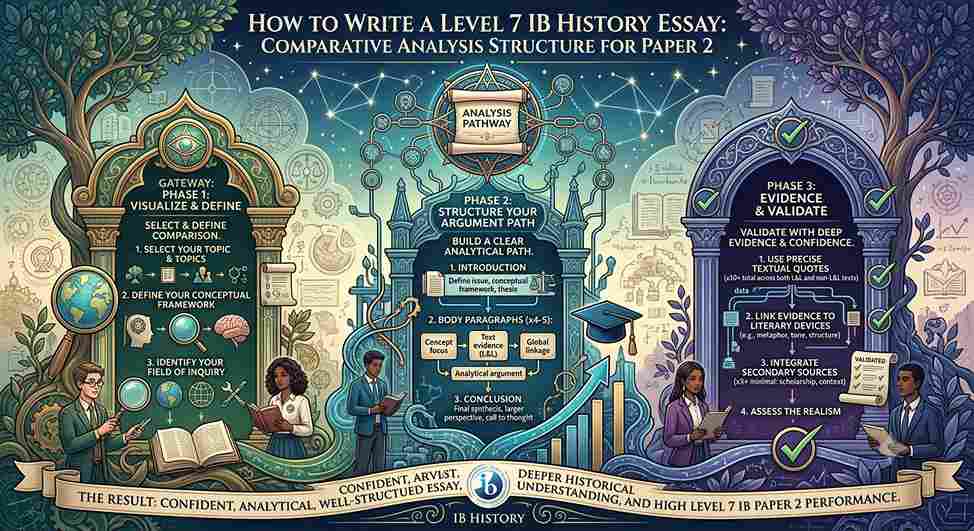
As shown in the analytical text-structure diagram above, mapping multiple causes feeding into a central conflict—or branching out from a conflict into distinct effects—keeps your essay analytical rather than descriptive.
Part 2: The 4-Tier Cause & Effect Analytical Framework
A. Structuring a "Causes of War" Essay (Thematic Hierarchy)
| Analytical Tier | Role in Explaining Outbreak | Key Concepts & Examples to Deploy |
| 1. Long-Term Structural Preconditions | Underlying systemic tensions making war possible over decades. | Imperial/colonial rivalry, alliance systems, nationalist irredentism, rigid militarism, or entrenched socio-economic inequality (e.g., latifundia land distribution in pre-1936 Spain; Qing collapse and warlordism in China). |
| 2. Medium-Term Catalysts | Developments over 3–10 years that destabilized diplomacy or radicalized politics. | The Great Depression (1929) fueling authoritarian expansionism in Germany and Japan; failure of collective security (League of Nations inaction over Manchuria 1931 and Abyssinia 1935); polarization under the Second Spanish Republic (1931–1936). |
| 3. Short-Term Crises & Immediate Triggers | Final flashpoints converting high tension into open warfare. | Assassination of Archduke Franz Ferdinand & the July Crisis (1914); Marco Polo Bridge Incident (July 1937); Nazi-Soviet Pact & invasion of Poland (August–September 1939); Gulf of Tonkin Resolution (1964). |
| 4. Historiographical Synthesis | Competing scholarly interpretations weighing intent vs. structural drift. | Fischer thesis (German structural/aggressive aims in 1914) vs. Clark (Sleepwalkers, shared systemic miscalculation); Intentionalist vs. Structuralist debates on WWII origins; Orthodox vs. Revisionist views on Cold War proxy conflicts. |
B. Structuring an "Effects of War" Essay (The PEST-I Matrix)
            PEST-I FRAMEWORK FOR EFFECTS OF MODERN WARFARE
                                  |
  • P — Political & Institutional: Regime collapse (e.g., 1917–18 empires),
        authoritarian consolidation, decolonization waves, or new constitutions.
  • E — Economic & Industrial: War debt, inflation/hyperinflation, Marshall Plan
        reconstruction, agrarian land reform, or shift in global financial power.
  • S — Social & Demographic: Civilian/military casualties, displacement/refugees,
        changing roles of women in labor & suffrage, class realignment.
  • T — Territorial & Geopolitical: Redrawn borders (Versailles, Potsdam, 38th
        Parallel), mandates, partition, and superpower bipolarity.
  • I — International Order: Creation/evolution of collective security (League
        of Nations -> United Nations), Geneva Conventions, nuclear deterrence.
Part 3: Worked Thesis & Top-Band Body Paragraph Model
Sample Paper 2 Prompt:
"Economic factors were the most significant cause of 20th-century wars." Discuss with reference to two wars, each chosen from a different region. [15 marks]
Top-Band Introduction & Ranked Thesis (Band 13–15):
While economic distress acted as a critical catalyst in destabilizing pre-war political systems, economic factors alone did not inevitably produce 20th-century warfare without ideological radicalization and the breakdown of political legitimacy. Comparing the Second World War in the Pacific (1937–1945 — Asia and Oceania) and the Spanish Civil War (1936–1939 — Europe) demonstrates that ideological and political polarization constituted the primary root cause of conflict, whereas economic crises—specifically the Great Depression and entrenched agrarian inequality—functioned as indispensable accelerators that pushed existing grievances into armed confrontation.
Top-Band Body Paragraph (PEEL-H Structure):
Point: In the Asia-Pacific theatre, economic vulnerability following the 1929 Great Depression heavily shaped Japanese expansionism, yet it operated through an existing ultranationalist and militarist ideology rather than purely rational economic calculation.
Evidence: Following the Smoot-Hawley Tariff (1930) and collapsing silk exports, Japan's Kwantung Army seized resource-rich Manchuria in September 1931 and escalated into full-scale war with China after the Marco Polo Bridge Incident (July 1937), culminating in the strike on Pearl Harbor (December 1941) after US oil and scrap-metal embargoes threatened Japan's naval reserves.
Explanation & Historiography: Historian Akira Iriye notes that Japan's pursuit of a self-sufficient "Greater East Asia Co-Prosperity Sphere" blended genuine raw-material insecurity with imperial ambition; crucially, alternative diplomatic and trade pathways existed, meaning it was the ascendancy of military leadership over civilian cabinet governance that translated economic pressure into offensive war.
Link: Thus, economic scarcity determined where and when Japanese aggression struck, while militarist political culture supplied the decisive drive toward war.
Part 4: Top 4 Traps That Cost Abu Dhabi IB History Students Marks
- Violating the "Two Different Regions" Requirement: Pairing World War I (Europe) with World War II in Europe—or the Korean War with the Vietnam War (both Asia and Oceania)—leaves half of your evidence ineligible for full credit whenever a prompt mandates two different regions.
- Writing Parallel Summaries Instead of Integrated Comparisons: On "Compare and contrast" prompts, organize paragraphs by theme (e.g., Role of Foreign Intervention, Economic Mobilization, Impact on Civilians) analyzing both wars inside every body paragraph.
- Dropping Historian Names Without Explaining Their Argument: Writing "As A.J.P. Taylor said..." without stating what Taylor argued and how it supports or challenges your thesis adds zero analytical value.
- Over-Spending 55 Minutes on Essay 1 and Rushing Essay 2: Both Paper 2 essays carry 15 marks each—set a strict 45-minute hard stop (5 minutes planning + 38 minutes writing + 2 minutes checking) per essay.
For 1-on-1 online tutoring to master IB History HL/SL Paper 1 source evaluation, Paper 2 thematic essays, HL Paper 3 depth studies, and your Internal Assessment (IA) in Abu Dhabi, book a session on EdFlik.
Frequently Asked Questions (FAQs)
Q1: How should I allocate my 90 minutes in IB History Paper 2?
Ans: Divide the 90 minutes strictly into two 45-minute blocks (since each essay is worth 15 marks). Spend 5 minutes outlining your ranked thesis and 3–4 thematic paragraphs, 38 minutes writing focused analytical paragraphs, and 2 minutes reviewing clarity and transitions.
Q2: Do I need to memorize long historiography quotes for IB History Paper 2?
Ans: No. Examiners do not reward memorized verbatim quotes; instead, briefly reference competing historical interpretations or schools of thought (such as intentionalist vs. structuralist arguments) and evaluate how well your specific factual evidence supports each view.
Q3: Which pairs of 20th-century wars work best for cross-regional Paper 2 essays?
Ans: High-utility cross-regional pairs include the Spanish Civil War (Europe) with the Chinese Civil War (Asia and Oceania) for civil-war causes/practices, or World War I (Europe) with the Second Sino-Japanese / Pacific War (Asia and Oceania) for total war, economic causes, and peacemaking effects.