
IB History Tutor in the UAE: How to Score 6 and 7 in Paper 1, 2, and 3
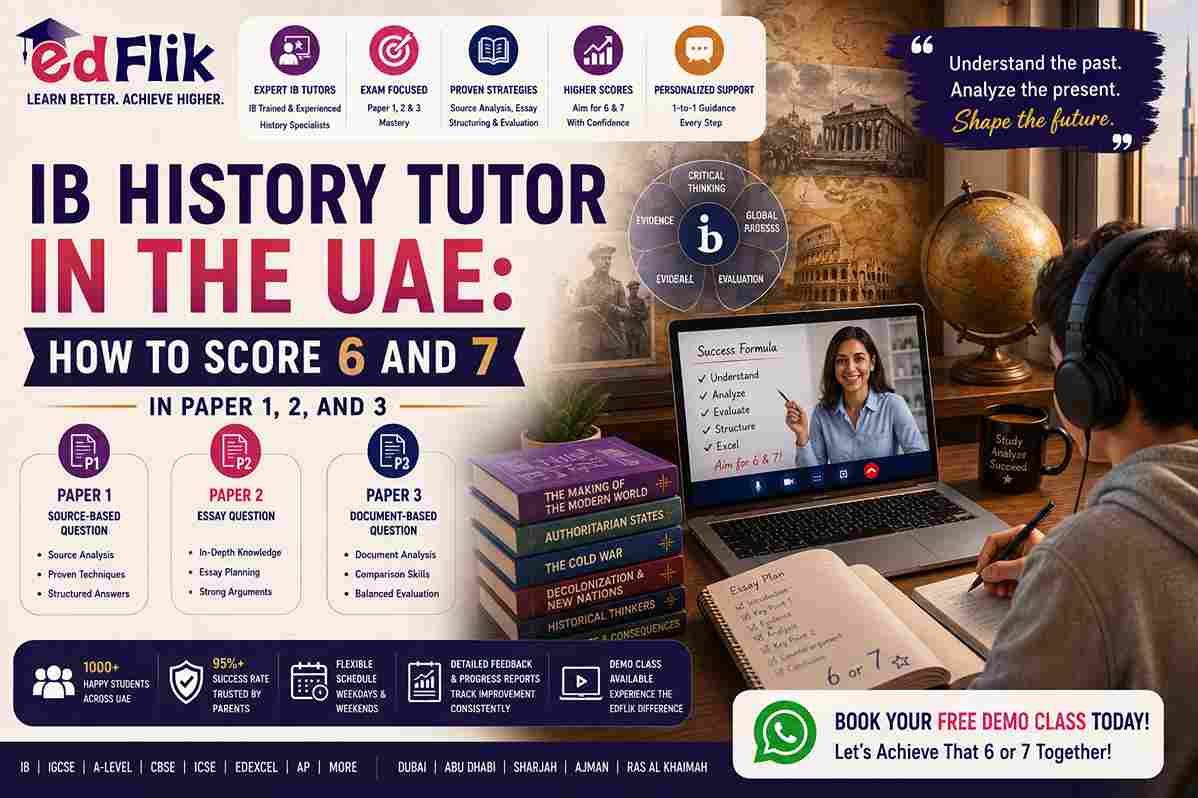
IB History is one of the most intellectually demanding subjects in the Diploma Programme. Students across the UAE — from international schools in Dubai, Abu Dhabi, and Sharjah — consistently report that History is the IB subject where they feel most uncertain about what examiners are looking for and why their responses score less than expected. The reason is structural: IB History is not a test of historical knowledge. It is a test of historical thinking — the ability to construct and sustain an argument, evaluate sources, and reason about cause, consequence, and significance in a disciplined and precise way. This guide explains the assessment structure of IB History, the techniques that separate 6 and 7 responses from average ones, and how a specialist IB History tutor helps students bridge that gap.
IB History Assessment Structure: SL and HL
IB History at Standard Level is assessed through Papers 1 and 2 and an Internal Assessment. At Higher Level, Paper 3 is added. Each paper tests different historical skills:
· Paper 1: Source-based paper. Students are given five prescribed sources (documents, photographs, maps, statistics, or cartoons) and answer four questions testing comprehension, inference, source evaluation, and extended source-based essay writing. This paper is the same for SL and HL students.
· Paper 2: Two essay-type questions from different topics. Students write two essays in 90 minutes, each responding to a question from the IB's prescribed topics, which include Causes and effects of 20th century wars, Authoritarian states, The Cold War, and others. Students must write essays that are analytical, structured, and supported by specific factual evidence.
· Paper 3 (HL only): Three extended essay responses on the HL regional option — usually The History of Europe, The Americas, Asia and Oceania, or Africa and the Middle East. Paper 3 answers are expected to be even more developed and historiographically aware than Paper 2.
· Internal Assessment (IA): A historical investigation of approximately 2,200 words, structured around three sections: identification and evaluation of sources, investigation, and reflection. The IA is completed in class but is externally moderated.
Paper 1: How to Use Sources Effectively
Paper 1 is often where students with strong historical knowledge underperform because they treat the sources as supplementary information rather than as the primary subject of analysis. The mark scheme rewards specific source skills:
· Question 1 (comprehension): State what the source reveals — quote or paraphrase accurately. Do not add background knowledge or evaluate the source's reliability here.
· Question 2 (inference): Explain what the source implies or suggests, beyond its literal content. Read between the lines — what does the author's choice of language, tone, or emphasis reveal?
· Question 3 (value and limitations): Evaluate the source's value and its limitations using both its origin (who produced it, when, in what context) and its purpose (why was it produced, for what audience). The most common error is treating 'value and limitations' as a synonym for 'reliability' — they are distinct concepts.
· Question 4 (mini-essay): Use the sources and your own knowledge to construct an argument addressing a historical claim. This question requires integration of source evidence and contextual knowledge — students who use only sources or only own knowledge cannot reach the top mark bands.
Paper 2: IB History Essay Technique
The IB History Paper 2 essay is perhaps the most demanding writing task in the DP for humanities students. A 7-level essay in Paper 2 has the following characteristics:
· A clear thesis in the introduction that directly addresses the question and signals the essay's line of argument.
· Body paragraphs that each advance a distinct analytical point, supported by specific historical evidence — not a chronological narrative of events.
· Counter-argument: the essay acknowledges perspectives or evidence that might challenge its thesis and explains why, on balance, the thesis still holds.
· Synthesis: the conclusion does not merely summarise but reflects on the significance of the argument, possibly considering different historical perspectives (historiography).
· Relevance throughout: every paragraph and piece of evidence must be connected back to the specific question. Off-topic detail, even if historically accurate, loses marks.
The most destructive essay habit in IB History is narrative description — telling the story of what happened rather than arguing why it happened, what caused it, or how significant it was. An IB History tutor trains students to identify the difference between narrative and argument in their own writing and rewrite accordingly.
Commonly Studied Themes in UAE IB Schools
The most commonly taught IB History prescribed topics in UAE international schools include:
· Causes and effects of wars: World War One, World War Two, the Korean War, and regional conflicts. Students are expected to explain the causes at multiple levels (immediate, underlying, long-term), evaluate their relative importance, and assess the consequences.
· Authoritarian states in the 20th century: Hitler's Germany, Stalin's USSR, Mao's China, and others. Students must analyse the conditions that enabled the rise of authoritarianism, the methods by which leaders established and maintained power, and the impact on the societies they governed.
· The Cold War 1945–2000: superpower relations, proxy conflicts, the arms race, detente, and the eventual end of the Cold War. This is one of the most popular Paper 2 topics and one where strong tutoring support is most in demand.
The Internal Assessment: Structure and Common Weaknesses
The IB History IA asks students to investigate a specific historical question, evaluate two key sources, and write a personal reflection on the challenges of historical investigation. Common weaknesses that cost students marks include:
· Section A (identification and evaluation of sources): students describe the sources rather than evaluating their value and limitations for the specific investigation.
· Section B (investigation): students narrate historical events rather than constructing an argument that directly addresses the investigation question.
· Section C (reflection): students write generally about history as a discipline rather than reflecting specifically on what their own experience of researching this topic revealed about the challenges of historical investigation.
· Word count management: students exceed the 2,200-word limit or fall significantly short, both of which affect performance.
EdFlik's IB History Tutoring in the UAE
EdFlik's IB History tutors are experienced DP teachers who know the assessment criteria for Paper 1, Paper 2, Paper 3, and the IA in detail. Sessions focus on developing the specific analytical and writing skills that IB History rewards, using past examination papers, mark schemes, and examiner reports as the primary tools. Pricing starts from AED 45, and a free trial is available at edflik.com.
Frequently Asked Questions
What is the difference in demands between IB History SL and HL?
The primary difference between IB History SL and HL is Paper 3. Both SL and HL students sit Papers 1 and 2 and complete the Internal Assessment. HL students additionally sit Paper 3, which covers the HL regional option in depth and requires three extended essay responses. The Paper 3 essays are expected to demonstrate greater analytical depth, a wider range of factual knowledge, and more developed historiographical awareness than Paper 2. HL students are therefore studying a considerably greater volume of content and developing a higher level of extended writing skill than SL students. For this reason, HL students typically benefit from more frequent tutoring support, particularly in the first year when the Paper 3 content is being studied.
How important is historiography in IB History essays?
Historiography — the study of different historians' interpretations of events — is an element of high-scoring IB History essays but it is not a prerequisite for a 6 or 7. What matters more is that a student constructs a clear, well-evidenced argument. If they can also acknowledge that historians have interpreted the evidence differently — for example, noting that some historians emphasise economic causes of WW1 while others prioritise nationalism — this adds depth and can push a strong essay from a 6 to a 7. Students should not force historiographical references into essays where they are not natural, but they should develop awareness of key historiographical debates in the topics they study.
Can an EdFlik tutor help my child specifically with the IB History IA?
Yes. The IB History IA is one of the components where targeted tutoring has the highest impact, because the IA structure is very specific and the common errors are predictable. EdFlik tutors work with students on all three sections of the IA — identifying and evaluating sources (Section A), developing the investigation argument (Section B), and writing the methodological reflection (Section C). Tutors also provide feedback on drafts to ensure the student is meeting the assessment criteria before submission. Because the IA is worth 25% of the final IB History grade, strong IA performance significantly supports the overall result.
My child is strong in other subjects but finds IB History essays particularly hard. Why might this be?
IB History essays reward a very specific type of analytical writing that is different from the essay style rewarded in English Literature, Economics, or other humanities subjects. The key difference is that IB History essays are primarily causal and evaluative — they explain why events happened and weigh the significance of different factors. Many students who write well in other subjects default to description or to the style of argument rewarded in those subjects, and find that this approach does not transfer cleanly to History. A specialist IB History tutor identifies the specific mismatch between a student's current writing style and what the History mark scheme rewards, and teaches the transition explicitly.