Mastering IGCSE Biology Homeostasis: How the Human Body Controls Blood Glucose and Temperature
Last Updated: October 2026 | By EdFlik Education Team
For students studying Cambridge IGCSE Biology (0610) or Edexcel IGCSE Biology (4BI1), homeostasis represents one of the most intellectually rewarding yet conceptually rigorous topics in the entire syllabus. Evaluated heavily across both core and extended theory papers (Papers 2, 4, and 6), examiners look for absolute precision in how you describe negative feedback loops, hormone secretion, and physiological responses.
Many students lose easy marks on homeostasis questions not because they don't understand the general idea of "keeping things balanced," but because they confuse key terms—such as mixing up glycogen with glucagon, or confusing vasoconstriction with vasodilation.
In this comprehensive, exam-focused masterclass guide, our expert IGCSE biology educators break down the core mechanisms of human homeostasis, unpack blood glucose regulation and thermoregulation, and share high-impact strategies to secure top $A^*$ grades.
Part 1: What is Homeostasis? (The Golden Rule)
In biology, homeostasis is defined as the maintenance of a constant internal environment within restricted limits, despite external environmental changes.
Without effective homeostatic control, enzyme-controlled metabolic reactions inside your cells would destabilize, leading to protein denaturation or cell death. Almost every homeostatic mechanism in the human body operates through a negative feedback loop, which follows this strict sequence:
- Stimulus: A change occurs in the internal or external environment (e.g., blood glucose rises after eating, or core body temperature drops in cold weather).
- Receptor: Specialized sensory cells detect the deviation from the optimum set point.
- Coordination Center: The brain (specifically the hypothalamus) or endocrine glands process the incoming information and formulate a corrective response.
- Effector: Muscles or glands carry out the corrective action.
- Response: The internal condition is restored back to the normal optimum level, switching off the receptor signal.
Part 2: Blood Glucose Regulation (The Pancreas and Liver)
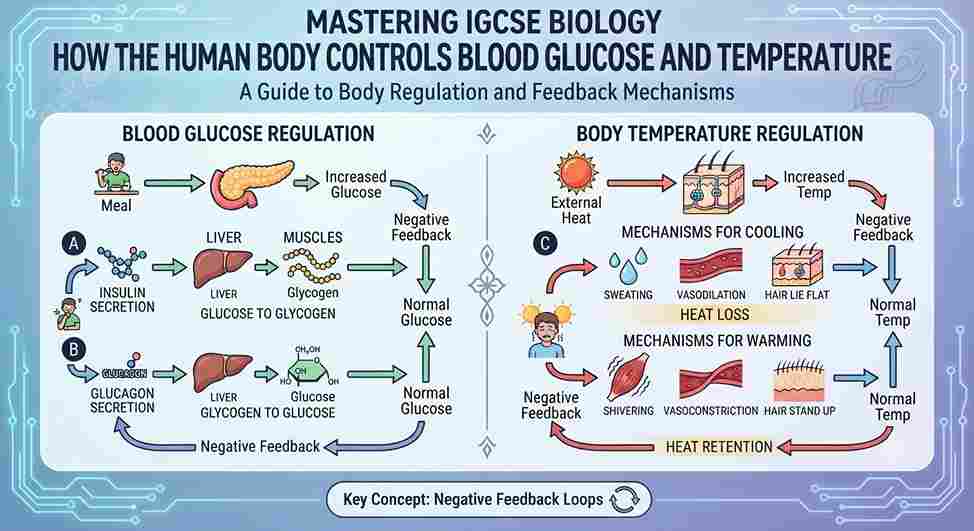
Blood glucose concentration must be tightly regulated at approximately $90\text{--}100\text{ mg/dL}$ to ensure cells have a steady supply of glucose for respiration without causing osmotic damage to tissues. This system is controlled entirely by two hormones secreted by the pancreas: insulin and glucagon.
1. When Blood Glucose is Too High (After a Carbohydrate-Rich Meal)
- Receptor & Control: Specialized cells in the pancreas detect the elevated blood glucose level.
- Hormone Released: The pancreas secretes insulin directly into the bloodstream.
- Effectors: The liver and skeletal muscle cells respond to insulin.
- Action Taken: Insulin stimulates liver and muscle cells to take up excess glucose from the blood and convert it into insoluble glycogen for storage. Additionally, cells increase their rate of glucose uptake for cellular respiration, bringing blood glucose back down to normal.
2. When Blood Glucose is Too Low (During Exercise or Fasting)
- Receptor & Control: Pancreatic cells detect the drop in blood glucose.
- Hormone Released: The pancreas secretes glucagon into the bloodstream.
- Effectors: The liver is the primary target effector.
- Action Taken: Glucagon stimulates liver cells to break down stored glycogen back into soluble glucose, releasing it back into the bloodstream.
(Exam Pro-Tip: Never spell "glycogen" and "glucagon" interchangeably; examiners mark them as distinct chemical entities and will deduct marks for spelling confusion).
Part 3: Thermoregulation (Controlling Body Temperature)
Human core body temperature must be maintained at an optimum set point of approximately $37^\circ\text{C}$ to keep metabolic enzymes functioning at peak efficiency. The control center for thermoregulation is the hypothalamus in the brain, which monitors blood temperature directly through specialized thermoreceptors.
1. Responses to Too Much Heat (Overheating / Vasodilation and Sweating)
When body temperature rises above $37^\circ\text{C}$, the hypothalamus triggers cooling mechanisms:
- Vasodilation: Arterioles supplying the skin's surface capillaries relax and widen (dilate). This allows a much larger volume of warm blood to flow near the skin surface, increasing heat loss to the environment via radiation, conduction, and convection.
- Sweating: Sweat glands secrete sweat onto the skin surface. As water evaporates, it absorbs latent heat of vaporization from the body, cooling the skin down.
- Hairs Lie Flat: Erector pili muscles relax, causing skin hairs to lie flat against the skin, removing the insulating layer of trapped air.
2. Responses to Too Much Cold (Hypothermia Prevention / Vasoconstriction and Shivering)
When body temperature drops below $37^\circ\text{C}$, the hypothalamus initiates warming mechanisms:
- Vasoconstriction: Arterioles supplying skin surface capillaries constrict (narrow). Blood is diverted away from the skin surface through shunt vessels, keeping warm blood deep inside the core to protect vital organs.
- Shivering: Skeletal muscles contract and relax rapidly in involuntary, rhythmic spasms. This increased respiration rate releases thermal energy as a metabolic byproduct, warming the blood.
- Hairs Stand Up: Erector pili muscles contract, pulling skin hairs upright. This traps a thick insulating layer of still air close to the skin surface.
Part 4: Top 4 Traps That Cost Students IGCSE Marks
- Mixing Up Vasodilation and Vasoconstriction: Remember that dilation means widening (cooling down), while constriction means narrowing (warming up).
- Confusing Glycogen with Glucagon: Glycogen is the carbohydrate energy store, whereas glucagon is the hormone that breaks it down.
- Vague Effector Descriptions: Saying "the body reacts to cool down" is too weak for IGCSE mark schemes. You must name specific effectors, such as sweat glands, skin arterioles, or liver cells.
- Ignoring Negative Feedback Terminology: When asked why a mechanism is described as negative feedback, always state that "any deviation from the optimum set point is reversed or corrected back to normal."
Struggling with IGCSE Biology homeostasis, hormone pathways, or past-paper mark schemes? EdFlik connects international school students globally with expert, 1-to-1 online biology tutors, helping you master complex physiological systems and secure top $A^$ grades.*Book a Free Demo Class Today!
Frequently Asked Questions (FAQs)
Q1: What is the difference between Type 1 and Type 2 diabetes in relation to homeostasis?
Ans: Type 1 diabetes is an autoimmune condition where the pancreas fails to produce sufficient insulin, usually diagnosed in childhood. Type 2 diabetes occurs when body cells stop responding properly to insulin (insulin resistance), often linked to diet, lifestyle, and genetics.
Q2: Why is maintaining a constant body temperature so critical for humans?
Ans: Humans are endotherms. Maintaining $37^\circ\text{C}$ ensures that metabolic enzymes operate at their optimum kinetic energy and temperature. If temperature rises too high, enzymes denature; if it drops too low, enzyme activity slows down drastically, disrupting cellular respiration.
Q3: How does the skin act as both a sense organ and an effector during thermoregulation?
Ans: The skin contains temperature receptors (nerve endings) that detect external thermal changes, acting as sensory receptors. Simultaneously, it houses sweat glands, erector pili muscles, and arterioles, which act as effectors carrying out corrective cooling or warming responses.
Q4: How does EdFlik support IGCSE Biology students?
Ans: EdFlik connects international school students worldwide with vetted, expert 1-to-1 online biology tutors specializing in Cambridge and Edexcel IGCSE curricula. Our personalized sessions focus on clarifying difficult physiological mechanisms, diagram analysis, and rigorous past-paper practice.