IGCSE Computer Science 0478 UAE — Cambridge Pseudocode vs Python: What Students Get Wrong
IGCSE Computer Science 0478 is the fastest-growing IGCSE subject at UAE British-curriculum schools — driven by the UAE's national AI and coding education mandate, by widespread interest among families from technology backgrounds, and by the genuine demand for computing qualifications from students who already enjoy programming. Yet it is also the subject where confident programmers most consistently underperform on Paper 2 — not because their algorithms are wrong, but because they write them in Python or JavaScript when Cambridge requires its own proprietary pseudocode language. One session fixing the pseudocode syntax typically recovers 15 to 25 marks in Paper 2.
Cambridge Pseudocode vs Python — The Complete Syntax Comparison
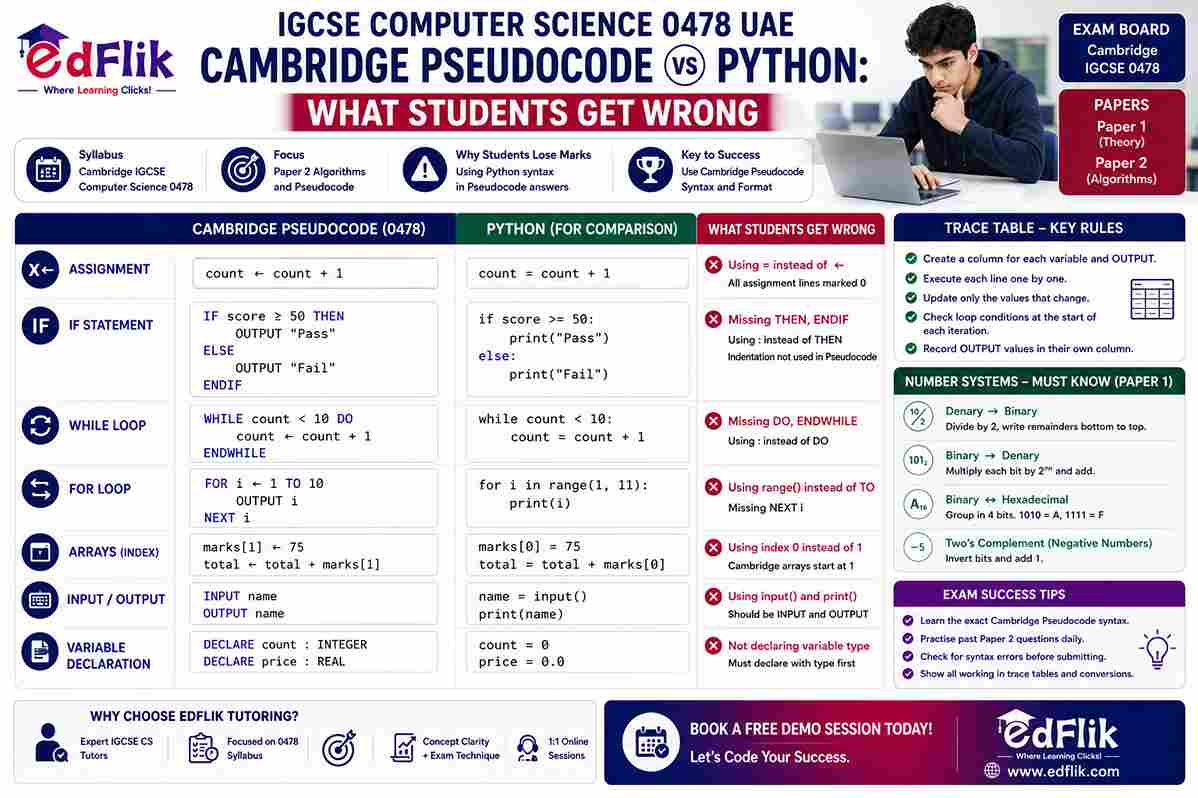
Every line of Paper 2 where a UAE student uses Python syntax instead of Cambridge pseudocode syntax earns zero marks for that line, regardless of whether the underlying algorithm logic is correct. The Cambridge pseudocode specification is available as a free download from cambridgeinternational.org — all 0478 students must have a copy and treat it as their Paper 2 reference.
|
Construct |
Cambridge
Pseudocode (CORRECT — earns marks) |
Python (WRONG
— earns zero for that line) |
|
Variable declaration |
DECLARE count : INTEGER |
(no declaration needed in Python) |
|
Assignment |
count ← 0 |
count = 0 |
|
Output |
OUTPUT "Hello World" |
print("Hello World") |
|
Input |
INPUT name |
name = input() |
|
IF statement |
IF count > 5 THEN
OUTPUT "Large" ELSE
OUTPUT "Small" ENDIF |
if count > 5:
print("Large") else:
print("Small") |
|
FOR loop |
FOR i ← 1 TO 10 OUTPUT i
NEXT i |
for i in range(1, 11):
print(i) |
|
WHILE loop |
WHILE count < 10 DO
count ← count + 1 ENDWHILE |
while count < 10:
count += 1 |
|
Array declaration |
DECLARE scores[1:10] : INTEGER |
scores = [0] * 10 |
|
Array access |
scores[1] through scores[10] (index starts at 1) |
scores[0] through scores[9] (index starts at 0) |
|
Procedure |
PROCEDURE greeting(name : STRING) OUTPUT "Hello ", name
ENDPROCEDURE |
def greeting(name):
print("Hello ", name) |
|
Function (with return) |
FUNCTION square(n : INTEGER) RETURNS INTEGER RETURN n * n ENDFUNCTION |
def square(n): return n
* n |
|
String concatenation |
name ← first & " " & last |
name = first + " " + last |
|
Integer division |
result ← total DIV count |
result = total // count |
|
Modulo (remainder) |
result ← total MOD count |
result = total % count |
Trace Tables — Step-by-Step Correct Method
Trace tables appear in every Cambridge 0478 Paper 2. The method:
1. Set up the table: create one column for each variable in the algorithm. Create a separate OUTPUT column for any OUTPUT statements.
2. Begin at the first line of code. Execute that specific line. Update ONLY the variable(s) that this line changes. Write the new value in that variable's column on the current row. Leave all other variables' columns empty for this row.
3. For WHILE loops: check the condition at the top of each iteration BEFORE executing the loop body. Record whether the condition is TRUE or FALSE. If TRUE, execute the loop body. If FALSE, exit the loop.
4. For FOR loops: assign the starting value to the loop variable. Execute the body. After NEXT, increment the loop variable. Check whether the loop variable has exceeded the end value. If not, repeat.
5. For IF statements: evaluate the condition using current variable values. Execute ONLY the branch that corresponds to the result (TRUE → THEN branch; FALSE → ELSE branch if present).
6. Record any OUTPUT statement in the OUTPUT column on the row when it executes.
7. The algorithm terminates when the final line executes or when a WHILE condition becomes FALSE.
The most common UAE student trace table errors in Paper 2 mark schemes:
• Updating multiple variables in the same row — each line typically changes one variable. Write one row per line of code executed.
• Forgetting to re-evaluate the WHILE condition after each iteration — the condition check is a separate step that must be shown.
• Arithmetic errors in conditions — simple calculation mistakes cost the accuracy mark for that row and can cascade into all subsequent rows.
• Forgetting the OUTPUT column — missing all OUTPUT marks in the trace table is a consistent mark-loss pattern.
Paper 1 Theory Topics — Binary, Hexadecimal, and Boolean Logic
Number System Conversion — Worked Example
The denary number 214: convert to binary step by step: 214 ÷ 2 = 107 remainder 0; 107 ÷ 2 = 53 remainder 1; 53 ÷ 2 = 26 remainder 1; 26 ÷ 2 = 13 remainder 0; 13 ÷ 2 = 6 remainder 1; 6 ÷ 2 = 3 remainder 0; 3 ÷ 2 = 1 remainder 1; 1 ÷ 2 = 0 remainder 1. Reading remainders from bottom to top: 11010110. Convert to hexadecimal by grouping in fours: 1101 = D; 0110 = 6. Hexadecimal: D6. Always show every division step — Cambridge awards method marks for intermediate steps.
Boolean Logic Gates — Truth Tables from Every Combination
Cambridge 0478 Paper 1 consistently tests logic gates: AND (output 1 only when both inputs are 1); OR (output 1 when at least one input is 1); NOT (output is the inverse of input); NAND (NOT-AND — output 0 only when both inputs are 1); NOR (NOT-OR — output 1 only when both inputs are 0); XOR (output 1 when inputs are different). For any Boolean expression, students must be able to: construct the truth table, draw the logic gate circuit, and simplify the expression using Boolean identities.
Frequently Asked Questions — IGCSE Computer Science 0478 UAE
Q: Why do UAE students who code in Python underperform in IGCSE CS Paper 2?
A: Cambridge 0478 Paper 2 requires Cambridge pseudocode — not Python, JavaScript, or any real language. Every line using Python syntax earns zero regardless of whether the algorithm logic is correct. Differences: assignment uses ← not =; IF blocks end with ENDIF; FOR loops use NEXT; WHILE uses DO-ENDWHILE; arrays start at index 1; variables must be declared with type. The Cambridge pseudocode specification is a free download from cambridgeinternational.org.
Q: What is the correct Cambridge pseudocode for FOR loop, WHILE loop, and IF statement?
A: FOR: FOR variable ← start TO end ... NEXT variable. WHILE: WHILE condition DO ... ENDWHILE. IF: IF condition THEN ... ELSE ... ENDIF. Most common errors: writing Python syntax (for i in range, while condition:, if condition:), omitting NEXT, ENDWHILE, and ENDIF closing keywords.
Q: How should UAE students complete trace tables in 0478 Paper 2?
A: Set up columns for every variable plus an OUTPUT column. Execute one line at a time — update only the variable(s) that specific line changes. Re-evaluate WHILE conditions before each iteration. Record OUTPUT values when OUTPUT statements execute. Most common errors: updating multiple variables in one row; forgetting to re-check the WHILE condition; missing the OUTPUT column.
Q: What binary and hexadecimal calculations must UAE students know?
A: Denary to binary: divide by 2 repeatedly, remainders from bottom to top. Binary to hex: group in fours from right, convert each group (0000–1111 = 0–F). Two's complement: flip all bits then add 1. Always show every division step — Cambridge awards method marks for intermediate working.
How EdFlik Supports IGCSE Computer Science 0478 Students Across UAE
EdFlik IGCSE Computer Science tutors teach Cambridge pseudocode as the first session priority for all students — regardless of existing programming experience. Trace table method, number conversion, and Boolean logic covered systematically. From AED 60. Free demo. www.edflik.com.