IGCSE Maths 0580 UAE — 10 Topics That Appear in Every Cambridge Paper
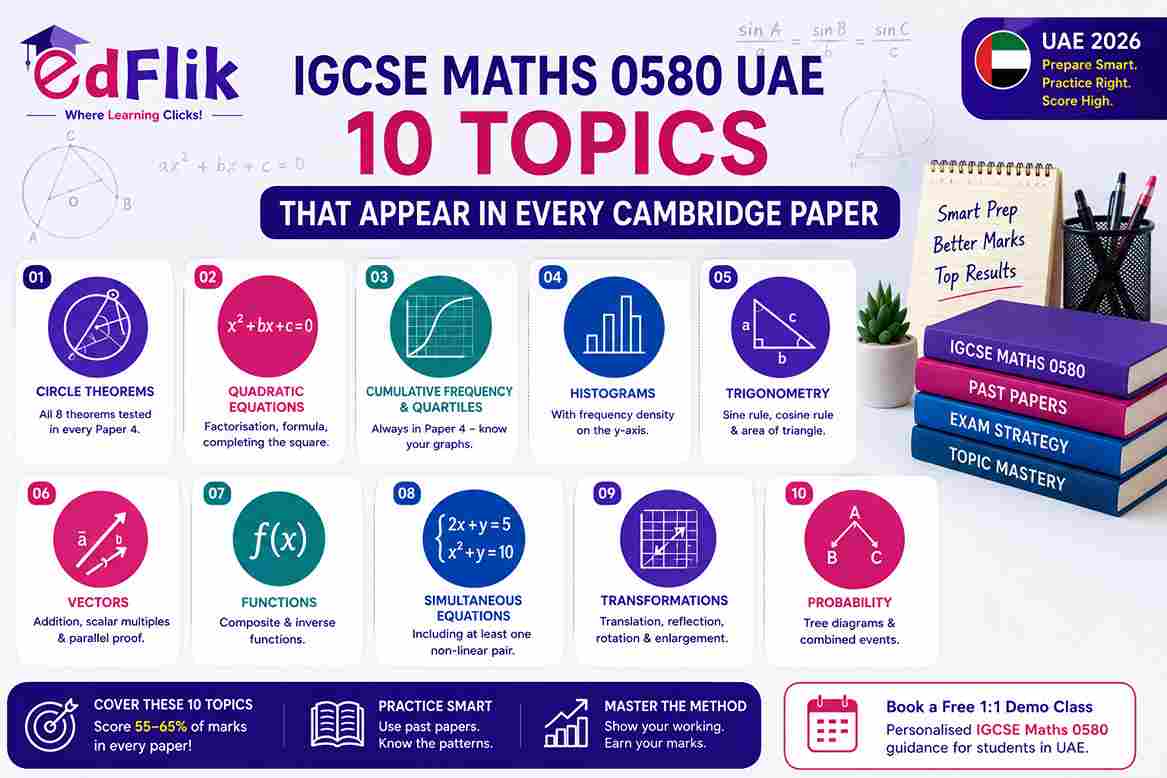
If you are a UAE Year 10 or 11 student preparing for Cambridge IGCSE Mathematics 0580 Extended, the most efficient revision strategy is not to cover everything — it is to master the topics that appear in every single paper series first. Based on analysis of Cambridge 0580 Extended past papers from 2019 to 2025, ten topics are tested in virtually every sitting. Collectively they account for 55 to 65 percent of all available marks. This guide tells you what those ten topics are, exactly how Cambridge tests each one, and the specific technique required to earn full marks on each — including the 2025 syllabus changes that removed three topics and added two new ones.
The 2025 Syllabus Changes — What to Stop Revising and What to Add
Before listing the ten core topics, UAE students must know what changed from June 2025 onwards. Using pre-2025 past papers without this knowledge leads to wasting revision time on removed content and missing new content.
|
Change |
Topic |
Impact for
UAE Students 2026–2027 |
|
REMOVED |
Linear programming |
Skip all linear programming questions in pre-2025 Paper 4 papers.
This topic no longer appears. |
|
REMOVED |
Box-and-whisker plots (Extended) |
No longer drawn or interpreted at Extended level. Cumulative
frequency remains — but box plots are gone. |
|
REMOVED |
Formal congruence criteria (SSS, SAS, AAS, RHS) |
Understanding congruence still required but naming these specific
criteria is no longer assessed. |
|
ADDED |
Domain and range of functions |
New for 2025. Both Paper 2 and Paper 4 can test domain and range.
Learn the notation: domain = set of input values, range = set of output
values. |
|
ADDED |
Exact trigonometric values |
New for non-calculator Paper 2. Must memorise: sin 30°=0.5, cos
60°=0.5, tan 45°=1, sin 60°=cos 30°=√3/2, sin 45°=cos 45°=√2/2. |
|
RESTRUCTURED |
Paper 2 now non-calculator |
From June 2025, Paper 2 Extended is non-calculator (70 marks, 90
minutes). Pre-2025 Paper 2 papers allowed calculators — mark as old-format
when practising. |
The 10 Topics That Appear in Every Cambridge 0580 Extended Paper
1. Circle Theorems — 5 to 15 marks, every Paper 4
Circle theorems appear in every Cambridge 0580 Extended Paper 4 without exception. They are worth 5 to 15 marks per sitting. The most important technique rule: when answering any circle theorem question, state the name or description of the theorem you are using before or alongside your working. Cambridge awards a separate reasoning mark — labelled as 'reason' in the mark scheme — for the stated theorem. Writing the correct angle without stating the theorem loses this mark every time.
The eight theorems every UAE student must memorise, in the Cambridge-required form:
• The tangent to a circle meets the radius at 90° at the point of tangency.
• Tangent lengths from an external point to a circle are equal.
• The angle at the centre is twice the angle at the circumference, both subtended by the same arc.
• Angles in the same segment of a circle are equal (both subtended by the same chord from the same side).
• The angle in a semicircle is 90° (angle subtended by a diameter at the circumference).
• Opposite angles of a cyclic quadrilateral sum to 180°.
• The angle between a tangent and a chord equals the angle in the alternate segment (alternate segment theorem).
• The perpendicular from the centre of a circle to a chord bisects the chord.
Practice method: cover the list, draw an empty circle, write all eight theorems from memory. Check. Repeat daily for two weeks. All eight must be recalled in under 90 seconds — the time pressure of Paper 4 does not allow lengthy recall attempts during the exam.
2. Quadratic Equations — every paper, both Paper 2 and Paper 4
Quadratic equations appear in some form in every 0580 Extended paper. Cambridge tests all three solution methods: factorisation, the quadratic formula, and completing the square. UAE students must know which method to use and when. The mark scheme specifies the method for some questions — 'solve by factorisation' or 'give your answers correct to 2 decimal places' (the latter signals quadratic formula is expected). Key rule: if a question asks you to show all working, do not skip the expansion or factorisation steps. M marks are awarded for each visible step.
|
Method |
When to Use |
Key Rule |
|
Factorisation |
When the discriminant is a perfect square; when the question says
'factorise' or 'solve by factorisation' |
Write the factored form before stating the solutions:
(x–3)(x+2)=0 therefore x=3 or x=–2 |
|
Quadratic formula |
When answers are decimals; when the question says 'give your
answers correct to n decimal places' |
Write the formula before substituting; substitute carefully; show
the two ± solutions separately |
|
Completing the square |
When the question specifically asks for it; or to find the
minimum point of a quadratic graph |
Write (x+p)² + q = 0 form; show each algebraic step; state the
minimum point as (–p, q) |
3. Cumulative Frequency — every Paper 4, 6 to 10 marks
Cumulative frequency is tested in every Paper 4. The question typically provides a grouped frequency table, asks students to draw a cumulative frequency curve, then read off the median and quartiles. The critical technique: quartiles are read from the cumulative frequency curve at specific values on the y-axis — not calculated from the data. The median is at the n/2 value, the lower quartile at n/4, the upper quartile at 3n/4, where n is the total frequency. UAE students who try to calculate quartiles algebraically rather than reading them from the graph lose the method marks for graphical reading.
Common error: drawing the points at the midpoint of each class instead of at the upper boundary of each class. Cumulative frequency points are always plotted at the upper class boundary. The curve must pass through all plotted points and form a smooth S-shape.
4. Histograms (Frequency Density) — every Paper 4, 4 to 8 marks
The y-axis of an IGCSE 0580 histogram must show frequency density, calculated as frequency divided by class width. This is different from many other exam systems where frequency appears on the y-axis. UAE students who draw histograms with frequency on the y-axis earn zero marks for the diagram regardless of how accurately the bars are drawn.
The two histogram question types: (1) Draw a histogram from a frequency table — calculate frequency density for each class, plot bars using frequency density on y-axis. (2) Complete or interpret a histogram — use the scale to work backwards: frequency = frequency density × class width. Always check: the total area of all bars should equal the total frequency.
5. Trigonometry — Sine Rule, Cosine Rule, 3D — every Paper 4
Trigonometry questions using the sine rule and cosine rule appear in virtually every Paper 4. The key UAE student error: not drawing and labelling the triangle before applying any formula. Always draw the triangle, label all known sides and angles, then decide which rule applies. Sine rule when two angles and a side are known, or two sides and a non-included angle. Cosine rule when two sides and the included angle are known, or all three sides are known. For 3D trigonometry: identify the right-angle triangle within the 3D figure, draw it as a separate 2D diagram, then apply Pythagoras or basic trigonometry.
6. Vectors — every Paper 4, 5 to 10 marks
Vector questions appear in every Paper 4. The standard question type: given vectors a and b, find the vector for various paths through a diagram, then prove two vectors are parallel or that three points are collinear. The key technique rules: express every vector as a path from a known starting point; be careful with direction (reversing a path negates the vector); two vectors are parallel if one is a scalar multiple of the other; to prove collinearity, show two vectors sharing a common point are scalar multiples of each other and state this explicitly.
7. Functions — Composite and Inverse — most papers
Composite functions fg(x) and inverse functions f⁻¹(x) appear in most paper series across both Paper 2 and Paper 4. Composite: fg(x) means apply g first, then f to the result — f(g(x)). Common error: reversing the order. Inverse: replace f(x) with y, rearrange to make x the subject, then write f⁻¹(x) replacing y with x. Domain and range (new for 2025): the domain is the set of allowed input values; the range is the set of resulting output values. For Paper 2 (non-calculator), exact answers for function evaluations are expected.
8. Simultaneous Equations Including Non-Linear — most papers
Simultaneous equations appear in most paper series. Cambridge tests both linear pairs (substitution or elimination) and non-linear pairs (one linear, one quadratic or circle equation). For non-linear: substitute the linear equation into the quadratic, expand, collect terms, solve the resulting quadratic for x, then substitute each x value back to find the corresponding y values. State both solution pairs clearly: (x₁, y₁) and (x₂, y₂). A common error: finding x values but forgetting to find the corresponding y values.
9. Transformations — most Paper 4
Transformation questions appear in most Paper 4 sittings. Cambridge tests two types: performing a transformation (draw the image) and describing a transformation (state the type and all required details). When describing, every detail must be given. Translation: state 'translation by vector (a, b)'. Reflection: state 'reflection in the line y = mx + c'. Rotation: state 'rotation, angle, direction (clockwise or anticlockwise), centre (coordinates)'. Enlargement: state 'enlargement, scale factor, centre (coordinates)'. Missing any one detail loses the full description mark.
10. Probability — Tree Diagrams and Combined Events — most Paper 4
Probability using tree diagrams and combined events (without replacement scenarios) appears in most Paper 4 sittings. The key rules: multiply probabilities along branches; add probabilities between branches; all branches from one node must sum to 1. For 'without replacement' scenarios, the denominator changes for the second event. UAE students who treat without-replacement problems as independent events — keeping the denominator the same — lose all accuracy marks.
How to Use These 10 Topics in Your Revision
|
Phase |
Timing |
Action |
|
Topic mastery |
September to November |
Complete all 8 circle theorems from memory. Practise all 3
quadratic methods. Frequency density calculation drills. Do not move to past
papers until each topic is understood. |
|
Topic-specific past paper questions |
November to January |
Use savemyexams.com or topical past paper collections to practise
20–30 questions per topic. Mark against official Cambridge mark scheme. Log
every error type. |
|
Full paper practice |
January to April |
Complete full Paper 2 + Paper 4 pairs under strict timed
conditions. Mark immediately. Track scores across papers. Target improvement
from paper to paper, not a static score. |
|
Consolidation |
April to exam |
Circle theorem theorems flashcard review daily. High-frequency
topic quick-run. Non-calculator Paper 2 exact values drill. |
Frequently Asked Questions — IGCSE Maths 0580 Topics UAE
Q: Which topics appear in every Cambridge IGCSE Maths 0580 Extended paper?
A: Ten topics appear in virtually every 0580 Extended series: circle theorems (all 8), quadratic equations (all 3 methods), cumulative frequency, histograms with frequency density, trigonometry (sine and cosine rule), vectors, composite and inverse functions, simultaneous equations including non-linear pairs, transformations (all 4 types), and probability with tree diagrams. These account for 55 to 65 percent of all Extended marks.
Q: What changed in Cambridge IGCSE Maths 0580 for 2025 and 2026?
A: Three topics removed: linear programming, box-and-whisker plots (Extended content), formal congruence criteria (SSS, SAS etc.). Two topics added: domain and range of functions, and exact trigonometric values (sin 30°, cos 45°, tan 60° etc. — required for non-calculator Paper 2). Paper 2 became non-calculator from June 2025. Pre-2025 Paper 2 papers used calculators — a different format from current exams.
Q: What is the most important single technique for IGCSE Maths 0580?
A: Showing method steps for every calculation question. Cambridge awards M marks for correct working shown clearly — independently of whether the final answer is correct. Not showing working is the single most common cause of mark loss in 0580, consistently identified in Cambridge Principal Examiner Reports. UAE students typically recover 15 to 25 marks per paper by changing this one habit.
Q: How should UAE students practise circle theorems for IGCSE Maths 0580?
A: Memorise all eight theorems by name. When answering, state the theorem name before or alongside the angle calculation — Cambridge awards a separate reasoning mark for the stated theorem. Practice: cover the list, write all eight from memory, check. Repeat daily until all eight are recalled in under 90 seconds. Circle theorems are 5 to 15 marks per Paper 4 and are entirely predictable — full marks are achievable through memorisation and practice.
Q: Why do UAE students lose marks on histogram questions?
A: The y-axis must show frequency density (= frequency ÷ class width), not frequency. Drawing histograms with frequency on the y-axis earns zero diagram marks regardless of how accurately the bars are drawn. Also: points must be plotted at the upper class boundary, not the midpoint.
Q: Does EdFlik provide IGCSE Maths 0580 tutoring for UAE students?
A: Yes. Cambridge CAIE 0580 Extended specialists across all UAE emirates. Every session uses official past papers with mark-scheme correction. First session identifies whether the issue is presentation (method marks) or topic gaps. From AED 60 per class.
How EdFlik Supports IGCSE Maths 0580 Students Across UAE
EdFlik IGCSE Maths tutors are matched to Cambridge CAIE 0580 specifically. Every session uses official past papers with mark-scheme correction. Method mark compliance is the first technique built in every session. From AED 60 per class. Free demo session. No lock-in contracts. Book at www.edflik.com