IGCSE Geography Tutor Online: What Parents Should Know
Geography can be one of the most rewarding subjects for teenagers. It connects classroom learning with the world around them, from weather patterns to the growth of cities. But IGCSE Geography also asks students to read maps, handle data, understand fieldwork and write clear answers under time pressure. Many students find these skills take practice, and parents often wonder how best to help.
This guide explains the main areas of the course, what to look for in an online tutor and how to use a free trial class to see whether the fit is right for your child. Whether you are in Dubai, Sharjah, Abu Dhabi or elsewhere in the GCC, the same questions apply.
What the Course Usually Covers
IGCSE Geography typically includes physical geography, human geography and geographical skills. Physical topics may include landforms, weather and climate, and ecosystems. Human topics often cover population, settlements, resources and economic activity. Students also learn to read maps, interpret graphs and tables, and use evidence to support their answers.
Because the syllabus can change, always check the current official syllabus or specification for your child's exam series. Your child's school will also have a scheme of work that shows the order of topics and key dates.
Skills That Make the Biggest Difference
Three skill areas often decide how confidently a student performs in geography.
The first is map and data work. Students need to read scales, grid references, contour lines and charts accurately. The second is fieldwork. Students must understand how data is collected, why methods matter and how to evaluate results. The third is written answers. Students need to use the command words in each question, such as describe, explain or evaluate, and support their points with specific examples.
A good tutor helps your child practise all three areas. They should not simply give answers, but ask questions that help your child find the reasoning for themselves.
What a Helpful One-to-One Lesson Looks Like
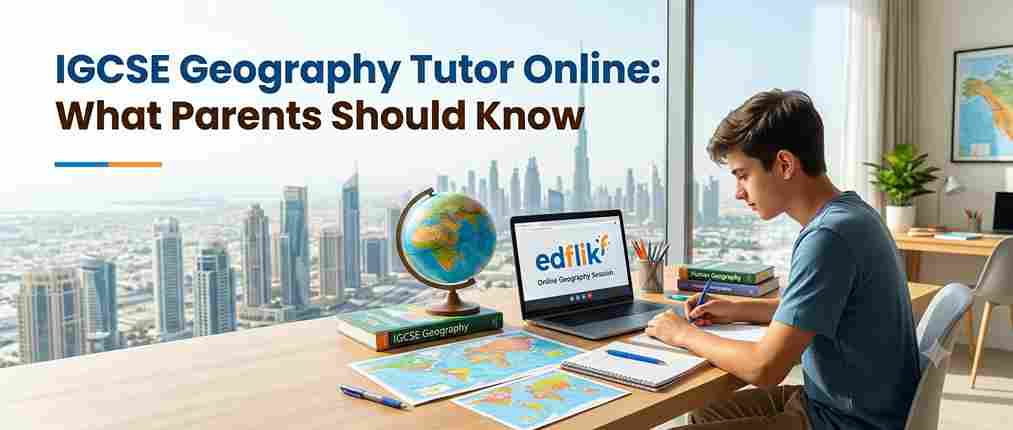
A one-hour lesson gives time to focus on the skill that needs the most attention. A typical session might start with a short review, move to a map or data task, and finish with a written answer that the tutor reviews together with your child.
Look for these signs in a free trial class:
- The tutor checks that your child understands what each command word asks for.
- Maps and graphs are used actively, with questions about what they show.
- Fieldwork ideas are explained with clear steps, from method to conclusion.
- Written answers are improved with specific feedback on structure and evidence.
- Your child leaves with a task to practise before the next lesson.
Ask the tutor which resources they use for practice. A clear answer about the type of practice, and how it links to the syllabus, is a good sign.
Maps and graphs are best practised on screen during lessons too, where the tutor can point to a feature and ask your child what it shows. This keeps the focus on reading the evidence rather than memorising it.
Why One-to-One Online Lessons Can Help
Geography rewards careful, step-by-step thinking. In a one-to-one online lesson, the tutor can focus entirely on your child's gaps. If your child struggles with map questions, the lesson can spend more time there. If written answers need work, the tutor can focus on structure and evidence.
Many families find that online lessons fit around school, sport and family commitments more easily than travel. A regular weekly slot, often in the evening, helps your child build skills steadily rather than cramming before a test.
Understanding Command Words
Command words tell students exactly what to do in an answer. "Describe" asks for the main features of something, such as the shape of a landform or a pattern on a map. "Explain" asks for reasons, so the student must link a cause to an effect. "Evaluate" asks for a judgement, weighing up evidence and reaching a supported conclusion. Read the current official syllabus for the full list, because the exact wording used in each paper matters.
Many students know the content but lose marks because they answer a different question from the one asked. A tutor can help your child underline the command word before writing, then check that each sentence responds to it.
Using Local Places as Examples
Students often find geography easier when they can picture a real place. Your child can draw on their own experience, such as a visit to a wadi, a stretch of coastline or a growing neighbourhood, to illustrate an idea. A tutor can show how to link that experience to the course content, using clear evidence rather than guesses.
Encourage your child to notice where geography appears in daily life, from the way a city is laid out to the way water is managed. These observations make revision more personal and help the ideas stay in memory.
Building a Revision Routine
Short, regular revision usually works better than long sessions just before a test. Ask your child to spend a little time each week on one map skill, one data question and one written answer. Over a term, these small sessions add up to a strong set of skills.
Keep a simple folder of corrected answers and annotated maps. Looking back at them before an assessment helps your child see their own progress, and it gives the tutor clear examples to work from in the next lesson.
A Practical Checklist for UAE Parents
1. Ask your child which topics feel strongest and which feel least clear.
2. Ask the tutor how they teach map, data and fieldwork skills.
3. Check that lessons are about one hour and fit your family's routine.
4. Ask how progress will be shared with you each month.
5. Book a free trial class and note whether your child feels comfortable asking questions.
6. Review the current official syllabus with your child, so you both know what is assessed.
How EdFlik can help
EdFlik offers live, one-to-one online classes for children and teens aged 3 to 18, including IGCSE Geography. Your child works with one tutor who can focus on their own questions, pace and exam goals. Classes are about one hour, and pricing starts from AED 45 per class.
Every family can start with a free trial class. It is a relaxed way to see how the tutor explains maps and written answers, and how your child responds. There is no pressure to continue after the trial. To book, visit www.edflik.com or email support@edflik.com.
Conclusion
IGCSE Geography is much easier to approach when your child knows which skills matter, how the command words work and where extra practice will help most. Check the current official syllabus, ask the questions in this guide and try a free trial class. With steady practice and the right support, your child can build confidence in map work, data and clear written answers.
Frequently Asked Questions
What topics does IGCSE Geography cover?
The course usually includes physical geography, human geography and geographical skills. Topics can include weather, landforms, population, settlements and resources. Check the current official syllabus for your child's exam series, as the detail can change.
How does a tutor help with fieldwork questions?
A tutor can explain how data is collected, why a method is chosen and how results are evaluated. They can also help your child practise planning answers, so they know how to present evidence clearly in the exam.
Which skills are tested in the exam?
Students are usually assessed on knowledge, map and data skills, fieldwork understanding and clear written answers. Command words guide what each question asks. Ask a tutor to show your child how to read each word carefully.
Can one-to-one lessons help with map and data questions?
Yes. A one-to-one lesson lets the tutor focus on your child's exact gaps, such as scale calculations or reading graphs. Regular practice with feedback helps students build accuracy and confidence over time.
How do I start with a free trial?
Visit www.edflik.com to book, or email support@edflik.com with your child's year group and preferred times. The team will help you choose a suitable trial class. Share your child's year group, the topics they find hardest and any exam dates, so the first lesson can be planned well.