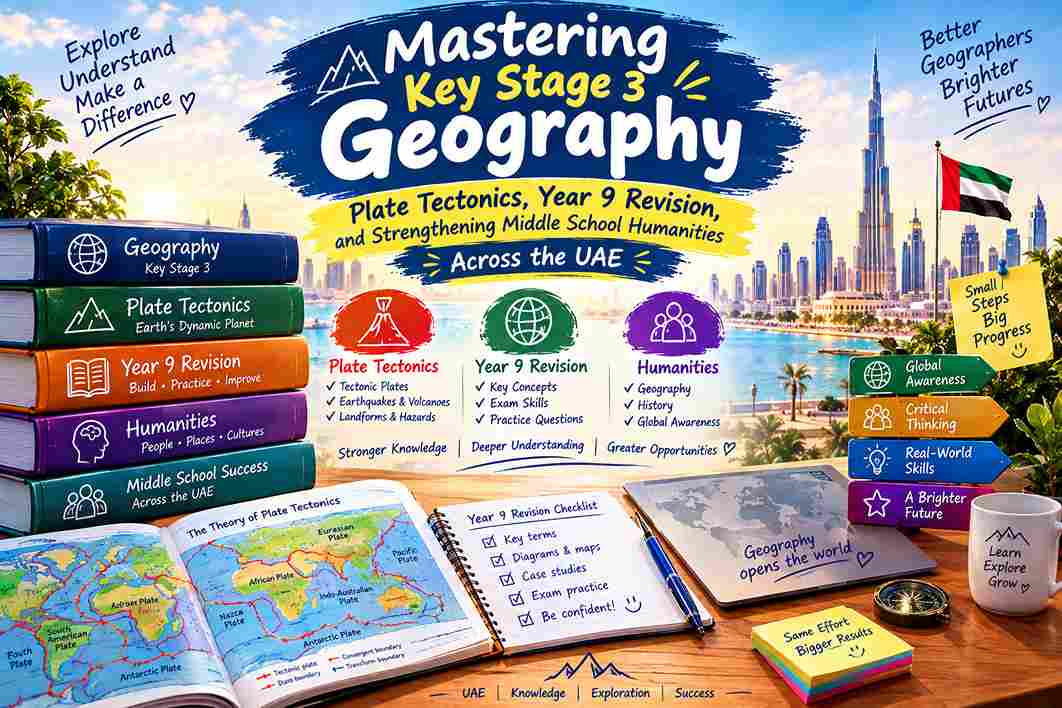
Mastering Key Stage 3 Geography: Plate Tectonics, Year 9 Revision, and Strengthening Middle School Humanities Across the UAE
Last Updated: September 2026 | By EdFlik Education Team
For students and parents navigating international schools across the UAE—including Dubai, Abu Dhabi, and Sharjah—following the British Curriculum (Key Stage 3), Year 9 (Grade 8/9) represents a vital transitional bridge. At this stage, middle school education moves away from descriptive, thematic geography toward dynamic physical earth processes and complex human interactions.
Among all physical geography topics in Key Stage 3, Plate Tectonics stands out as one of the most intellectually engaging and visually striking units. Understanding how the Earth's crust moves, why earthquakes and volcanic eruptions occur, and how human societies adapt to tectonic hazards requires a robust grasp of both physical science and human geography.
In this comprehensive guide, our expert Key Stage 3 geography and humanities tutors break down essential revision notes on plate tectonics, share high-impact study strategies for Year 9 exams, and explain how targeted academic support can set students up for elite IGCSE and GCSE success.
Part 1: Deconstructing Key Stage 3 Geography — Plate Tectonics
The Earth is not a static, solid shell; its outer layer is fractured into massive jigsaw pieces called tectonic plates that float on the semi-fluid mantle beneath. To ace your Year 9 geography assessments, you must master the internal structure of the Earth, plate boundary types, and the real-world impacts of tectonic hazards.
1. The Internal Structure of the Earth
Before studying plate movement, you must know the four primary layers:
- The Inner Core: A solid ball of iron and nickel at the center of the Earth with extreme temperatures (around 5,000°C to 6,000°C).
- The Outer Core: A liquid layer surrounding the inner core, generating Earth's magnetic field.
- The Mantle: The thickest layer of the Earth, made of semi-molten rock (magma). Convection currents driven by core heat cause the mantle to circulate slowly.
- The Crust: The thin, rocky outer skin of the Earth. It is split into two types: Oceanic Crust (dense, thin, younger rock, mostly basalt) and Continental Crust (less dense, thicker, older rock, mostly granite).
2. The Three Types of Plate Boundaries
Plates move due to mantle convection currents. Where these plates meet, geological activity occurs. You must be able to describe and sketch the three main types of boundaries:
- A. Destructive (Convergent) Boundaries
- Movement: Two plates move toward each other.
- Process: The heavier oceanic plate subducts (sinks) beneath the lighter continental plate into the trench and mantle, melting due to friction and heat.
- Hazards: Violent earthquakes, explosive composite volcanoes, and deep ocean trenches (e.g., The Andes or the Mariana Trench).
- B. Constructive (Divergent) Boundaries
- Movement: Two plates move apart from each other.
- Process: Magma rises up from the mantle to fill the gap, cooling to form brand-new crust.
- Hazards: Gentle earthquakes, shield volcanoes, and underwater mid-ocean ridges (e.g., The Mid-Atlantic Ridge or the East African Rift Valley).
- C. Conservative (Transform) Boundaries
- Movement: Two plates slide past each other horizontally, either in opposite directions or at different speeds.
- Process: Friction causes plates to lock temporarily. Pressure builds up until the rock suddenly fractures or slips, releasing massive seismic energy.
- Hazards: Powerful, shallow-focus earthquakes with no volcanic activity (e.g., The San Andreas Fault in California).
Part 2: Human Interaction — Why Do People Live Near Plate Boundaries?
Middle school humanities and geography require you to look beyond physical science and evaluate human responses. Despite the obvious dangers of earthquakes and volcanoes, millions of people live in active tectonic zones for several compelling reasons:
- Fertile Volcanic Soils: Volcanic ash breaks down over time to create mineral-rich soil that is exceptionally fertile for agriculture (e.g., farming around Mt. Vesuvius in Italy or Java in Indonesia).
- Geothermal Energy: Volcanic activity provides cheap, renewable geothermal energy (e.g., Iceland generates a massive percentage of its electricity and heating this way).
- Mining and Mineral Wealth: Tectonic movements force valuable minerals, precious metals, and gemstones close to the Earth's surface for extraction.
- Tourism and Economy: Volcanoes, hot springs, and dramatic landscapes attract millions of tourists, boosting local economies and employment.
- Economic Inertia and Family Ties: Many populations simply cannot afford to relocate, or their families have lived in the region for generations, leading to complacency or reliance on government disaster preparedness (earthquake-proof buildings, early warning systems).
Part 3: Top 4 Strategies to Secure Top Grades in Year 9 Geography
- Master Sketching and Diagram Annotation: Geography is a visual subject. Practice drawing cross-sections of destructive, constructive, and conservative plate boundaries from memory, labeling key features like subduction zones, trenches, magma chambers, and convection currents.
- Use Case Studies to Support Arguments: Never make vague generalizations in humanities essays. Support your points with named examples (e.g., contrasting the 2010 Haiti earthquake in an LEDC with the 2011 Tohoku earthquake in an MEDC).
- Decommand Command Words: Understand what your teacher or examiner is asking for when they use words like describe (state what you see), explain (give reasons why it happens using geographical processes), or evaluate (weigh up the pros and cons to reach a reasoned conclusion).
- Integrate Science and Humanities: Plate tectonics bridges physical science and human geography. Always connect the physical cause (e.g., seismic wave release) to the human consequence (e.g., infrastructure collapse and economic loss).
Part 4: Why Personalized Tutoring Matters in Middle School Humanities
Transitioning from primary school into Year 9 humanities and science requires mastering complex terminology, structured paragraph writing, and spatial analysis. School classrooms cannot always provide the individualized attention needed to target specific learning gaps.
Partnering with an expert 1-to-1 tutoring provider like EdFlik offers transformational advantages during Key Stage 3:
- Targeted Concept Clarity: Breaking down difficult geological processes and map-reading skills into clear, manageable steps.
- Essay & Structured Writing Support: Teaching students how to structure geographical case studies using clear PEEL paragraphs (Point, Evidence, Explanation, Link).
- Academic Confidence: Providing a supportive mentorship environment where middle school students can ask questions freely and build absolute readiness for the transition into IGCSE / GCSE courses.
Preparing for Year 9 geography and humanities exams across the UAE? EdFlik offers expert, 1-to-1 online tutoring customized specifically for international school students following the British curriculum, helping you build analytical mastery and secure top academic grades.Book a Free Demo Class Today!
Frequently Asked Questions (FAQs)
Q1: What is the difference between oceanic crust and continental crust?
Ans: Oceanic crust is thinner, denser, and younger (made of basalt), found beneath the world's oceans. Continental crust is thicker, less dense, and older (made of granite), forming the Earth's landmasses.
Q2: Why are there no volcanoes at conservative plate boundaries?
Ans: At conservative boundaries, plates slide horizontally past each other. Because no crust is being created or destroyed, magma does not rise from the mantle to the surface, meaning volcanic activity cannot occur.
Q3: Why do earthquakes in LEDCs (Lower Economically Developed Countries) often cause more deaths than in MEDCs?
Ans: LEDCs often lack the financial resources to build earthquake-resistant infrastructure, possess less advanced early warning systems, and struggle with slower emergency response times compared to wealthy, technologically prepared MEDCs.
Q4: How can EdFlik support Key Stage 3 students in the UAE?
Ans: EdFlik connects students across Dubai, Abu Dhabi, Sharjah, and the UAE with vetted, experienced 1-to-1 online tutors specializing in middle school science, geography, and humanities. Our personalized sessions focus on clarifying difficult topics, mastering map skills, and building academic confidence.