IGCSE History Tutor UAE 2026 — Cambridge 0470 Source Questions, Essay Technique and Period Guide
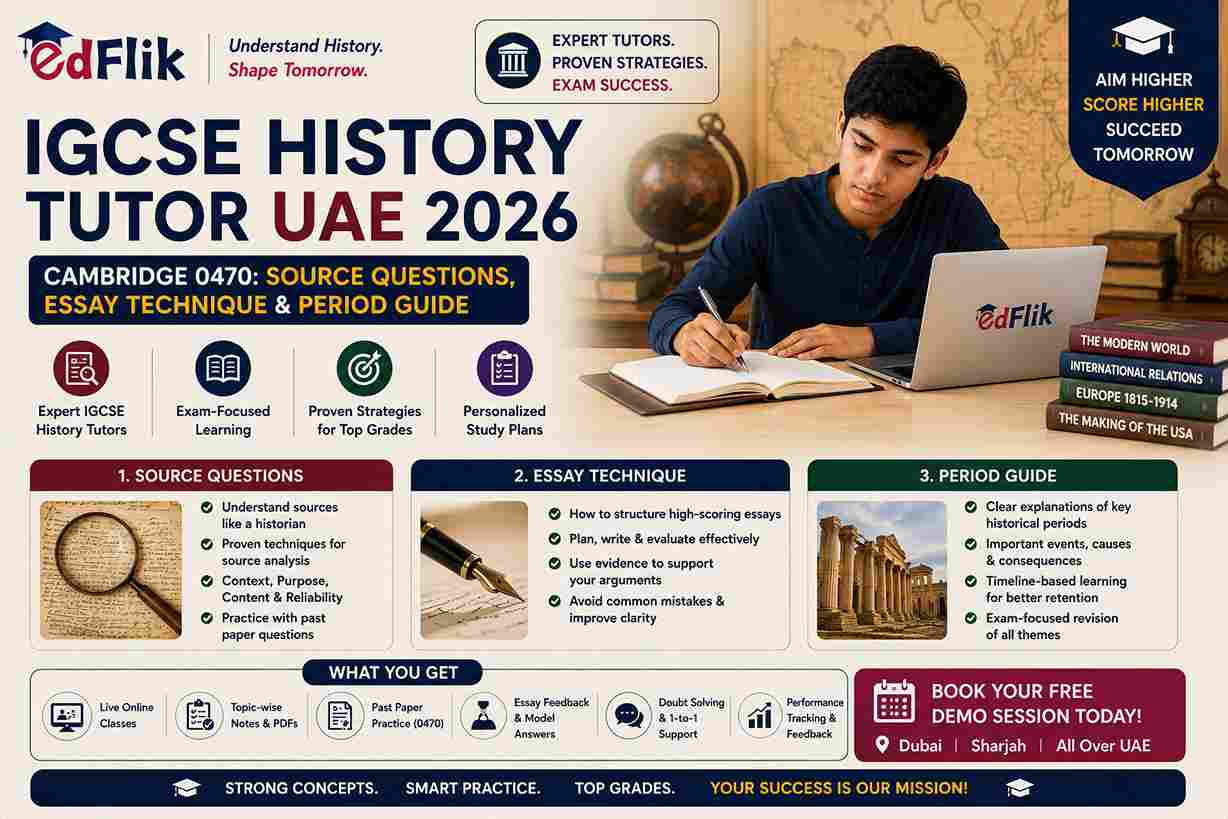
IGCSE History (Cambridge 0470) is an intellectually engaging subject that rewards specific, learnable skills — and one where UAE students often lose marks not from lack of historical knowledge, but from not knowing the exact format examiners require. The source evaluation technique (NOP) and the structured analytical essay format are both systematic frameworks that improve rapidly with explicit instruction. This guide covers both.
IGCSE History Paper Structure — Cambridge 0470
|
Paper |
Content |
Duration |
% of Grade |
|
Paper 1 |
Core Content —
20th century world history. Source-based questions and essays. |
2 hours |
50% |
|
Paper 2 |
Depth Study —
chosen period (e.g. Cold War, inter-war period). Sources + free-standing
essays. |
2 hours |
50% |
Source Evaluation Technique — The NOP Framework
All Cambridge IGCSE History source questions require the NOP evaluation framework. This is the single most important learnable technique in the subject:
|
NOP Element |
Questions to
Answer |
Why It Earns
Marks |
|
Nature |
What type of
source is it? (speech, photograph, diary entry, newspaper article, official
report, propaganda poster, etc.) |
Establishes
what kind of evidence the source provides and what it can/cannot show |
|
Origin |
Who created
the source? When? Where? Under what circumstances? |
Contextualises
the source and identifies potential bias from the creator's position |
|
Purpose |
Why was this
source created? What was the creator trying to achieve? Who was the intended
audience? |
Explains
potential deliberate shaping of the message — propaganda differs from a
private diary in purpose |
|
Content /
Cross-reference |
What does the
source actually say or show? How does it relate to other evidence you know? |
Connects the
source to contextual knowledge and other sources provided |
Usefulness vs Reliability — An Important Distinction
"How useful is this source to a historian studying..." is a different question from "How reliable is this source?" A propaganda poster may be completely unreliable as evidence of facts but extremely useful as evidence of how a government tried to influence public opinion. UAE students who conflate usefulness and reliability lose evaluation marks. The safest approach: state what the source is useful for, then explain what limits its usefulness and why.
The Analytical Essay Paragraph Structure
IGCSE History essays are marked on the quality of historical argument, not the breadth of knowledge recalled. Every body paragraph should follow PEAL:
• P — Point: Make one clear, specific historical argument relevant to the question
• E — Evidence: Support the point with specific, accurate historical evidence (dates, events, names, statistics)
• A — Analysis: Explain WHY the evidence supports the point — the historical significance, cause, or consequence
• L — Link: Connect the point back to the question's specific wording — show why this point answers the question
The most common UAE student error in IGCSE History essays: narrative paragraphs that describe events without making an argument. Describing what happened in 1933 when Hitler became Chancellor earns few marks. Arguing WHY Hitler's rise to power in 1933 was primarily caused by economic factors, and explaining the specific evidence that supports this, earns full analytical marks.
Most Popular Depth Study Periods at UAE Schools
|
Depth Study
Period |
Key Topics
Covered |
Most Examined
Questions |
|
The First
World War (1914-18) |
Causes of WWI
(assassination, alliance system, militarism, imperialism), trench warfare,
key battles, America's entry, impact of war |
Why did WWI
break out? Was the Treaty of Versailles fair to Germany? How effective was
trench warfare? |
|
Rise of Hitler
and Nazi Germany (1919-45) |
Weimar
Republic weaknesses, Great Depression impact, Hitler's rise, Nazi policies,
Holocaust |
Why did Hitler
become Chancellor? How did Nazis maintain control? How did persecution of
Jews develop? |
|
The Cold War
(1945-2001) |
Origins of
Cold War, Truman Doctrine and Marshall Plan, Berlin crises, Cuban Missile
Crisis, Vietnam, détente, end of Cold War |
Why did the
Cold War start? Who was most to blame? How dangerous was the Cuban Missile
Crisis? |
|
The League of
Nations (1919-45) |
Formation,
structure, successes, failures, Manchuria, Abyssinia, impact on WWII |
Why did the
League of Nations fail? How significant were the failures in Manchuria and
Abyssinia? |
|
EdFlik IGCSE
History tutors are Cambridge 0470 specialists. Sessions cover NOP source
evaluation, PEAL essay structure, and period-specific content for the most
popular UAE school depth studies. From AED 60 per session. Free diagnostic
trial. Book at www.edflik.com or WhatsApp +91 88788 96600. |
Frequently Asked Questions
Q: What are the most popular history topics in IGCSE at UAE schools?
The Cold War and the inter-war period (rise of Hitler, League of Nations, appeasement) are the most frequently taught depth studies at UAE British curriculum schools. The First World War is also popular.
Q: What is the source evaluation technique for IGCSE History?
The NOP framework: Nature (what type of source), Origin (who created it, when, where), Purpose (why created, intended audience). Then evaluate usefulness — what it can and cannot tell us — and cross-reference with other sources.
Q: What is Paper 2 in IGCSE History?
A 2-hour paper on the chosen depth study period, combining source-based questions and free-standing essays. Worth 50% of the total IGCSE grade.
Q: Is IGCSE History hard?
Content-heavy and requires a specific writing style — evidence-based analytical paragraphs, not narratives. The source evaluation and essay techniques are learnable frameworks that improve consistently with targeted practice.
Q: What is the difference between IGCSE History Paper 1 and Paper 2?
Paper 1 covers 20th century world history core content with source-based questions. Paper 2 covers the chosen depth study period with source questions plus free-standing essay responses.