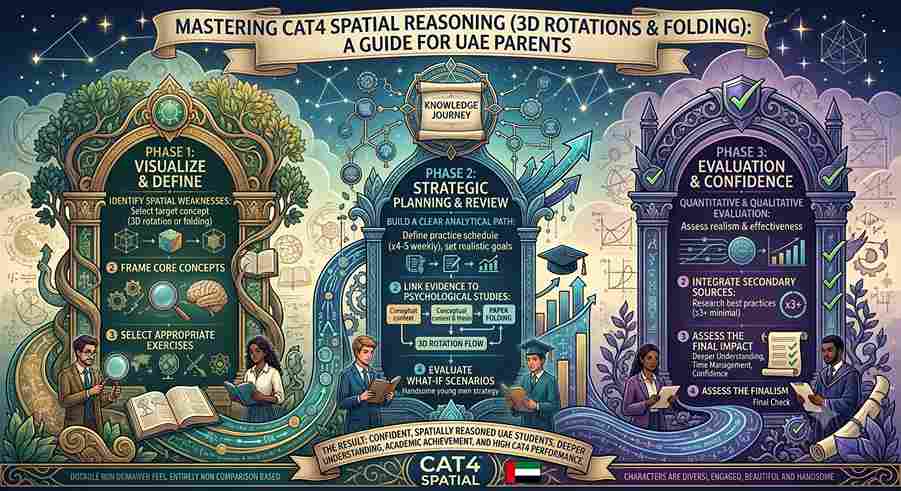
Mastering CAT4 Spatial Reasoning (3D Rotations and Folding): A Guide for UAE Parents
Last Updated: October 2026 | By EdFlik Education Team
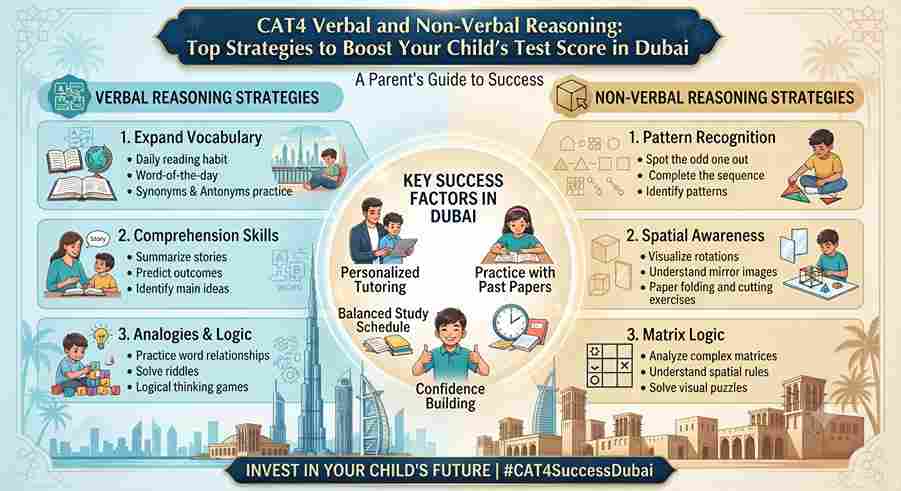
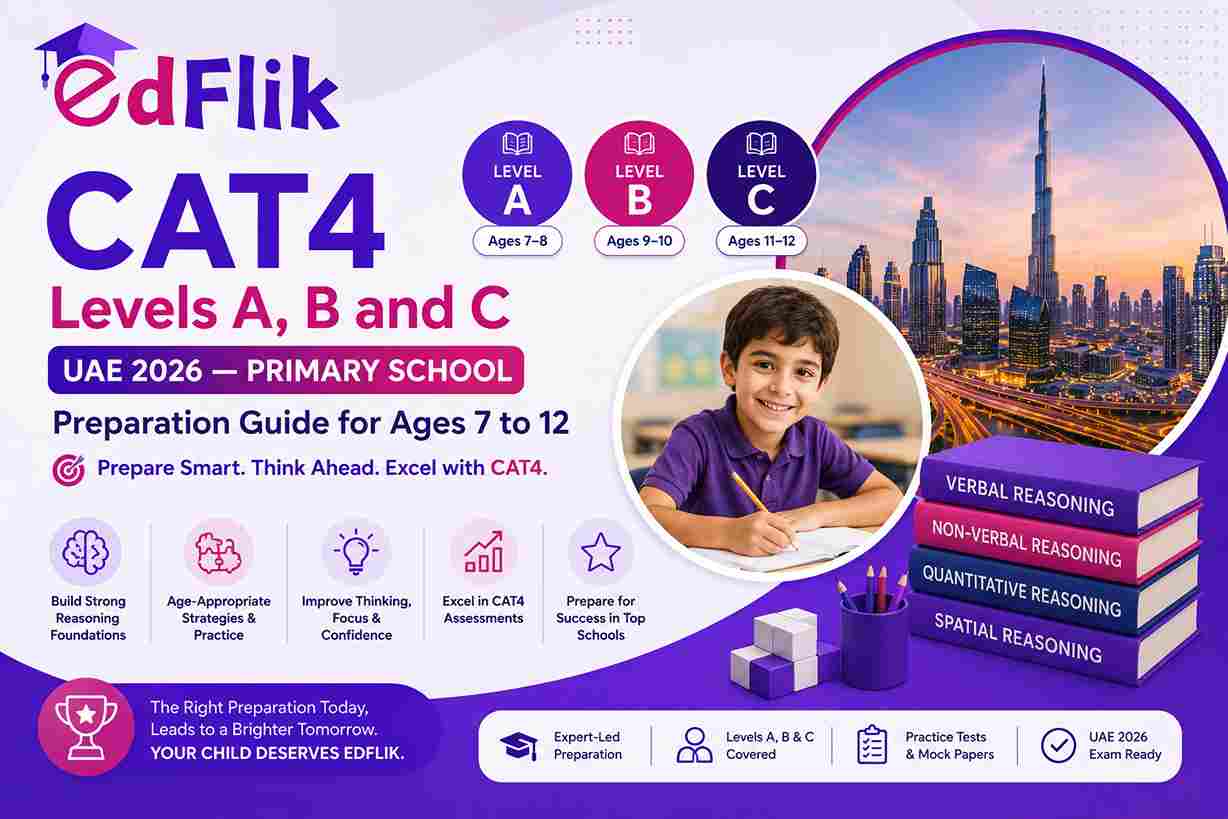
For families navigating the admissions and selective testing processes across private international schools in the United Arab Emirates—whether in Dubai, Abu Dhabi, Sharjah, or the Northern Emirates—the Cognitive Abilities Test (CAT4) is a familiar and critical milestone. Administered by GL Assessment, the CAT4 is widely used by British, IB, and American curriculum schools to measure a student’s cognitive reasoning capabilities across four distinct batteries: Verbal, Non-Verbal, Quantitative, and Spatial Reasoning.
Among these four batteries, Spatial Reasoning—specifically sub-sections testing Figure Rotation (3D Rotations) and Figure Analysis (Paper Folding and Hole Punching)—frequently presents the steepest learning curve for students. Unlike traditional school subjects that rely on memorizing curriculum content or mathematical formulas, spatial reasoning measures how a student manipulates visual patterns in their mind's eye.
In this comprehensive guide, our expert academic advisors and cognitive test strategists break down the mechanics of CAT4 Spatial Reasoning, analyze the cognitive challenges of 3D mental rotation and paper folding, and provide actionable practice strategies to help UAE parents support their children.
Part 1: What Is the CAT4 Spatial Reasoning Battery?
The CAT4 Spatial Reasoning battery assesses a student's ability to think and reason using 2D and 3D shapes. It evaluates how effectively someone can visualize transformations, rotate objects mentally, and track how physical materials change when folded, cut, or punched.
                  CAT4 SPATIAL REASONING BATTERY STRUCTURE
                                     |
        +----------------------------+----------------------------+
        |                                                         |
  1. FIGURE ROTATION (3D)                                   2. FIGURE ANALYSIS (FOLDING)
  • Visualizing 3D objects rotated                          • Tracking a square paper sheet through
    through various spatial planes.                           multiple folds and a final punch hole.
  • Requires mental axis-flipping.                          • Requires reverse-sequencing skills.
Why Spatial Reasoning Matters
Cognitive research shows that spatial ability is strongly correlated with problem-solving success in STEM (Science, Technology, Engineering, and Mathematics) fields, computer-aided design (CAD), architecture, and advanced mathematics. Success on this battery does not depend on prior schooling; it relies on mental agility and spatial visualization practice.
Part 2: Conquering CAT4 Figure Rotation (3D Rotations)
The Figure Rotation sub-test presents a 3D reference shape (often an asymmetrical geometric block made of joined cubes, shaded polygons, or L-shaped components) and asks the student to identify which of the multiple-choice options is a rotated version of the original shape.
                  THE 3D MENTAL ROTATION CHALLENGE
                                 |
     +---------------------------+---------------------------+
     |                                                       |
WHAT STOPS STUDENTS (TRAPS)                            WINNING TACTICS
• Mirror images (distractors that have                  • Track reference corners and faces.
  been reflected, not rotated!).                        • Eliminate mirror-image option traps first.
• Complex multi-axis spins.                             • Use physical finger rotation to visualize.
1. The Danger of Mirror Images (The Ultimate Trap)
The most common distractor in CAT4 Figure Rotation questions is a reflection (mirror image) of the target shape. GL Assessment test designers intentionally create answer choices that look similar to the original shape but have been flipped across a mirror plane.
- Rule: A valid rotation can always be achieved by spinning the object in 3D space without flipping it over like a pancake. If an option is a reflected copy, eliminate it immediately.
2. The Reference Feature Strategy
Instead of trying to rotate the entire 3D block in your head all at once, teach your child to focus on one or two distinct reference features:
- Look for an indented corner, a shaded top face, or an asymmetric protruding nub.
- Track how that single feature moves relative to the overall coordinate axes as the shape rotates.
Part 3: Mastering Figure Analysis (Paper Folding and Hole Punching)
The Figure Analysis sub-test evaluates how a student tracks physical changes made to a square sheet of paper that is folded multiple times and then punctured with a hole. When unfolded, where will the holes appear?
                  PAPER FOLDING REVERSE-ENGINEERING
                                 |
  Step 1: Track the Folds    ---> Note each crease line (diagonal, half, quarters)
  Step 2: Locate Punch Hole  ---> Identify exact position on the final folded square
  Step 3: Reverse Sequence   ---> Unfold step-by-step, mirroring holes across crease lines
Step-by-Step Worked Example:
Question: A square piece of paper is folded in half from top to bottom, then folded in half from left to right. A circular hole is punched through the center of the folded square. How many holes appear when the paper is completely unfolded, and where are they located?
Step 1: Track the Folds
- Original square: Unfolded ($1$ layer).
- Folded top-to-bottom: Folded into a rectangle ($2$ layers thick).
- Folded left-to-right: Folded into a smaller square ($4$ layers thick).
Step 2: Track the Punch Hole
A single hole is punched through all $4$ layers at the center point.
Step 3: Unfold and Mirror
- When you unfold the left-to-right fold, the single hole mirrors across the vertical crease, becoming $2$ holes.
- When you unfold the top-to-bottom fold, those $2$ holes mirror across the horizontal crease, resulting in $4$ total holes arranged symmetrically around the center.
Part 4: Top 4 Mistakes Students Make in Spatial Reasoning
- Guessing Too Quickly Without Visual Proof: Trying to answer spatial questions in under 10 seconds by guessing, rather than systematically eliminating mirror-image distractors.
- Ignoring Orientation Cues: Failing to pay attention to shading patterns or textured surfaces on 3D blocks that indicate which face is pointing forward.
- Failing to Reverse-Engineer Paper Folds: Trying to visualize the unfolded paper all at once instead of working backward step-by-step from the final punch position.
- Test Fatigue: Spatial reasoning requires intense visual concentration. Students often experience cognitive fatigue halfway through the test, leading to careless errors on simpler rotation items.
Preparing your child for CAT4 assessments in Dubai, Abu Dhabi, or across the UAE? EdFlik connects international school students globally with expert, 1-to-1 online CAT4 tutors, helping you master spatial reasoning, non-verbal matrices, quantitative problem-solving, and test-taking strategies. Book a Free Demo Class Today!
Frequently Asked Questions (FAQs)
Q1: What age groups take the CAT4 Spatial Reasoning battery?
Ans: CAT4 is administered across multiple levels (from Level X for Year 4 up to Level G for Sixth Form / Year 12) in international schools across the UAE. Spatial reasoning is evaluated across virtually all primary and secondary levels.
Q2: Can spatial reasoning be improved with practice?
Ans: Yes! Unlike innate intelligence myths, spatial visualization skills are highly improvable. Regular practice with 3D physical blocks, origami paper-folding exercises, and targeted CAT4 practice questions significantly enhances a student's mental rotation speed and accuracy.
Q3: How does the CAT4 score affect international school admissions in Dubai?
Ans: Admissions directors in UAE private schools use CAT4 Standard Age Scores (SAS) and Stanine ratings to understand a student's cognitive baseline, identify learning support needs, and assess academic potential alongside English and mathematics entrance exams.
Q4: How does EdFlik support students preparing for CAT4 assessments?
Ans: EdFlik connects students across Dubai, Abu Dhabi, and the wider GCC with vetted, expert 1-to-1 online tutors specializing in CAT4 test preparation. Our personalized coaching focuses on mastering spatial rotation, paper folding, verbal analogies, and quantitative reasoning under timed exam conditions.