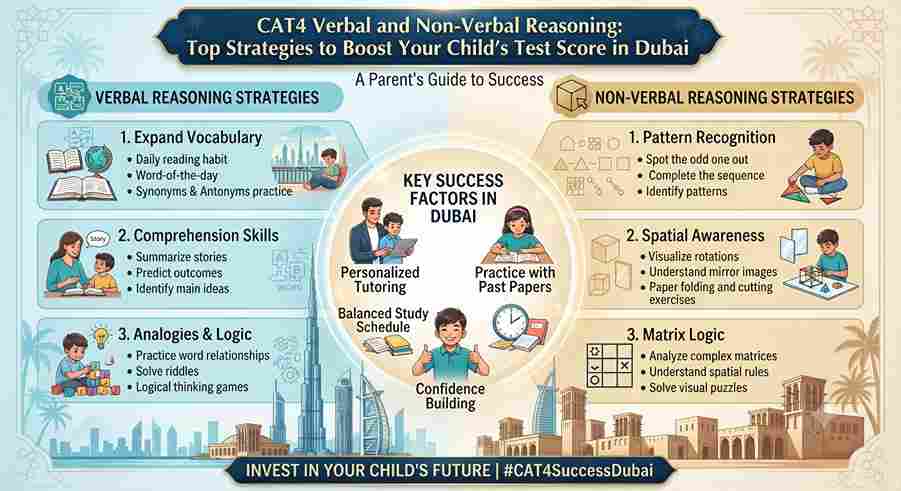
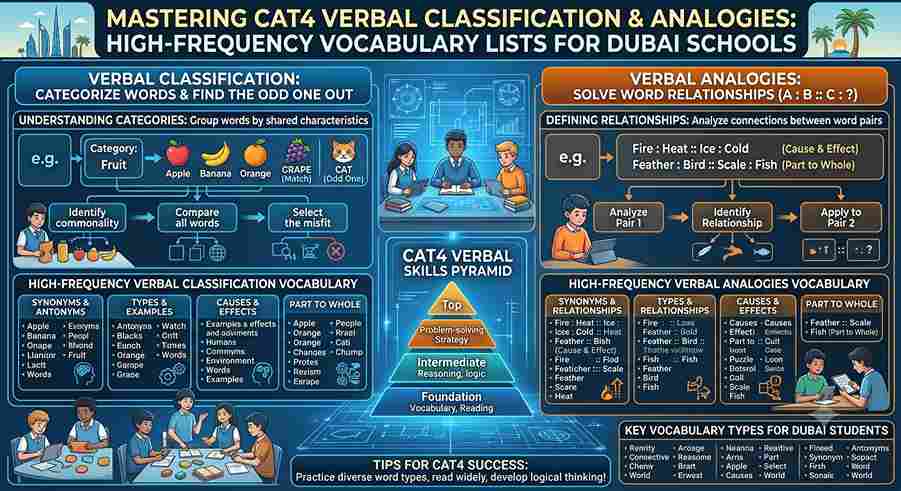
Mastering CAT4 Verbal Classification and Analogies: High-Frequency Vocabulary Lists for Dubai Schools
Last Updated: October 28, 2026 | By EdFlik Team
Across premier private institutions in Dubai, Abu Dhabi, and Sharjah—governed by regulators such as the Knowledge and Human Development Authority (KHDA) and the Abu Dhabi Department of Education and Knowledge (ADEK)—the GL Assessment Cognitive Abilities Test Fourth Edition (CAT4) serves as the definitive benchmark for academic potential, student placement, and gifted-and-talented identification.
Unlike traditional curriculum exams that test recalled knowledge from textbooks, the CAT4 evaluates a student's underlying reasoning capacity across four distinct batteries: Verbal, Non-Verbal, Quantitative, and Spatial.
For students enrolled in British curriculum (IGCSE/A-Level), International Baccalaureate (IB MYP/DP), and American curriculum schools across the UAE, the Verbal Reasoning Battery—consisting of Verbal Classification and Verbal Analogies—presents a unique challenge. Because these modules rely heavily on word precision, conceptual grouping, and nuanced relational logic, vocabulary gaps can drastically penalize a student's Standard Age Score (SAS).
In this masterclass guide, our expert assessment team breaks down the mechanics of CAT4 Verbal Reasoning, explores high-frequency vocabulary tiers tailored for Dubai school levels, provides step-by-step problem-solving frameworks, and supplies a 100% copy-paste JSON-LD schema markup for your study resources.
Part 1: Anatomy of the CAT4 Verbal Reasoning Battery
The Verbal Reasoning Battery assesses a student's ability to identify conceptual links between words, understand semantic hierarchies, and apply logical rules to verbal patterns.
The Two Core Verbal Subtests:
                     CAT4 VERBAL REASONING BATTERY
                                   |
        +--------------------------+--------------------------+
        |                                                     |
1. VERBAL CLASSIFICATION                               2. VERBAL ANALOGIES
• Students are given 3 target words that share         • Students are given a paired relationship
  a hidden, precise connection.                          `[A -> B]` and must complete a second pair
• They must select 1 word from 5 options that           `[C -> ?]` following the exact same rule.
  belongs to the exact same conceptual group.
Part 2: Step-by-Step Problem Solving Frameworks
1. The Verbal Classification "Narrowest Common Denominator" Rule
When approaching Verbal Classification questions, the most common trap is choosing a word that is too broadly related rather than precisely categorized.
                 VERBAL CLASSIFICATION STRATEGY
                                |
  Step 1: Identify Target Group ---> Find the shared traits of the 3 given words.
  Step 2: Test Constraints     ---> Define the **narrowest** possible category (not just "animals" or "things").
  Step 3: Eliminate Options    ---> Eliminate words that fit a broader category but violate the specific rule.
  Step 4: Select Matching Word ---> Pick the single option that satisfies all constraints.
Worked Example:
- Target Words:
Emerald,Ruby,Sapphire - Broad Category: Precious stones / Gems.
- Narrow Constraint: Precious gemstones that measure 9 or above on the Mohs scale of hardness (or mineral-based precious gems, excluding organic gems like pearls or amber).
- Options:
[A] Diamond|[B] Pearl|[C] Amber|[D] Gold|[E] Glass - Correct Selection:
[A] Diamond(Fits both the mineral and precious gem criteria, whereas Pearl and Amber are organic, Gold is a metal, and Glass is synthetic).
2. The Verbal Analogies Sentence Bridge Method
To solve Verbal Analogies quickly without getting confused by distractor options, construct a precise Bridge Sentence that links Word A to Word B, then apply that exact sentence to Word C.
$$\text{Word A} \xrightarrow{\text{Bridge Sentence}} \text{Word B} \implies \text{Word C} \xrightarrow{\text{Bridge Sentence}} \text{Target Word}$$
Worked Example:
- Given Pair:
[ Telescope : Astronomer ] - Target Pair:
[ Microscope : ? ] - Bridge Sentence: "A Telescope is a specialized optical tool used by an Astronomer to observe distant objects."
- Apply Bridge: "A Microscope is a specialized optical tool used by a Biologist / Microbiologist to observe microscopic objects."
Part 3: High-Frequency CAT4 Vocabulary Lists for UAE Students
To help students preparing for CAT4 assessments across Dubai and Northern Emirates, we have categorized high-frequency test vocabulary into three developmental levels corresponding to CAT4 Levels A–G (Years 4–11).
Level 1: Primary / Key Stage 2 (CAT4 Levels A–C | Years 4–6)
High-Frequency Synonyms & Classifications:
| Target Word | Primary Meaning / Synonyms | Common Conceptual Category |
| Arid | Dry, parched, barren | Climate / Environmental conditions |
| Pinnacle | Peak, summit, zenith | Highest physical points / Achievements |
| Ponder | Contemplate, deliberate, reflect | Cognitive processes / Mental actions |
| Camouflage | Disguise, conceal, mask | Defensive biological adaptations |
| Timid | Apprehensive, bashful, hesitant | Personality traits / Behaviors |
| Velocity | Speed, pace, momentum | Physical measurements / Motion |
Level 2: Middle School / Key Stage 3 (CAT4 Levels D–E | Years 7–9)
High-Frequency Analogies & Relational Words:
| Target Word | Meaning & Context | Analogous Relationship Example |
| Benevolent | Kind-hearted, altruistic, charitable | [ Malicious : Malevolent :: Kind : Benevolent ] |
| Ephemeral | Short-lived, transient, fleeting | [ Permanent : Enduring :: Temporary : Ephemeral ] |
| Lethargy | Sluggishness, apathy, torpor | [ Vigorous : Energy :: Lethargic : Apathy ] |
| Meticulous | Scrupulous, precise, painstaking | [ Careless : Error :: Meticulous : Precision ] |
| Audacious | Daring, bold, intrepid | [ Timid : Caution :: Audacious : Risk ] |
| Superfluous | Excessive, redundant, unnecessary | [ Essential : Required :: Superfluous : Extra ] |
Level 3: Secondary / Key Stage 4 (CAT4 Levels F–G | Years 10–11)
Advanced Semantic Tier for High-Band Scoring (SAS 125+):
| Word | Definition | Exact Synonyms | Category / Antonym |
| Anachronism | Something placed out of its historical time period | Misplacement, chronological error | Temporal anomalies |
| Pragmatic | Dealing with things sensibly and realistically | Practical, utilitarian, rational | Antonym: Idealistic / Unrealistic |
| Candid | Truthful, straightforward, frank | Unreserved, forthright, direct | Antonym: Deceptive / Evasive |
| Esoteric | Intended for or understood by only a small group | Obscure, abstruse, recondite | Antonym: Universal / Common |
| Acolyte | A devoted follower or assistant | Disciple, assistant, follower | Category: Hierarchical roles |
| Taciturn | Reserved or uncommunicative in speech | Reticent, quiet, untalkative | Antonym: Loquacious / Talkative |
Part 4: Top 4 Traps That Cost Dubai Students CAT4 Marks
- Confusing Association with Classification: Choosing an option simply because it "sounds related" to the topic (e.g., matching
OceanwithFishin classification) rather than picking a word that belongs to the exact same functional group (e.g., matchingOceanwithSeaorLake). - Ignoring Secondary Word Meanings: Failing to recognize polysemous words with multiple definitions (e.g.,
Barkas tree coverage vs. dog sound;Scaleas fish skin vs. musical range vs. weight measure). CAT4 questions frequently test secondary definitions. - Reversing Analogy Directions: Identifying the correct relationship pair but reversing the sequence (e.g., matching
Cause -> Effectwith an option formatted asEffect -> Cause). Directionality must match $100\%$. - Pacing and Time Fatigue: Spending over 45 seconds on a single tricky word. The CAT4 Verbal reasoning sections are strictly timed ($\sim 8$ minutes per subtest for 24 questions). Students should eliminate obvious incorrect answers, make an educated selection, and move forward.
Looking for expert 1-on-1 coaching for CAT4 preparation, cognitive skill development, and Dubai school entry assessments? Book a class on EdFlik.
Frequently Asked Questions (FAQs)
Q1: What is a "good" CAT4 Standard Age Score (SAS) for Dubai schools?
Ans: The national average SAS is 100. A score between 112 and 125 represents above-average performance, while an SAS of 126+ places a student in the top $4\%$ globally, often qualifying them for gifted-and-talented enrichment programs in KHDA and ADEK inspected schools.
Q2: Can students prepare for the CAT4 test?
Ans: While CAT4 tests innate cognitive reasoning rather than curriculum recall, familiarization with question formats, time management, and expanding vocabulary breadth significantly reduces test anxiety and prevents simple procedural mistakes.
Q3: How often do Dubai schools administer the CAT4 exam?
Ans: Most private schools in the UAE conduct CAT4 assessments at key transition milestones—typically at the start of Years 4, 7, 9, and 12—or during entry admissions for new applicants.