Mastering IB Biology HL Paper 2 Data-Based Questions: A Step-by-Step Analytical Framework
Last Updated: October 2026 | By EdFlik Education Team
For students enrolled in the International Baccalaureate (IB) Diploma Programme pursuing Higher Level (HL) Biology, Paper 2 is the most demanding and heavily weighted hurdle of the final assessment. Comprising a significant portion of your overall grade, Paper 2 features a mandatory Section A packed with intricate, multi-part Data-Based Questions (DBQs) drawn from unfamiliar experimental contexts.
Unlike simple recall questions, DBQs test your scientific literacy, quantitative reasoning, and ability to bridge raw data with core biological mechanisms. Many students lose marks not from a lack of biological knowledge, but because they fail to decode what the examiners are explicitly asking for.
In this masterclass guide, our expert IB Biology educators break down the anatomy of Paper 2 DBQs, unpack high-impact analytical techniques, and provide a systematic framework to secure top marks.
Part 1: The Anatomy of Paper 2 Section A DBQs
Section A of Paper 2 throws you into real-world scientific scenarios—ranging from enzyme kinetics and genetic mutations to ecological shifts and metabolic pathways. You will encounter three primary formats:
- Graphical Plots: Line graphs, scatter plots, and bar charts showcasing correlations, rates, or distributions across independent and dependent variables.
- Data Tables: Raw numerical matrices requiring comparison, manipulation, or calculation.
- Experimental Case Studies: Descriptions of lab setups, microscopy results, or field data where you must evaluate methodology and deduce conclusions.
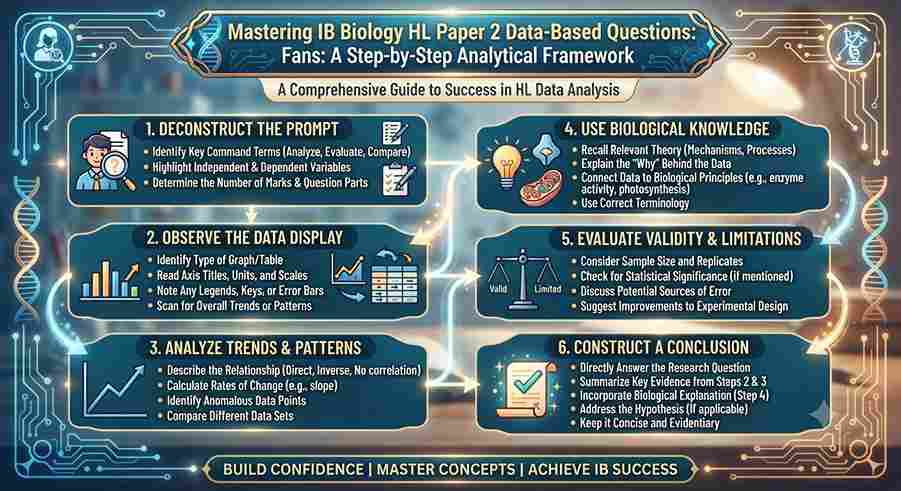
Part 2: The 4-Step Analytical Framework for DB Success
When faced with an unfamiliar data set under strict time constraints, panic is the enemy. Use this repeatable 4-step framework to extract maximum marks:
Step 1: Interrogate the Axes, Units, and Legends First
Before reading a single sub-question, spend 60 seconds mapping out the visual data:
- Identify the Independent Variable (x-axis / input) and the Dependent Variable (y-axis / output).
- Note the exact units of measurement (e.g., $\text{mmol dm}^{-3}\text{min}^{-1}$ vs. $\mu\text{mol}$). Missing units in calculated answers is an easy, avoidable error.
- Check error bars or standard deviation markers if present; these signal data reliability and guide evaluation questions.
Step 2: Decode the Command Word
IB examiners write questions with precise intent. Match your response structure directly to the command term:
- State / Identify: Requires a direct, factual reading from the graph or table. No long explanation needed (worth 1 mark typically).
- Describe: Detail the general trend, peak, plateau, or correlation. Always quote specific data points with units to substantiate your description.
- Explain: Go beyond the data. State why the pattern occurs using foundational biological concepts (e.g., enzyme denaturation, competitive inhibition, or gene transcription shifts).
- Evaluate: Present a balanced argument weighing evidence that supports a conclusion against data that contradicts or limits it.
Step 3: Execute Calculations with Precision
Quantitative questions (such as percentage change, rate calculations, or statistical tests) carry easy marks if formatted methodically:
$$\text{Percentage Change} = \frac{\text{Final Value} - \text{Initial Value}}{\text{Initial Value}} \times 100$$
Always show your working line-by-line. Even if your final calculator entry slips, clear working earns method marks.
Step 4: Synthesize Broader Biological Context
High-level DBQs in Section A often culminate in an evaluation or extension question linking the data to HL core themes (such as cell respiration, plant science, or advanced genetics). Ensure your explanation connects microscopic cellular behavior or molecular structures to the macroscopic trends shown in the graph.
Part 3: Top 4 Traps That Cost Students Paper 2 Marks
- Ignoring Error Bars in Evaluations: If error bars overlap significantly between two data sets, the difference between them is generally not statistically significant. Claiming a definitive increase or decrease when error bars overlap will lose you evaluation marks.
- Describing Instead of Explaining: Writing a lengthy narrative of what a graph is doing when the prompt specifically asks why it is happening.
- Vague Data Quotation: Saying "As time went on, the rate went down" without citing specific coordinates or time intervals (e.g., "between minute 2 and minute 6, the rate drops from $45\text{ arbitrary units}$ to $10\text{ arbitrary units}$").
- Running Out of Time: Spending 25 minutes trying to solve a single stubborn 3-mark data calculation in Section A, leaving insufficient time for Section B extended-response essays.
Struggling with IB Biology HL data analysis, experimental design questions, or past-paper mark schemes? EdFlik connects international school students globally with expert, 1-to-1 online biology tutors, helping you master analytical frameworks and secure top grade 7s.Book a Free Demo Class Today!
Frequently Asked Questions (FAQs)
Q1: How much time should I spend on Section A of IB Biology Paper 2?
Ans: Because Section A contains data-based questions and short answers covering all compulsory material, aim to complete Section A in roughly 60 to 75 minutes, leaving the remaining time for your two chosen Section B extended-response essays.
Q2: Are calculators allowed in IB Biology Paper 2?
Ans: Yes, an approved graphic or scientific calculator is mandatory for Paper 2 to handle statistical calculations, rate computations, and percentage changes.
Q3: How should I handle an unfamiliar context or organism in a DBQ?
Ans: Do not panic if the exam features an obscure species or novel biochemical pathway. The IB uses unfamiliar contexts specifically to test your ability to apply core biological principles—such as surface area-to-volume ratio, energy transfer, or gene expression—to new scenarios.
Q4: How does EdFlik support IB Biology HL students?
Ans: EdFlik connects international school students worldwide with vetted, expert 1-to-1 online tutors specializing in IB Biology HL and SL. Our personalized coaching focuses on data analysis mastery, command-word dissection, essay structuring, and past-paper mock simulations.