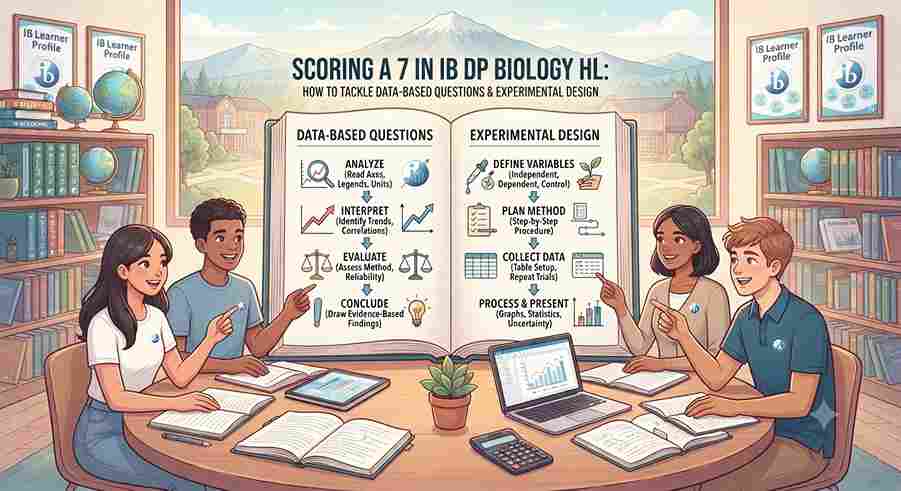
Scoring a 7 in IB DP Biology HL: How to Tackle Data-Based Questions and Experimental Design
Last Updated: September 2026 | By EdFlik Education Team
For students enrolled in the International Baccalaureate (IB) Diploma Programme (DP), Biology Higher Level (HL) is widely considered one of the most content-heavy and rigorous science subjects. Spanning complex metabolic pathways, advanced genetics, ecology, and human physiology, the syllabus requires an immense amount of memorization.
However, students quickly realize that memorizing every detail of the Oxford or Pearson textbook is not enough to secure a Level 7. The real battleground on Paper 2 and Paper 3 consists of Data-Based Questions (DBQs) and Experimental Design/Practical Planning. These sections test your ability to think like a scientist, analyze unfamiliar data sets, evaluate methodology, and apply biological principles to novel scenarios.
In this comprehensive guide, our expert IB Biology tutors break down the exact strategies you need to master DBQs and experimental design to lock in a top score.
Part 1: Cracking Data-Based Questions (DBQs) Like a Pro
Data-based questions are a staple of IB Biology assessments. They present you with tables, graphs, scatter plots, or micrographs from real scientific research papers—often featuring experiments you have never seen before.
Examiners use DBQs to test your quantitative and analytical skills. Here is how to approach them systematically:
1. Read the Stem and Axes First
Before looking at the data, read the introductory text carefully. Identify the independent variable (what is being changed) and the dependent variable (what is being measured). When looking at graphs, check the axis labels and units immediately. A common student error is misinterpreting units (e.g., mixing up micrometers and nanometers or seconds and minutes).
2. Master the Vocabulary of Command Terms
IB mark schemes are strictly aligned with command terms. Knowing what is expected makes the difference between earning full marks or zero:
- "Describe": State the trend or pattern shown in the data. (e.g., "As substrate concentration increases, the rate of enzyme activity increases until it plateaus at $V_{\text{max}}$"). Do not try to explain why unless asked.
- "Explain": Give reasons why the data looks the way it does using biological theory (e.g., enzyme active sites become saturated).
- "Compare": Identify similarities and differences between two data sets. Always use comparative language (e.g., higher than, greater proportion, inverse relationship).
3. Handle Calculations and Percentages Accurately
Expect to calculate percentage changes, rates of reaction, or magnification.
- Percentage Change Formula:$$\text{Percentage Change} = \frac{\text{Final Value} - \text{Initial Value}}{\text{Initial Value}} \times 100$$
- Always show your working out. Even if your final calculator input slips, method marks are frequently awarded for correct formula setup.
Part 2: Mastering Experimental Design Questions
In Paper 2 and Paper 3, you will often be asked to design an experiment, evaluate a given methodology, or suggest improvements to a procedure. This is where examiners test your practical lab experience (Internal Assessment skills).
To score full marks on experimental design questions, ensure your proposed setup covers these five essential pillars:
1. Independent and Dependent Variables
- Clearly state what you will deliberately change (Independent Variable) with at least five distinct, well-spaced quantitative increments to establish a reliable trend line.
- Clearly state what you will measure (Dependent Variable) and specify the measuring instrument or technique used (e.g., measuring oxygen volume produced using a gas syringe over 5 minutes).
2. Controlled Variables (The Key to Validity)
Listing vague controls like "use the same equipment" will lose you marks. You must identify specific environmental or biological variables that could affect the outcome and explain how and why you will control them.
- Example: Temperature must be controlled using a thermostatically controlled water bath because fluctuations alter enzyme kinetic energy and denaturation rates.
3. Precision, Reliability, and Replication
- Always state that you will repeat each experimental condition at least three times to calculate a mean and identify anomalies.
- Mention using apparatus with appropriate precision (e.g., using a pipette measured to $\pm 0.05 \text{ cm}^3$ instead of a standard beaker).
4. Safety, Ethics, and Environmental Considerations
If the question involves biological specimens (like enzymes, live plants, or human subjects), briefly mention ethical handling or safety precautions (e.g., wearing safety goggles when handling corrosive solutions or ensuring ethical consent for human physiological trials).
Part 3: Top 4 Habits of Students Who Score a 7 in IB Biology HL
- Annotate Past Papers Actively: Don’t just read mark schemes; study why specific keywords are required. Notice how examiners reward precision over length.
- Draw and Label Diagrams From Memory: DBQs frequently require interpreting anatomical or cellular diagrams. Practice sketching chloroplasts, nephrons, synaptic clefts, and heart structures until you can do so effortlessly.
- Use Precise Biological Terminology: Never use colloquial terms like "germs" when you mean "pathogens," or "strength" when you mean "tensile strength" or "concentration gradient." Precise language triggers marks on the rubric.
- Time Management: Paper 2 is long and demanding. Practice pacing yourself so you don't spend 20 minutes on a single multi-part DBQ at the expense of your extended-response essay questions later in the exam.
Struggling with IB Biology data analysis, complex DBQs, or prepping for your upcoming exams? EdFlik offers expert, 1-to-1 online tutoring customized specifically for the IB DP Biology HL curriculum, helping you build analytical confidence and secure a Level 7.Book a Free Demo Class Today!
Frequently Asked Questions (FAQs)
Q1: What is the difference between IB Biology SL and HL DBQs?
Ans: While both SL and HL students encounter data-based questions, HL DBQs frequently integrate higher-level biochemical pathways, advanced genetic crosses, sophisticated statistical analysis (such as Chi-squared tests or t-tests), and deeper physiological mechanisms.
Q2: Are calculators allowed in IB Biology exams?
Ans: Yes. A approved scientific calculator is permitted for both Paper 1 and Paper 2. You must know how to use it for statistical calculations, magnification problems, and rate equations.
Q3: How important is the Internal Assessment (IA) for my final IB Biology grade?
Ans: The IA accounts for 20% of your final IB Biology grade. A strong IA score provides a massive buffer heading into the external May/November examination papers.
Q4: How can EdFlik help my child achieve a Level 7 in IB Biology HL?
Ans: EdFlik connects students with experienced, certified 1-to-1 online tutors who specialize in the IB Diploma Programme. Our tutors break down complex syllabus content, guide students through rigorous DBQ drills, and provide targeted feedback on past paper practice.