Mastering Organic Chemistry: Proven Revision Strategies for High School Students
Last Updated: August 2026 | By: EdFlik Education Team
Quick Contact: Need an online chemistry tutor in Dubai & UAE 2026 right now? WhatsApp us at +91 88788 96600 | Sessions starting from AED 55–75/hour | Book a Free Trial Class today viawww.edflik.com.
Introduction: The Great Wall of High School Chemistry
For many high school students studying IGCSE, International A-Levels, IB, or advanced board curricula across Dubai, Abu Dhabi, and around the world, chemistry is a subject of two distinct halves. Inorganic and physical chemistry rely heavily on stoichiometry, mole calculations, and periodic trends that feel structured and logical.
Then, halfway through high school, students encounter Organic Chemistry.
Suddenly, numbers vanish, replaced by sprawling structural formulas, zig-zag carbon skeletons, curly arrows tracking electron movement, and an intimidating roster of named reactions (from the Grignard reaction and Aldol condensation to esterification and electrophilic substitution). To a student who has spent years relying on rote memorization, organic chemistry feels like learning a chaotic foreign language with thousands of vocabulary words and zero consistent grammar rules.
Panic sets in. Flashcards pile up. Yet, exam questions keep introducing unfamiliar multi-step conversions that leave students staring blankly at the page.
The good news? Organic chemistry is not a test of memory; it is a puzzle governed by elegant, predictable patterns. When students switch from passive memorization to mechanism-based logic, organic chemistry transforms from a dreaded academic hurdle into the most satisfying, high-scoring section of their science exams.
Section 1: The Trap of Rote Memorization vs. Mechanism-Based Learning
The single biggest mistake students make when revising organic chemistry is treating every single reaction as a standalone piece of trivia to be memorized. If a syllabus covers hundreds of distinct reactions, trying to commit every reactant, reagent, catalyst, and product to memory via flashcards is a losing battle.
- The Problem with Memorization: The moment an exam board tweaks a question or introduces a novel reagent sequence, memorized knowledge collapses because the student lacks foundational flexibility.
- The Power of Mechanisms: Organic chemistry is driven by one fundamental rule: electrons flow from areas of high electron density (nucleophiles) to areas of low electron density (electrophiles).
- Shifting Perspective: When a student learns to track electron movement using curly arrows rather than just memorizing equations, they can predict the outcome of reactions they have never seen before.
Section 2: Building Visual Reaction Maps & Flowcharts
Because organic chemistry is a vast web of interconnected functional groups, linear study notes rarely work. Trying to read a chapter from start to finish leaves students lost in the details. Top-scoring students rely instead on Reaction Mapping.
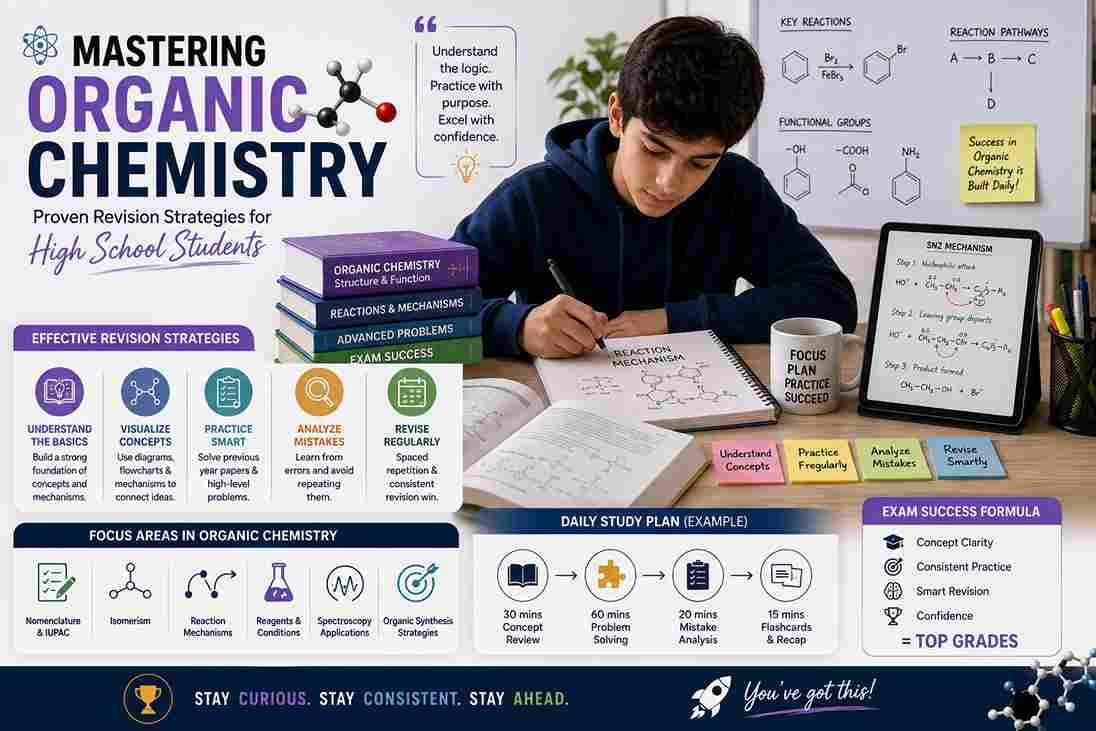
- Connecting Functional Groups: Create visual flowcharts centered around core hydrocarbons (alkanes, alkenes, haloalkanes, alcohols, carbonyls, and carboxylic acids).
- Mapping the Pathways: Draw arrows connecting functional groups to show how one compound transforms into another. For example, mapping how an alkene reacts with steam to form an alcohol, which can subsequently be oxidized into an aldehyde and then a carboxylic acid.
- Color-Coding Reagents: Use strategic color codes in your maps—such as green for reducing agents, red for oxidizing agents, and blue for substitution catalysts. Hanging these maps near your study desk anchors the visual framework permanently in your long-term memory.
Section 3: High-Impact Revision Techniques for Organic Chemistry
To conquer organic chemistry effectively during exam revision, students should implement these scientifically proven strategies:
1. Active Reagents & Conditions Flashcards
While understanding mechanisms is vital, certain reagents and specific temperature/pressure conditions must be recalled instantly (e.g., concentrated sulfuric acid, reflux conditions, UV light). Build targeted flashcards focusing strictly on missing reagents or hidden catalysts.
2. Backward Multi-Step Synthesis Practice
Exam questions love multi-step synthesis chains (e.g., "Convert compound A into compound D through a 3-step pathway"). The secret to solving these is working backward. Look at the final product, ask yourself what functional group directly precedes it, and trace the synthetic route in reverse back to the starting material.
3. Molecular Model Kits and Virtual Simulations
Organic chemistry occurs in three dimensions. Stereochemistry, optical isomerism, and ring conformations are nearly impossible to visualize on a flat 2D notebook page. Using a physical molecular model kit or an interactive 3D simulation tool allows students to physically twist, rotate, and build molecules to see spatial constraints firsthand.
Section 4: Common Pitfalls Highlighted by Examiners
Reviewing official Cambridge, IB, and board examiner reports reveals recurring errors that cost students easy marks:
- Misplacing Curly Arrows: Drawing a curly arrow starting from a carbon atom rather than from a lone pair or a covalent bond (electrons always originate from electron sources).
- Ignoring Reaction Conditions: Forgetting to state specific temperature requirements or catalysts, resulting in lost marks even if the primary chemical products are correct.
- Confusing Intermediates: Failing to recognize the stability of carbocations (tertiary vs. primary), which dictates major and minor products in electrophilic addition reactions.
Section 5: How EdFlik Tutors Transform Organic Chemistry Revision
At EdFlik Education, we understand that mastering organic chemistry requires patient, expert guidance that strips away confusion. Our specialized 1-on-1 online tutoring model provides targeted support for students across Dubai, Abu Dhabi, and the UAE:
- Interactive Mechanism Coaching: Our expert tutors use digital whiteboards and stylus pens to draw and animate electron-pushing mechanisms live with students, making abstract concepts instantly clear.
- Customized Reaction Roadmaps: We help students build personalized, color-coded reaction maps and teach them how to dissect multi-step synthesis problems with confidence.
- Exceptional Affordability: Elite 1-on-1 chemistry coaching starting at an accessible AED 55–75/hour, delivering world-class academic support without inflated agency markups.
Success Stories & Testimonials
"Organic chemistry reactions completely overwhelmed me before my A-Level mocks. I was trying to memorize hundreds of reactions and failing. My EdFlik tutor taught me how to look at mechanisms and electron flow instead of memorizing blindly. My grade jumped from a D to an A!"
— Student in Dubai Silicon Oasis
"Finding a tutor who could explain complex organic synthesis pathways patiently to a high schooler online was difficult until we discovered EdFlik. My son's confidence in chemistry has skyrocketed."
— Parent in Abu Dhabi
Frequently Asked Questions (FAQ)
Is organic chemistry purely about memorization?
No. While certain reagents and named reactions require recall, successful organic chemistry relies primarily on understanding reaction mechanisms, nucleophile-electrophile interactions, and logical problem-solving.
What is the best way to revise for organic synthesis questions?
The best approach is working backward from the final target molecule, practicing multi-step conversion flowcharts, and mastering how specific functional groups interconvert.
How much do online chemistry tutoring sessions cost with EdFlik?
EdFlik offers expert 1-on-1 online chemistry tutoring starting at an accessible AED 55–75/hour, providing elite exam preparation across the UAE.
Ready to Master Organic Chemistry?
Turn your chemistry stress into top-tier exam grades with expert 1-on-1 mentorship. Experience the EdFlik difference today.
- WhatsApp Us:+91 88788 96600
- Visit Us:www.edflik.com
- Special Offer: Book your Free Trial Class now!