Mastering Sine and Cosine Rules: Essential IGCSE Trigonometry Problem-Solving Framework
Last Updated: October 2026 | By EdFlik Education Team
For students studying Cambridge IGCSE Mathematics (0580 / 0980), Edexcel IGCSE Mathematics (Specification A/B), or Oxford AQA International GCSE, trigonometry is a core component of the core and extended curricula. While right-angled triangles can be solved effortlessly using SOH CAH TOA and Pythagoras' Theorem, real exam papers frequently test non-right-angled triangles.
When you encounter a triangle that lacks a $90^\circ$ corner, SOH CAH TOA fails. To conquer these high-yield geometry questions, you must master two powerful tools: The Sine Rule and The Cosine Rule.
In this comprehensive, exam-focused masterclass guide, our expert mathematics educators break down when to use each rule, provide step-by-step problem-solving frameworks, and expose the top traps that cost students marks.
Part 1: The Foundation — Labeling Triangles Correctly
Before touching any formula, your triangle labeling must be pristine. A careless labeling error guarantees a wrong calculation.
- Capital Letters ($A, B, C$): Represent the angles of the triangle.
- Lower-Case Letters ($a, b, c$): Represent the sides of the triangle.
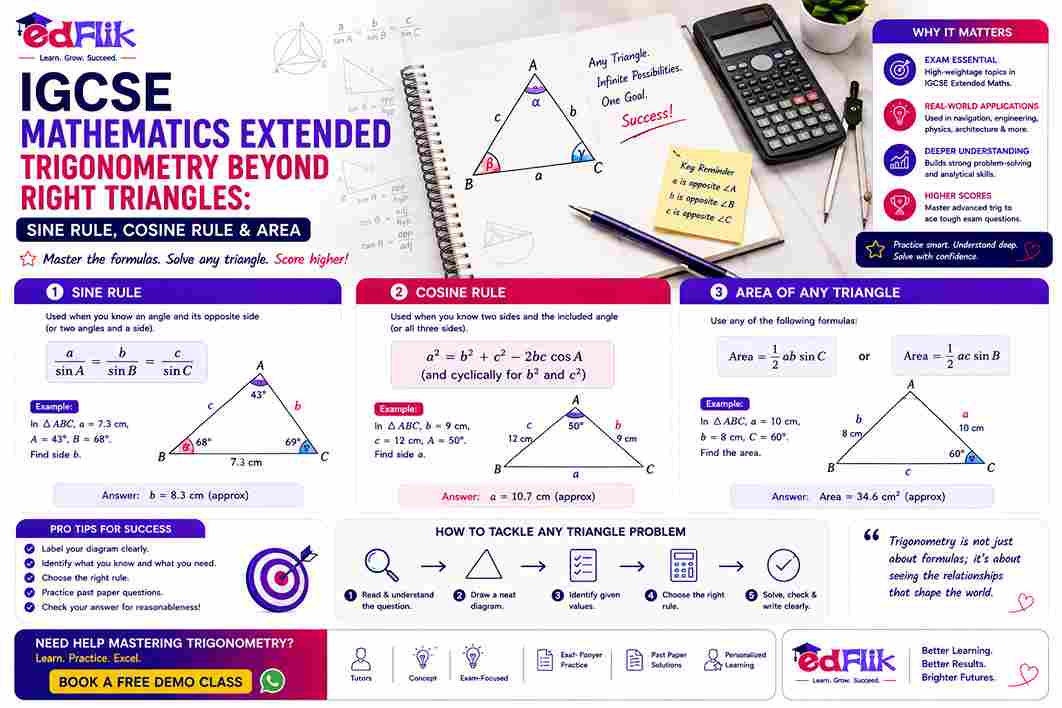
- The Golden Rule of Opposite Pairs: Side $a$ must always sit directly opposite Angle $A$. Side $b$ is opposite Angle $B$, and Side $c$ is opposite Angle $C$.
Part 2: The Sine Rule — The Opposite-Pair Specialist
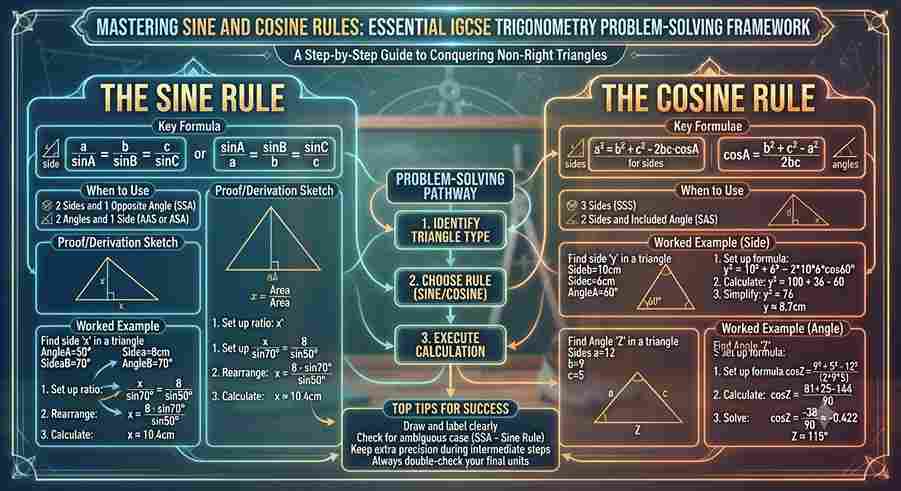
1. The Formulas
The Sine Rule establishes a ratio between the lengths of the sides of a triangle and the sines of their corresponding opposite angles.
- To find an unknown SIDE:$$\frac{a}{\sin A} = \frac{b}{\sin B} = \frac{c}{\sin C}$$
- To find an unknown ANGLE (flipped for algebraic convenience):$$\frac{\sin A}{a} = \frac{\sin B}{b} = \frac{\sin C}{c}$$
2. When Do You Use the Sine Rule?
You deploy the Sine Rule when you have a "complete opposite pair" (a known side and its opposite angle) plus one other piece of information. Look for:
- AAS (Angle-Angle-Side): Two angles and one opposite side.
- SSA (Side-Side-Angle): Two sides and a non-included angle (Caution: This leads to the Ambiguous Case explored in Part 4!).
Part 3: Step-by-Step Sine Rule Worked Example
Worked Exam-Style Question:
In triangle $ABC$, angle $A = 48^\circ$, angle $B = 72^\circ$, and side $a = 8.5\text{ cm}$. Calculate the length of side $b$.
Step-by-Step Solution:
- Identify Knowns and Unknowns:
- $A = 48^\circ$, $a = 8.5\text{ cm}$ (Complete pair!)
- $B = 72^\circ$, $b = ?$ (Unknown side)
- State the Formula:$$\frac{a}{\sin A} = \frac{b}{\sin B}$$
- Substitute the Values:$$\frac{8.5}{\sin(48^\circ)} = \frac{b}{\sin(72^\circ)}$$
- Rearrange and Solve:$$b = \frac{8.5 \times \sin(72^\circ)}{\sin(48^\circ)}$$$$b = \frac{8.5 \times 0.9511}{0.7431} = 10.88\text{ cm} \quad (\text{to 3 sig. figs.})$$
Part 4: The Cosine Rule — The Sandwich Specialist
When you do not have a complete opposite pair, the Sine Rule hits a dead end. That is when you pull out the Cosine Rule.
1. The Formulas
- To find an unknown SIDE (when you know two sides and the included angle - SAS):$$a^2 = b^2 + c^2 - 2bc \cos(A)$$
- To find an unknown ANGLE (when you know all three sides - SSS):$$\cos(A) = \frac{b^2 + c^2 - a^2}{2bc}$$
2. What is an "Included Angle"?
The included angle is the angle sandwiched directly between the two known sides. If you know sides $b$ and $c$, angle $A$ must be the angle formed between them.
Part 5: Step-by-Step Cosine Rule Worked Example
Worked Exam-Style Question:
Calculate the length of side $x$ in a triangle where side $b = 7\text{ cm}$, side $c = 10\text{ cm}$, and the included angle $A = 60^\circ$.
Step-by-Step Solution:
- State the Formula:$$a^2 = b^2 + c^2 - 2bc \cos(A)$$
- Substitute the Values:$$x^2 = 7^2 + 10^2 - (2 \times 7 \times 10 \times \cos(60^\circ))$$
- Compute:$$x^2 = 49 + 100 - (140 \times 0.5)$$$$x^2 = 149 - 70 = 79$$
- Square Root for Final Answer:$$x = \sqrt{79} = 8.89\text{ cm} \quad (\text{to 3 sig. figs.})$$
Part 6: Top 4 Traps That Cost Students Marks
- Calculator Mode Slip-Ups: Leaving your calculator in Radians (RAD) or Gradians (GRA) instead of Degrees (DEG). Always check your screen banner before starting an exam!
- Premature Rounding: Rounding decimal values midway through a calculation (e.g., writing $0.74$ instead of keeping the full decimal string). Store values in your calculator memory or keep 4+ decimal places until the final step.
- The Ambiguous Case (SSA Trap): When given two sides and a non-included acute angle using the Sine Rule, the calculated angle could theoretically have a supplementary obtuse counterpart ($180^\circ - \theta$). Double-check diagram constraints if a triangle is drawn to scale.
- Forgetting the Square Root in Cosine Rule: Stopping your calculation after finding $a^2 = 79$ and forgetting to take $\sqrt{79}$ to find side length $x$.
Struggling with IGCSE Mathematics trigonometry past papers, multi-step geometric proofs, or complex problem-solving? EdFlik connects international school students globally with expert, 1-to-1 online math tutors, helping you master formulas and secure top $A^$ grades.*Book a Free Demo Class Today!
Frequently Asked Questions (FAQs)
Q1: How do I know whether to use Sine Rule or Cosine Rule in an exam?
Ans: Look for pairs! If you have a matching angle and opposite side pair, use the Sine Rule. If you are dealing with a "sandwich" of two sides and an included angle (SAS) or all three sides (SSS), use the Cosine Rule.
Q2: Can I use the Sine Rule on a right-angled triangle?
Ans: Yes! Mathematically, $\sin(90^\circ) = 1$, which reduces the Sine Rule to basic SOH ratio. However, SOH CAH TOA is much faster for right-angled triangles.
Q3: How many significant figures should I round my final answer to?
Ans: Unless the exam question specifies otherwise, standard IGCSE convention dictates rounding final numerical answers to 3 significant figures, and angles to 1 decimal place.
Q4: How does EdFlik support IGCSE Mathematics students?
Ans: EdFlik connects international school students worldwide with vetted, expert 1-to-1 online mathematics tutors specializing in Cambridge, Edexcel, and Oxford AQA curricula. Our personalized tutoring targets weak conceptual areas, difficult exam paper questions, and confidence-building.