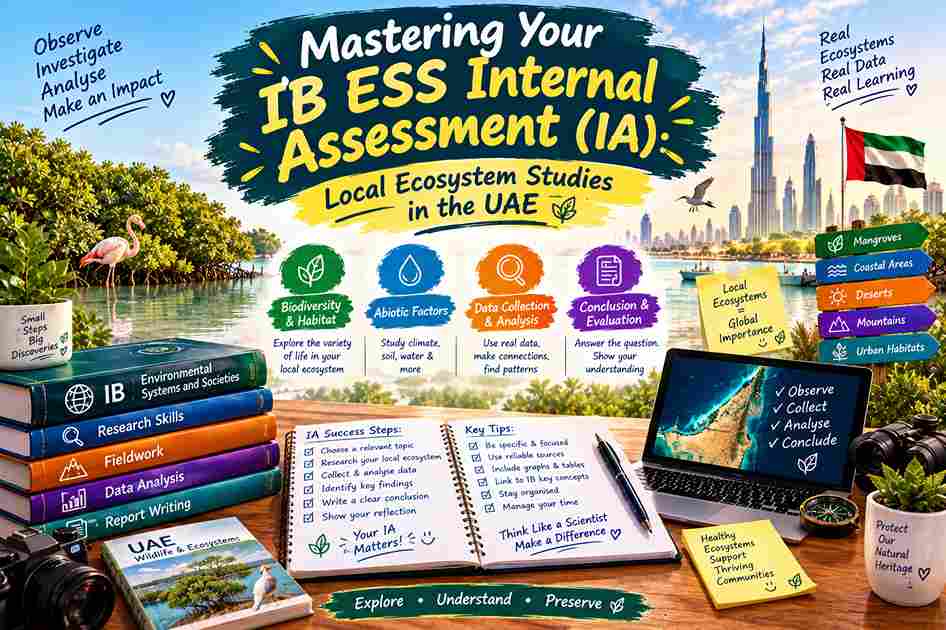
Mastering Your IB ESS Internal Assessment (IA): Local Ecosystem Studies in the UAE
Last Updated: September 2026 | By EdFlik Education Team
For International Baccalaureate (IB) Diploma Programme students studying Environmental Systems and Societies (ESS) at Standard Level (SL) or Higher Level (HL) across the UAE, the Internal Assessment (IA) accounts for 25% of your final grade. Because ESS is a transdisciplinary subject sitting at the intersection of the sciences and individuals and societies, your IA report requires a careful blend of rigorous scientific field data and socio-environmental context.
For students living in the UAE, the local environment—ranging from coastal mangrove forests and hyper-saline sabkha flats to urban desert ecosystems and artificial marine reserves—provides a unique living laboratory. However, choosing a broad topic like "How does pollution affect the desert?" will lead to a shallow, unmarkable report.
In this comprehensive guide, our expert IB science and humanities tutors break down how to choose a high-scoring research question, structure your report to meet all criteria, and execute a standout local ecosystem study in the UAE.
Part 1: Deconstructing the IB ESS IA Assessment Criteria
The ESS IA is an individual investigation presented as a written report (typically between 1,500 and 3,000 words). It is evaluated across six specific criteria, each designed to test your ability to frame, execute, and evaluate an environmental study:
- Identifying the Context (6 marks): Establishing a clear environmental issue, formulating a focused research question, and linking local observations to wider global contexts.
- Planning (6 marks): Designing a safe, ethical, and repeatable methodology with justified variables and controlled factors.
- Results, Analysis, and Conclusion (6 marks): Processing raw data correctly, applying appropriate statistical tests, and interpreting trends to answer your research question.
- Discussion and Evaluation (6 marks): Evaluating methodological limitations, weaknesses, and suggesting realistic improvements.
- Applications (3 marks): Proposing real-world solutions or management strategies based on your findings.
- Communication (3 marks): Maintaining a structured, clear, and professionally formatted academic report.
Part 2: Selecting a Winning UAE Ecosystem Topic
Choosing a localized context is essential, but your study must directly connect to core ESS syllabus themes such as ecosystems, biodiversity, pollution, or sustainability.
High-Potential UAE Ecosystem Ideas:
- Mangrove Afforestation & Zonation (Coastal UAE):
- Context: Mangroves (Avicennia marina) along the Abu Dhabi or Dubai coastlines act as vital carbon sinks and coastal defenses.
- Example Research Question: "To what extent does distance from the seaward edge affect the pneumatophore density and soil salinity of Avicennia marina stands in Khor Al Bazm, Abu Dhabi?"
- Urban Microclimates & Vegetation Cover:
- Context: Rapid urbanization across UAE cities creates urban heat island effects.
- Example Research Question: "How does proximity to native landscaping versus non-native turf grass affect ambient air temperature and soil moisture levels in Dubai public parks?"
- Marine Intertidal Biodiversity:
- Context: Examining rocky shores or sandy beaches subjected to varying levels of human recreational pressure or industrial proximity.
- Example Research Question: "How does human foot traffic intensity correlate with the species richness and population density of gastropods on the rocky intertidal shores of the East Coast (Fujairah)?"
Part 3: Step-by-Step Structural Guide for Your IA Report
To score in the top mark bands, organize your report into clear subsections corresponding to the assessment criteria.
1. Introduction and Context
- State your environmental issue clearly. Explain the ecological principles at play (e.g., tolerance ranges, abiotic factors, succession).
- Justify your chosen UAE location. Why is this site relevant on a local scale, and how does it connect to global environmental concerns (such as climate change or coastal degradation)?
2. Methodological Planning & Risk Assessment
- State your focused research question clearly (avoid overly broad questions).
- Identify your independent variable (what you change), dependent variable (what you measure), and controlled variables (what you keep constant to ensure validity).
- Address ethical considerations (e.g., minimizing habitat destruction during fieldwork) and safety precautions required for outdoor fieldwork in the UAE climate (hydration, heat exhaustion management).
3. Data Collection and Processing
- Present raw data tables with clear units, proper decimal place consistency, and qualitative observations.
- Process your data using descriptive statistics (mean, median, standard deviation) and inferential statistics suited to your data type (e.g., Spearman's Rank Correlation for relationships, Chi-Square for association, or Mann-Whitney U Test for comparisons between two sites).
- Include sample calculations for every formula used.
4. Conclusion and Evaluation
- State a clear conclusion directly answering your research question, supported explicitly by your processed data and statistical results.
- Critically evaluate your methodology. Identify three major systematic errors or limitations (e.g., small sample size due to tide constraints or equipment precision errors) and offer realistic, specific improvements.
5. Applications
- This section separates average reports from top-tier ones. Connect your specific local findings to broader environmental management in the UAE.
- Discuss how governmental bodies (such as the Environment Agency Abu Dhabi - EAD or Dubai Municipality) could use data like yours to shape local conservation policies, marine protected areas, or urban greening initiatives.
Part 4: Top 4 Strategies to Secure a Grade 7 in ESS IA
- Avoid Purely Descriptive Studies: An IA cannot just be a nature walk where you list what plants you saw. It must test a hypothesis using quantitative abiotic and biotic measurements evaluated statistically.
- Master Your Statistics Early: Do not leave statistical tests until the final week. Practice running Spearman’s Rank or Chi-Square tests during practice labs so you know your calculator steps inside out.
- Check Environmental Ethics: If your study involves touching, moving, or sampling living organisms (like crabs or plants), state explicitly how you ensured minimal ecological disruption and released organisms unharmed.
- Keep Word Counts in Check: The recommended sweet spot for an ESS IA is between 2,000 and 3,000 words. Be concise; avoid fluff, rambling introductions, or excessive background history that does not directly serve your research question.
Struggling to pin down a research question, process field data, or structure your IB ESS Internal Assessment? EdFlik offers expert, 1-to-1 online tutoring customized specifically for IB diploma students across the UAE, helping you refine your investigation and secure a top Grade 7.Book a Free Demo Class Today!
Frequently Asked Questions (FAQs)
Q1: Can I use secondary data for my IB ESS IA?
Ans: While primary data collected via hands-on fieldwork or laboratory experiments is strongly recommended and preferred, the IB does permit the use of reliable secondary datasets (such as government environmental monitoring records or satellite data) provided you analyze them to answer a unique research question.
Q2: How many data points or replicates do I need?
Ans: As a general rule of thumb, aim for at least 30 independent data points or sufficient replication across quadrats/transects to ensure your statistical tests yield valid, reliable conclusions.
Q3: Can my ESS IA topic overlap with my Biology IA or Extended Essay?
Ans: No. The IB strictly prohibits "double dipping". Your ESS IA must have a distinct environmental focus and research question that is entirely separate from any work submitted for other subjects or an Extended Essay.
Q4: How can EdFlik support my IB ESS studies in the UAE?
Ans: EdFlik connects students across Dubai, Abu Dhabi, Sharjah, and the UAE with vetted, experienced 1-to-1 online tutors specializing in IB ESS, Biology, and Geography. Our personalized sessions focus on planning high-scoring IAs, mastering data processing, and refining exam technique.